
In 5200 BBY, Sith Lords Marka Ragnos and Simus entered a power struggle for control of the Sith Empire. The competition lasted for decades and eventually culminated in a duel in which Ragnos decapitated Simus. Ragnos's victory began the long reign later remembered as the Golden Age of the Sith.
Two rival elites
Both Ragnos and Simus were powerful Sith Lords seeking the title of Dark Lord.
The struggle reflected a political system where leadership could depend on personal power as much as institutional succession.
A conflict that eventually becomes personal combat
Around a century later, Simus challenged Ragnos directly.
Ragnos won and took control of the Empire, while Simus survived in a reduced biological form.
Anthropological assessment
The Ragnos-Simus struggle shows a political order in which elite violence was accepted as a method of succession.
It also reveals why long-term stability under Ragnos later appeared exceptional rather than normal in Sith politics.
Manderon Era · Legends research
The Sith throne before the Golden Age
In Legends chronology, Marka Ragnos and Simus competed for supremacy in a Sith political order that had no universally accepted procedure for deciding who should become Dark Lord. Their rivalry belonged to a long period of struggles among powerful Sith aristocrats. The summary date of 5200 BBY should be understood as the approximate beginning of the struggle, not the year in which every later consequence occurred. The duel in which Ragnos defeated and decapitated Simus belongs to a later phase, traditionally placed around a century afterward.
Simus did not simply disappear from Sith politics following the duel. His survival as a living head supported by technology is one of the unsettling details preserved in the original Golden Age of the Sith comic narrative. He remained a figure of influence even after losing the direct contest for power. That outcome distinguishes physical defeat from complete political erasure. Ragnos eventually presided over the powerful, internally competitive Sith Empire remembered as an age of extraordinary expansion and concentration of Force-related authority, though the title Golden Age reflects the values of later Sith observers rather than the experiences of all subjects.
Succession through personal force
In Sith elite politics, victory through combat could give a rival the prestige needed to seize an office. Yet the presence of courts, followers and established Lords meant that violence alone did not automatically reorganize an entire state. Other elites needed to recognize or accommodate the victor's authority.
An enemy who survives defeat
Simus's later continued presence reveals why a duel is not always a clean transfer of power. The defeated rival could still communicate, retain knowledge and participate in elite intrigues. The history should distinguish the end of a contest from the end of a person's influence.
Did Ragnos kill Simus outright in the final duel?
No. He decapitated Simus, but Simus survived in a reduced, technologically sustained form and later appeared in the Golden Age of the Sith narrative.
Evidence and continuity: Star Wars: Tales of the Jedi – The Golden Age of the Sith #3; Star Wars: Behind the Magic. Comic source: https://www.marvel.com/comics/issue/54592/ Legends-only retrospective history. Source-established actions are separated from social and political interpretation; dating and the limits of testimony remain explicit.
Original IDS study · Legends source reconstruction
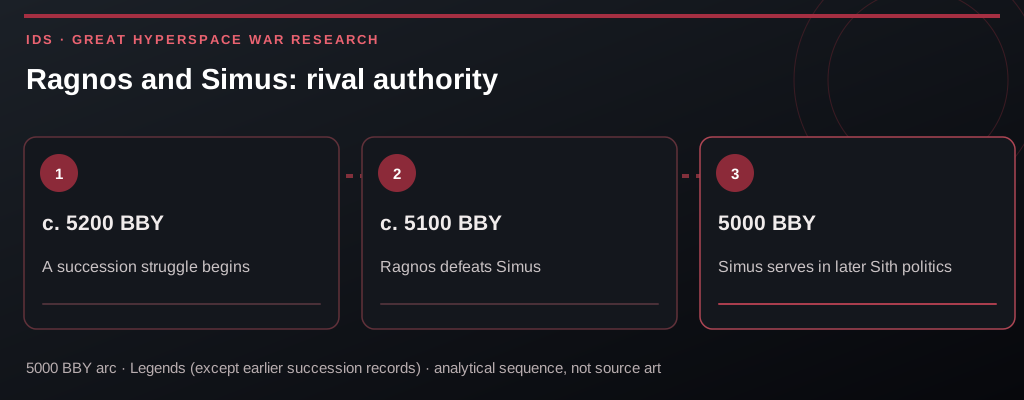
Evidence sequence: Ragnos and Simus: rival authority
What the original history supports
The Golden Age of the Sith #3 retrospectively refers to Simus's prior duel with Ragnos. It does not depict their century-long competition as a continuous illustrated campaign. The start and later duel are approximations in reference chronology, not separate scenes with exact comic timestamps.
Interpretation and evidence limit
Simus survives his defeat through Sith practices and continues as a political actor. His history exposes a split between martial authority and the influence of senior advisers under Ragnos's rule.
Sources and further reading
- Star Wars: Behind the Magic.
- The Golden Age of the Sith #3 (retrospective reference to Simus and the duel, not a depiction of its start).
- Marka Ragnos, Wookieepedia