
Hero artwork: original IDS editorial reconstruction for this Legends episode. View the comic issue at Marvel for the original source.
In 5000 BBY, Kirrek became another major battlefield of Naga Sadow's invasion. Jedi Master Ooroo and his Padawan Odan-Urr fought beside Koros troops, former Kirrek rebels, and other defenders against Massassi warriors and Sith war machines. The battle ended in a Koros victory, but Ooroo died after exposing himself to oxygen in order to release the gas his unusual biology required, killing many attackers around him.
Former rebels defend Teta's new state
Some fighters on Kirrek had resisted Teta only years earlier during the Unification Wars.
The Sith invasion turned former internal enemies into defenders of the same political system.
Ooroo's sacrifice
Ooroo's species breathed a cyanogen-rich atmosphere rather than oxygen.
Breaking his protective environment became a lethal act both for himself and for nearby attackers.
Odan-Urr survives the war
Odan-Urr continued his Jedi career and later became one of the great scholars of the Order.
His memories helped preserve the war as Jedi historical knowledge.
Anthropological assessment
Kirrek shows how external invasion can rapidly reorganize political identity. People who had recently fought Teta could still defend their world against a new threat.
Ooroo's death also demonstrates how biology itself can become part of warfare in a multispecies galaxy.
Legends · 5000 BBY · Source reading
Rebels, amnesty, and Ooroo's sacrifice
Llaban's fighters had previously opposed Teta. They join the defense against the Sith rather than support the invasion.
Jedi Master Ooroo releases the cyanogen atmosphere essential to his own survival. The action injures attackers but also kills him.
The comic's aftermath depicts a call for cooperation and reconstruction under Teta's amnesty. Alliance in crisis need not erase prior grievances.
Did all of Kirrek agree with Empress Teta after this?
No. The comic establishes participation by named former rebels, not unanimous acceptance by the world's inhabitants.
Source: Kevin J. Anderson, Tales of the Jedi: The Fall of the Sith Empire #5 (Dark Horse Comics, 1997). Publisher's comic listing and cover →. The documented story is Legends; social interpretation is editorial analysis.
5000 BBY · Legends · Historical source lab
Kirrek: former adversaries defend a newly united state
Ooroo, Odan-Urr and Koros defenders fought alongside people who had previously resisted Empress Teta's unification. That change of allegiance makes Kirrek distinct from a simple imperial battle scene. A newly consolidated political community faced an external invasion, and former rebels had a reason to protect local homes even if they had once opposed Teta's rule. Ooroo's fatal choice depended on his unusual biology and the limits of the chamber he used to survive in oxygen-rich conditions. The story does not establish ordinary cyanogen chemistry as a real-world defense tactic, and the fictional account should not be read as one. The central historical question is how an earlier internal conflict affected the later defense.
Evidence boundary: historical fact versus interpretive analysis
This is a Legends fictional-history dossier. Characters, encounters and broad outcomes follow Tales of the Jedi and licensed secondary chronology. Assessments of power, institutions, consent and political legitimacy are IDS interpretations. Page-specific casualty counts, direct speeches and scientifically exact mechanisms should not be inferred from a general reference summary or comic cover.
Historical judgment · 5000 BBY
Test your historical judgment
Answer both questions to receive a score and corrections explaining the evidence.
Primary story series: Kevin J. Anderson and Dario Carrasco Jr., Tales of the Jedi: The Golden Age of the Sith #0–5 and The Fall of the Sith Empire #1–5. Marvel's Fall of the Sith Empire #1 describes Jori Daragon's warning and Naga Sadow's invasion. Marvel's Golden Age #2 describes the succession crisis. Not every page-specific incident can be independently established from publisher marketing summaries alone.
Original IDS study · Legends source reconstruction
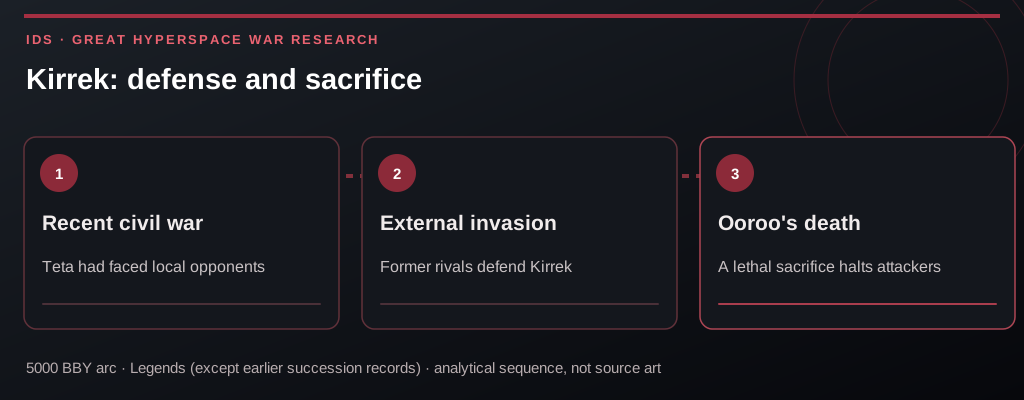
Evidence sequence: Kirrek: defense and sacrifice
What the original history supports
Kirrek had been a site of conflict within the Koros Unification Wars. The later Sith invasion changes the political setting: people who opposed Teta's consolidation may nevertheless face a common external threat. Ooroo's actions belong to the invasion, not the earlier unification battle.
Interpretation and evidence limit
Ooroo's unusual atmosphere requirements are relevant to the sacrifice. This diagram explains the sequence without pretending to depict the precise battlefield or his species' biology.
5000 BBY · Legends · Independent source reading
Political amnesty, multispecies limits and the defense
The Kirrek defense began with a political problem predating the Sith invasion. Llaban and other former opponents of Teta's unification joined her forces after an agreement that offered amnesty. Reinforcements drawn from prisoners on Ronika also became part of the defense. These participants were not a single longstanding loyalist army. Their temporary coalition illustrates how an invading force can alter the terms on which former rebels and a ruler cooperate.
Ooroo's sacrifice should be read with precision. The Celegian Jedi Master lived within a cyanogen-filled life-support environment. By breaking the protective tank during the Massassi assault, Ooroo released gas dangerous to his attackers but also exposed himself to oxygen, which was fatal to him. His death was not evidence that ordinary atmospheric conditions have identical effects across every sentient species. Nor should it be presented as a medical claim about real physiology.
The fighters from Ronika arrived late enough to affect the conclusion rather than the entire beginning of the battle. In issue 5, Llaban's postbattle appeal turns wartime amnesty toward peacetime rebuilding. This is a second, distinct stage of political incorporation. A promise to fight a common enemy did not automatically settle the legitimacy of Teta's rule or erase memories of the earlier rebellion.
Historical judgment: Did the former Kirrek rebels support the Sith invasion against their previous ruler?
Correction and evidence: No. Llaban's former rebels agreed to cooperate with Teta against the invading Sith and were offered amnesty. That reversal is central to this episode.
Great Hyperspace War campaign sequence → · Compare related front → · Continue to Primus Goluud →
Primary storyline: Tales of the Jedi: The Fall of the Sith Empire Issues 3–5 (1997), written by Kevin J. Anderson, art by Dario Carrasco Jr. Publisher's issue catalog →. Editorial interpretation is separate from the depicted events. Verify original printed panels before assigning page numbers, exact force totals or precise clock times.
Sources and further reading
- Tales of the Jedi – The Fall of the Sith Empire.
- Daniel Wallace and Jason Fry, The Essential Atlas, 2009.
- Battle of Kirrek, Wookieepedia