
IDS original symbolic illustration. Not a Lucasfilm still or reference illustration.
In 4225 BBY, the Galactic Republic and Jedi Order launched the Kaikieli Reconquista to restore government on Kaikielius, a Core World where crime syndicates, gang warfare, and Hutt influence had overwhelmed ordinary law enforcement. Jedi Master Vandar Tokare led the Jedi element with two Padawans, including Derrica Praji.
Crime becomes a Republic security issue
The Odominic kajidic supplied weapons into a conflict between gangs and police.
Once the Republic treated the situation as a security threat rather than ordinary crime, military intervention became possible.
Vandar Tokare and the Jedi task force
Vandar and two Padawans supported Republic troops.
The operation shows Jedi participating in restoration of civil government rather than fighting Sith.
Family loyalty and evidence
Derrica Praji discovered evidence implicating his great-aunt in sedition.
He destroyed the evidence to protect his family, illustrating conflict between institutional duty and kinship obligation.
Anthropological assessment
The Reconquista shows how states redefine criminal disorder as war when ordinary institutions lose control.
Derrica Praji's choice also highlights a recurring anthropological tension: loyalty to family can compete directly with loyalty to public office.
Legends · Post-Manderon period
How a Core World became a test of public authority
Kaikielius was no distant ungoverned frontier. It had deep ties to the Galactic Republic, yet a combination of gang warfare, piracy and Hutt involvement had made ordinary policing ineffective. By 4225 BBY the Odominic kajidic was supplying weapons to rival sides of the fighting, while Republic intervention was delayed by political obstruction. The Kaikieli Reconquista became possible when the conflict was recognized as a wider security problem. A combined Republic-Jedi expedition including Master Vandar Tokare and Padawan Derrica Praji intervened to break criminal control and restore institutional order.
Derrica's investigation revealed another layer. His own great-aunt, Minister Emppu Praji-Barck, had contributed to the crisis by encouraging the Odominic's arms traffic. Derrica destroyed evidence to protect his family, even though suppressing it prevented public accountability. The consequences show the limits of a military victory: removing armed criminals could change conditions in the streets, while the political relationships that had empowered them remained partially concealed. A restored city could still carry unresolved questions about who had profited from its crisis.
From criminal disorder to a security emergency
States often distinguish ordinary policing from threats severe enough to justify armed intervention. That classification changes which institutions can act and what kinds of power they may exercise. The Reconquista shows an emergency decision shaped not only by violence on the streets but by obstruction at the political center.
Family loyalty and corrupted records
Derrica had obligations as a Jedi and as a member of a powerful local lineage. Erasing evidence protected kinship reputation but limited the state’s ability to identify wrongdoing. Public archives and criminal prosecutions can be shaped by private relationships in precisely this way.
Did the successful Jedi operation also expose all political sponsors?
No. Derrica Praji destroyed evidence concerning his great-aunt, leaving an important part of the political scandal concealed.
Source evidence: Tinker, Tailor, Soldier, Praji (Hyperspace); Kaikieli Reconquista Legends accounts. Secondary source with original reference index →. Explanatory analysis is distinguished from events established by published sources.
Legends · Research field note
Historical perspective: The Kaikieli Reconquista
The language of reconquest frames a campaign as restoration of legitimate authority, a claim worth examining critically.
Reading the evidence: This interpretation draws out the social implications of the recorded event without supplying undocumented conversations, numbers or motivations.
Research question: what would stronger evidence require?
Compare the source cited below with nearby chronology entries. Distinguish what is explicitly recorded from broader conclusions about political institutions, lived experience and historical consequences.
4250–4225 BBY · Legends
Kaikielius is retaken from organized crime
- Crime and politics converge
The planet Kaikielius was troubled by pirates and criminal groups receiving weapons from the Odominic Hutt kajidic. Violence affected the ring cities while powerful Core World family interests had previously blocked intervention. In 4225 BBY the Republic mounted a campaign to restore public control. The episode shows that organized crime can develop within gaps created by political protection and that restoring authority is rarely detached from struggles among wealthy households.
- Vandar Tokare arrives with two Padawans
Jedi Master Vandar Tokare led an operation with Derrica Praji and another apprentice. Derrica faced a conflict between his Jedi commitments and his family's rivalry with House Vahali, which stood to benefit from the Republic's success. The campaign lasted months rather than a single raid. The Jedi were not operating outside politics merely because they acted against armed criminals. Their involvement changed local power relationships.
- A private act undermines public evidence
Derrica discovered a datatape implicating his great-aunt Emppu Praji-Barck in the conflict. He destroyed the record and subsequently separated himself from his family. The choice is ethically difficult even though he continued in Jedi service. Destroying potentially important evidence meant that protecting a family member and obeying an abstract ideal of impartial justice were not the same action. The story supplies a rare personal account within a broader military chronology.
Did Derrica Praji preserve the datatape implicating his family?
No. The Legends story says he destroyed it rather than allow his great-aunt to be implicated, then distanced himself from his family.
Original source family: Tinker, Tailor, Soldier, Praji (original Star Wars Hyperspace story). Further references →. Exact page citations and source artwork still require verification.
4225 BBY · Legends · Source-critical investigation
Kaikielius: why a military victory did not settle political responsibility
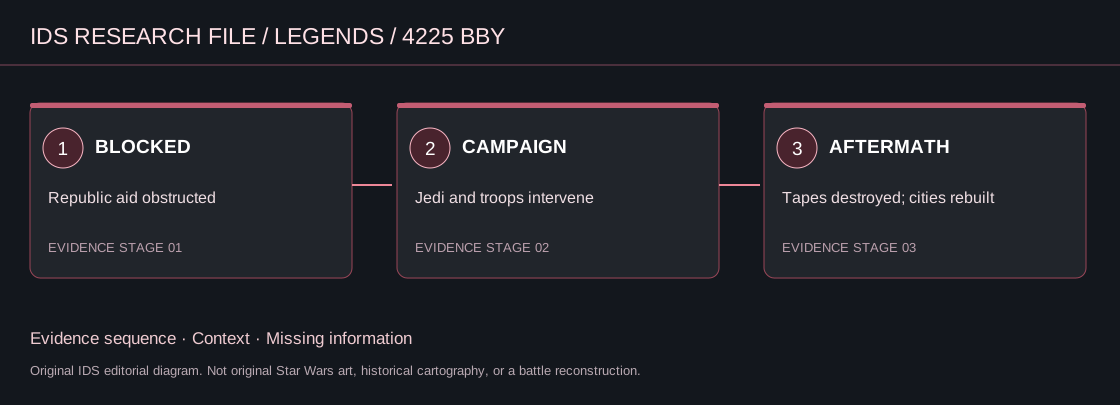
What the published record can establish
Kaikielius was an established Republic Core World, not a newly discovered lawless planet. Its ring-cities had grown as construction spread outward while crime hollowed out parts of older urban centers. The Odominic Hutt kajidic armed parties in the escalating conflict between criminals and police. For years Minister of State Emppu Praji-Barck blocked action. Once violence became a Republic security issue, intervention could proceed. In 4225 BBY a joint military and Jedi force led by Master Vandar Tokare, with Padawans including Derrica Praji, fought the criminal factions over a campaign lasting months.
Historical sequence and causation
The resulting victory had consequences beyond battlefield control. Kaikielius suffered major damage and underwent rebuilding as House Vahali regained influence. Derrica, a member of the rival House Praji, had to serve in an intervention that benefited his family's opponents. While on the planet he found datatapes implicating his great-aunt Emppu in deliberately encouraging Hutt weapons trafficking. He destroyed those tapes. That choice prevented the surviving evidence from being used for public prosecution and illustrates why the end of a campaign should not be confused with the completion of justice.
Anthropological interpretation
A military campaign may claim to restore public order without resolving who was responsible for allowing institutions to fail. Ring-city poverty, patronage and family competition belonged to the social history of Kaikielius as much as the armed fighting did. The Jedi acted through their public commitments, but Derrica's actions show that belonging to an elite lineage could still affect individual decisions. The surviving source is especially useful for distinguishing the physical reconstruction of a city from the incomplete repair of civic accountability. The term Reconquista itself frames the action as a restoration of authority.
Uncertainty and chronology safeguards
There is no evidence that the concealed ministerial misconduct was successfully prosecuted after the datatapes were destroyed. The operation included urban fighting, but the source does not give a full neighborhood-level battle map. This diagram describes decision points rather than troop positions.
Historical judgment: Did the Reconquista both defeat the criminal forces and expose all those who helped them?
Correction and explanation: The military operation was victorious, but Derrica destroyed evidence implicating his great-aunt, leaving a major act of political misconduct concealed.
Source trail: Tinker, Tailor, Soldier, Praji (Hyperspace); Kaikieli Reconquista bibliography. Reference notes and bibliography ↗. Original-publication pagination and visual-rights checks remain open.
Sources and further reading
- Tinker, Tailor, Soldier, Praji.
- Kaikieli Reconquista, Wookieepedia