
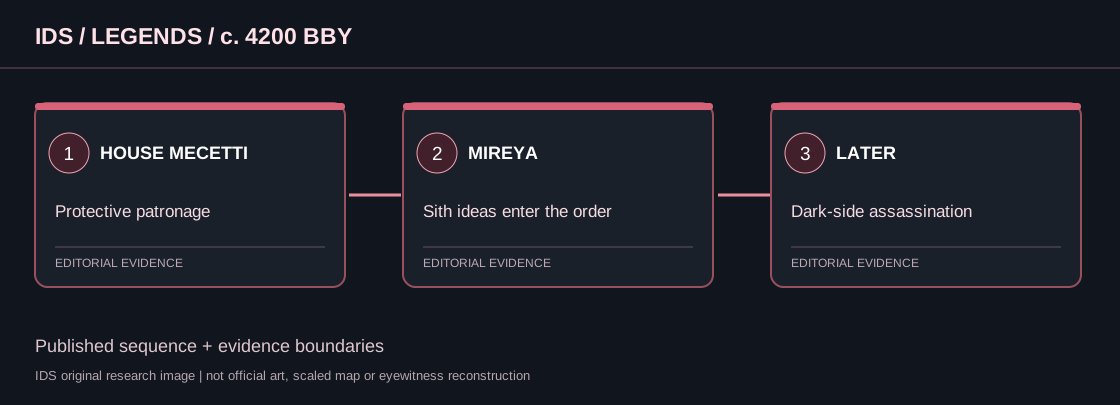
Original IDS symbolic drawing, not a depiction verified by the books or films.
Around 4200 BBY, Viscountess Mireya founded the Mecrosa Order on Nyssa in the Tapani sector. The organization initially served the political interests of House Mecetti. Over the next two centuries, Sith teachings gradually corrupted the order, turning it into one of the sector's most secretive traditions of assassination and dark-side practice.
A secret order inside noble politics
The Mecrosa Order was tied to House Mecetti rather than functioning as an independent galactic religion.
Secrecy made it useful for political tasks that formal noble institutions could not publicly acknowledge.
Two centuries of gradual corruption
Sith teaching did not transform the order overnight.
Dark-side ideas accumulated inside an existing political institution over generations.
Anthropological assessment
The Mecrosa Order shows how esoteric traditions can grow inside elite political networks rather than outside them.
Its slow transformation also demonstrates that ideological change can be generational and institutional, not one dramatic conversion.
Legends chronology / primary-source discussion
A noble household builds a hidden instrument of power
Viscountess Mireya founded the Mecrosa Order around 4200 BBY in the Tapani sector, where House Mecetti was one of the powerful noble families competing over status and policy. The secret organization was connected to the house's interests and developed traditions of assassination, poisons and covert service. Later Legends histories associated its internal practices with Sith teachings, but not every stage of its transformation is documented. Some accounts allege that Mireya herself helped introduce these influences. An evidence-conscious archive separates that accusation from a fully proven account of her actions.
The Mecrosa Order was neither an independent Jedi academy nor an open empire ruling a group of star systems. It operated inside noble politics, where private relationships, inherited privilege and secrecy could determine who received protection and who faced danger. This setting helps explain its long life: elites had reasons to maintain specialized agents whose services could not always be acknowledged publicly. Its later entanglement with the Krath and Sith causes belongs to subsequent centuries, not the exact founding moment.
Court politics create demand for secrecy
A wealthy house can maintain formal titles and public rituals while also relying on informal channels of influence. Covert orders become useful when leaders want outcomes without openly accepting responsibility. An assassin society linked to a noble family is best understood through that institutional context.
Religious practice changes over generations
Sith teachings could enter a preexisting organization gradually through apprenticeships, documents and personal contacts. A narrative that presents immediate total corruption at the moment of founding would erase the uncertainty of the two-century historical record.
Was the Mecrosa Order founded as a public Sith government?
No. It began as a secret society serving House Mecetti. The precise origin and timing of later Sith influence remain less certain.
Evidence used: Jedi vs. Sith: The Essential Guide to the Force; Tapani Sector Legends setting references; The Complete Star Wars Encyclopedia. Reference and chronology cross-check →. The source and this editorial interpretation are not interchangeable; unsupported tactical and technical details have been omitted.
c. 4200 BBY · Legends
Mecrosa Order emerges within noble politics
- Private protection becomes an organization
Around 4200 BBY House Mecetti developed a clandestine order within the politics of the Tapani sector. Some reference accounts associate its creation with Viscountess Mireya, while other summaries describe a protective society that she later influenced. The distinction matters: a family's security apparatus and the order's later full Sith alignment need not have begun on one exact day. Members operated under a system of aristocratic patronage that could reward discretion more than public accountability.
- Assassination and doctrine change its role
The Mecrosa Order became associated with poisons, covert killings and secret methods used in noble rivalries. Sith teachings later transformed its ideology and linked parts of the order to wider dark-side political efforts. The approximately two centuries between its early foundation and the Great Sith War provide room for institutional changes. It is not accurate to label every original recruit a servant of Exar Kun, whose war came much later.
- The household and the organization are different actors
A protective force could serve a noble family while cultivating practices and commitments of its own. This divergence between sponsor and institution is important when interpreting accounts that attribute the Mecrosa's actions to House Mecetti in general. The original sources also do not establish that the entire Tapani sector submitted to Sith rule in 4200 BBY. The article's date marks an institutional beginning, not the final form of its ideology.
Did the Mecrosa Order support Exar Kun immediately in 4200 BBY?
No. Its early foundation preceded the Great Sith War by roughly two centuries. Its later Sith alignment cannot be projected onto every founding member.
Source basis: Jedi vs. Sith: The Essential Guide to the Force; Legends Tapani sourcebooks. Further bibliography →. Specific edition page numbers, real source-event art and live social cards remain to be checked.
c. 4200 BBY · Legends · Evidence lab
Mecrosa: a noble order and a changing doctrine
What the record establishes
Legends references describe the Mecrosa Order as a secret Force-sensitive organization protecting House Mecetti. Its headquarters stood on Nyssa, and the order is traditionally dated to about 4200 BBY under Viscountess Mireya. Sources differ in emphasis: some name her as founder, while others emphasize how she introduced Sith teachings to a protective organization. These accounts should not be forced into a single invented founding scene.
Anthropological assessment
A noble household can maintain clandestine agents while those agents develop commitments and doctrines of their own. House loyalty and Sith allegiance are analytically distinct. The order's name and patronage remained recognizable even as beliefs and practices changed across generations. This helps explain why later associations with dark-side assassination should not be projected backward onto every early member.
Evidence limits
The later alignment with Exar Kun's movement belongs approximately two centuries after the founding. Neither a precise induction ceremony nor universal belief among Mecrosa members is established by the surviving accounts.
Check your historical judgment: Did the Mecrosa Order serve Exar Kun upon its foundation?
Correction: No. Exar Kun's Great Sith War was much later; early house protection and later Sith alliances have separate histories.
Source trail: Jedi vs. Sith: The Essential Guide to the Force; Evil Never Dies: The Sith Dynasties. Bibliography and reference history ↗. Printed page verification remains open.
Sources and further reading
- Jedi vs. Sith: The Essential Guide to the Force.
- 4200 BBY, Wookieepedia