
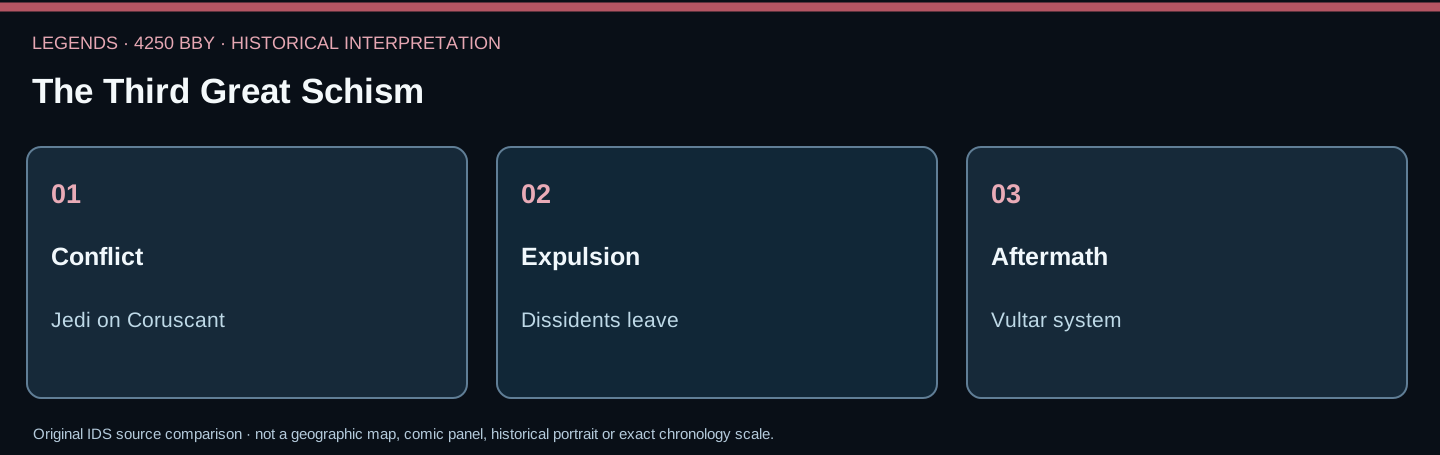
IDS original symbolic illustration. Not a Lucasfilm still or reference illustration.
In 4250 BBY, another internal rupture divided the Jedi Order. Dark Jedi influenced by Sith teachings fought their former companions on Coruscant in the Third Great Schism. After intense fighting, the dissidents were driven from the capital and fled to the Vultar system, where they discovered ancient machinery attributed to the Celestials.
Jedi fight Jedi on the Republic capital
The conflict placed internal religious violence at the symbolic center of the Republic.
The fighting repeated a pattern established by earlier Great Schisms but on a much shorter timescale.
Sith teachings without a Sith invasion
The Dark Jedi were influenced by Sith ideas, but the old Sith Empire was not invading Coruscant in 4250 BBY.
The event shows doctrine traveling independently of the state that originally produced it.
The dissidents flee to Vultar
Defeat on Coruscant did not immediately end the group.
Their retreat brought them into contact with technology far older than the Jedi-Sith conflict itself.
Anthropological assessment
The Third Great Schism shows how ideas can outlive political regimes and continue generating institutional conflict centuries later.
The Jedi's recurring schisms also demonstrate that formal unity does not eliminate disagreement over authority, knowledge, or acceptable use of power.
Legends chronology / primary-source discussion
How a Jedi rupture became an archaeological catastrophe
The Third Great Schism was an internal Jedi conflict, not a renewed invasion by the ancient Sith Empire. In 4250 BBY, Jedi who had adopted dark-side teachings fought their former colleagues on Coruscant. The political geography matters: violence took place on the Republic capital, in the same urban and institutional environment where the Order was expected to model disciplined service. Defeat did not eliminate the dissidents. They fled from Coruscant toward the Vultar system and encountered machines attributed to the much older Celestials. The Schism became inseparable from the disaster that followed, but fighting on Coruscant and the destruction of Vultar remain distinct stages.
The surviving historical summaries say little about individual leaders, units or the number of people who fought in the streets. That scarcity is a reason to avoid an imaginary order of battle. It is possible to discuss what is supported: a doctrinal rupture, armed conflict, retreat, discovery of machinery and catastrophic use of technology. The old Sith teachings circulated without requiring a contemporary Sith government to command the rebels. The relationship between inherited beliefs and new acts of violence is therefore more relevant than any invented claim about precise orders from a dead empire.
Ideas travel without their original rulers
A political organization may disappear while rituals, documents and explanations of power continue to circulate. The dissidents adopted teachings associated with Sith traditions, but that did not turn the Coruscant fighting into one uninterrupted campaign of the 5000 BBY Sith Empire. Religious disagreement became violence inside a living institution.
Flight carried danger to a different society
The defeated group did not simply withdraw into obscurity. Its movement brought a violent internal dispute into contact with immensely old machinery. The chronology must follow the move from a dispute between people to a technological experiment with consequences for an entire star system.
Did a standing Sith Empire invade Coruscant in 4250 BBY?
No. The Legends sources describe a Jedi schism involving Dark Jedi influenced by Sith ideas, followed by their retreat to Vultar. They do not establish a conventional invasion by the old Sith Empire.
Evidence used: The New Essential Chronology; Jedi vs. Sith: The Essential Guide to the Force; The Jedi Path: A Manual for Students of the Force. Reference and chronology cross-check →. The source and this editorial interpretation are not interchangeable; unsupported tactical and technical details have been omitted.
4250–4225 BBY · Legends
The Third Great Schism divides the Jedi
- A crisis within the Jedi Order
Some Jedi influenced by Sith teachings entered open conflict with the wider Order in 4250 BBY. Fighting broke out on Coruscant, the Republic's political center. The term Third Great Schism connects the event to earlier internal crises, but it does not mean the same people or organizations participated in all three. The immediate conflict was between Jedi and dissidents, not a recorded invasion of the capital by Vitiate's hidden Sith Empire.
- Defeat brings the dissidents to Vultar
The dark-side faction was forced from Coruscant and fled to the Vultar system. There it found mysterious structures associated with the vanished Celestials. The surviving accounts preserve the general sequence of flight and discovery but not a complete roster of fugitives or a reliable description of their negotiations with any local inhabitants. The dissidents viewed the ancient machinery as a possible way to regain power after their defeat.
- One catastrophe closes the schism
The group activated the Cosmic Turbine, a machine linked to gravity manipulation, but could not control the result. The destruction of the entire star system became known as the Vultar Cataclysm. This was a distinct consequence of the schism, not evidence that every dark Jedi sought the destruction of a star. The date is well established in Legends reference chronology, while the individual names and exact death toll remain undocumented.
Did this conflict establish the Sith Empire on Dromund Kaas?
No. Vitiate's hidden Empire was established centuries earlier. The Third Great Schism was a conflict inside the Jedi Order followed by flight to Vultar.
Original source family: The New Essential Chronology; Jedi vs. Sith: The Essential Guide to the Force. Further references →. Exact page citations and source artwork still require verification.
Legends · Historical source review
An internal Jedi division with wider consequences
The Third Great Schism around 4250 BBY was a conflict inside the Jedi Order, not an external invasion by Naga Sadow's much earlier Sith Empire. The exiled dissidents later traveled to Vultar, where events culminated in the destruction of an entire star system. Those phases must remain separate: a religious and institutional rupture on Coruscant does not itself describe the Cosmic Turbine's activation. Later reference books provide broad chronology but little battle-level evidence, so this article avoids inventing the casualties of the Coruscant fighting. It explores how the management of dissent, the journey of the exiles and the stewardship of unfamiliar artifacts contributed to a chain of events without being identical events.
Evidence boundary and primary-source trail
The New Essential Chronology; Jedi vs. Sith sourcebook tradition. View source or reference information →. Source-supported fiction history is distinguished from IDS interpretation of political institutions and material culture. No undocumented eyewitness testimony, precise casualty figures or invented rituals are claimed.
History quiz · Legends
Test your historical judgment
Get a score and a correction explaining the source for each question.
4250 BBY · Legends · Historical evidence
An internal religious rupture has consequences beyond Coruscant
The Third Great Schism is described as a struggle inside the Jedi Order that developed into armed fighting on Coruscant. Dissidents drew on Sith teachings, but this does not mean an external Sith army invaded the Republic capital. The central historical fact is an institutional conflict between people connected to one tradition.
Exile followed the dissidents' defeat. Their movement toward the Vultar system became important to later accounts of lost technology and the subsequent Vultar Cataclysm. Those later consequences need separate chronology rather than being treated as immediate occurrences at the first outbreak of conflict.
In comparative terms, a religious organization can define orthodoxy by expelling opponents, but this process does not establish the private beliefs of every participant. The story's specific campaigns, numbers of involved Jedi and exact disciplinary hearings are poorly preserved; the IDS illustration maps the reported institutional sequence, not a scene from a named battle.
Historical judgment: Was the Third Great Schism a direct invasion of Coruscant by the ancient Sith Empire?
Explanation: No. The source describes an internal Jedi rupture involving practitioners of forbidden Sith teachings.
Read a related historical dossier → · Complete timeline →
Primary story or reference family: Third Great Schism Legends historical references. Explanations distinguish source-reported facts from editorial inference; original editions require page-level proofing where only summaries are available.
Sources and further reading
- The New Essential Chronology.
- Jedi vs. Sith: The Essential Guide to the Force.
- Third Great Schism, Wookieepedia