Illustration: original IDS reconstruction, not a film still or comic panel. Consult the source.
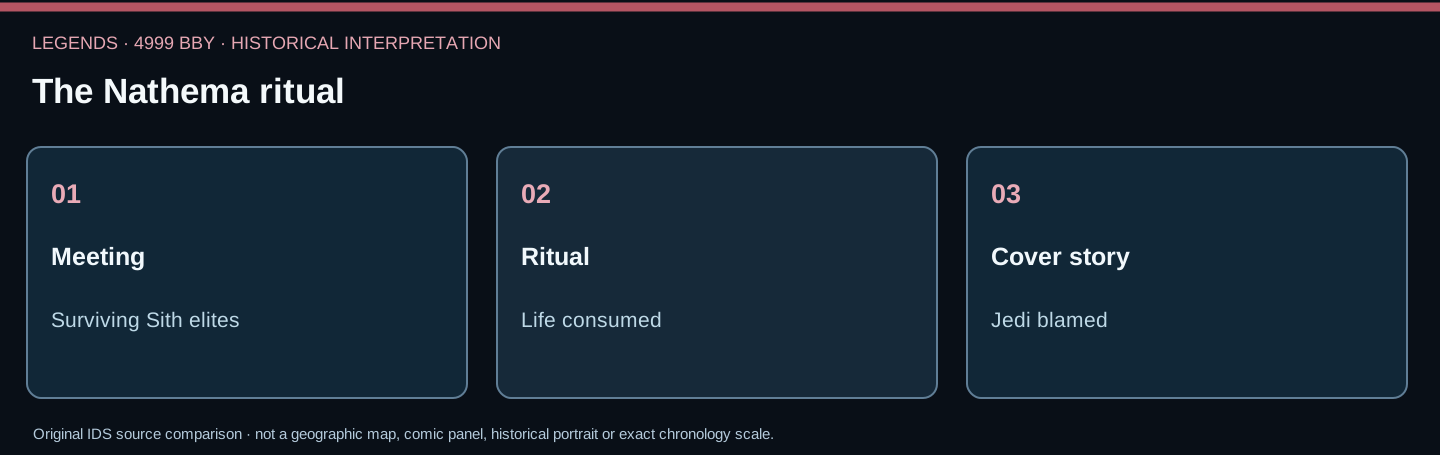
In 4999 BBY, Vitiate summoned surviving Sith Lords to Nathema as the Republic counterinvasion devastated the old Empire. He presented himself as the leader capable of saving the Sith. Instead, he used a vast dark-side ritual to consume the life of the planet and the Force energy of those assembled.
A crisis creates an opportunity
The Sith faced military defeat, famine, disease, and political collapse. That fear made rival elites willing to gather under Vitiate's direction.
Nathema becomes lifeless
The ritual killed inhabitants and left the world unnaturally empty in the Force.
Vitiate centralizes power
The old Sith Empire had been ruled by competing lords. Nathema removed many potential rivals and made Vitiate the center of a new political order.
Anthropological assessment
Nathema shows how leaders can use existential crisis to centralize authority. Vitiate transformed collective fear of extinction into a mechanism for eliminating competing elites and binding survivors to himself.
Great Hyperspace War / Legends chronology
A ruler promises salvation and destroys an inhabited world
Vitiate gathered surviving Sith leaders on Nathema while the old Empire was collapsing in the aftermath of the Great Hyperspace War. He presented the gathering as a way to preserve a people threatened by the Republic counterinvasion. Instead, the participants became instruments in a dark-side ritual that destroyed life on the planet and left an absence in the Force encountered by later visitors. The disaster was not simply a contest among Sith politicians: its victims included the wider population of Nathema, people who did not make decisions about the ceremony.
The ritual transformed political weakness into extraordinary personal power. By destroying many rival leaders, Vitiate removed alternative centers of Sith authority. He subsequently blamed the Jedi and the Republic for the catastrophe, making a false account of the event part of the story through which a new Sith state would define itself. The actual cause and the official account thus diverged sharply. Later visits by Revan and Meetra reveal the enduring results of the crime but are not eyewitness records of every participant's decision in 4999 BBY.
Refugee fear can strengthen an aspiring ruler
People facing political collapse may respond to promises of safety without having the means to verify the leader's knowledge or motives. Vitiate exploited the vulnerability of defeated elites and their followers.
The perpetrator controls the historical narrative
By misattributing Nathema's destruction, Vitiate created a justification for continued hostility toward outside enemies while concealing his own responsibility for mass death.
Was Nathema destroyed by a normal Republic attack?
No. The Legends narrative attributes the destruction to Vitiate's ritual. Blaming the Jedi and Republic was part of his deception.
Source tradition: Drew Karpyshyn, The Old Republic: Revan; SWTOR Encyclopedia. The original Legends historical sequence is not treated as automatically confirmed current Canon.
4999 BBY · Legends · Source and interpretation
A promise of rescue conceals mass killing
- The danger facing the survivors
In Legends, the defeat of the old Empire and the Republic's pursuit left surviving Sith leaders in a crisis. Vitiate exploited that uncertainty by offering a ritual that supposedly promised protection from their enemies. A desperate collective response does not demonstrate that the participants knew the actual purpose of the ceremony.
- The difference between the promise and the event
The novel Revan recounts a ritual in which Vitiate consumed the life of Nathema and the Force power of Sith Lords who had assembled there. It devastated the local population as well as the gathering of elites. Later characters' descriptions of the devastation provide the narrative basis for this reconstruction; the novel is not a neutral contemporary census of Nathema.
- Eliminating rivals and controlling explanation
With many competing Sith leaders destroyed, Vitiate could present himself as the remaining source of guidance. The political consequence was inseparable from control of information: blaming outside enemies for a disaster he caused helped mobilize followers and shield his role. The account belongs to Legends and is not independently established by the current Canon timeline.
Does the source identify a normal Republic bombardment as the cause of Nathema's devastation?
No. The Legends novel attributes Nathema's devastation to Vitiate's dark-side ritual. Claims about exact participant counts should still be distinguished from the larger point that a mass killing occurred.
Original source: Drew Karpyshyn, Revan (2011), original Legends novel; publisher edition. SWTOR historical setting and the later Nathema narrative; page-specific novel citations and total numbers remain for source review. The interpretations here do not assert an exact date or eyewitness account beyond the source.
Legends · Source study · 5000–4896 BBY
A promise of collective rescue becomes a planetary sacrifice
Nathema is the moral and political center of Vitiate's rise to power. While the surviving Sith faced invasion and civil disorder, he summoned Sith Lords to a meeting that promised a means of saving their civilization. In Legends, the ritual instead consumed life and Force energy on the planet and empowered Vitiate. This was not an ordinary military defeat inflicted on Nathema by invading Republic troops. The person presenting the rescue plan was the agent of the catastrophe. Accounts emphasizing the Republic's subsequent blame must keep that difference explicit.
The anthropology of this event concerns control of information during a crisis. The gathered Lords were offered a solution framed as collective survival, but the leader concealed the true cost. Later followers learned a narrative that attributed Nathema's fate to their enemies. That version could consolidate loyalty without accurately describing the event. A chronology should contrast the destruction in 4999 BBY with the later discovery of Nathema by Revan and Malak. The later visitors are witnesses to the aftermath, not participants in the original ritual. The Force-draining mechanism is fictional dark-side lore, not a biological or archaeological explanation.
Connected histories and boundaries
Source trail: Licensed or official source. These establish a licensed fictional narrative; historical interpretation of migration, governance, colonization or destruction is IDS analysis. No unrecorded casualty figures or spoken orders are claimed.
Why this article stays separate from nearby events
The collapse of Naga Sadow's Sith Empire, the Republic's counterinvasion, Vitiate's ritual, the exile fleet's long voyage and the Dromund Kaas founding belong to a connected sequence, not one undifferentiated battle. Keep separate dates and documented causes.
Historical judgment · Legends
Test your historical judgment
Answer both questions and receive scored corrections explaining what the source material actually supports.
Legends · Comparative evidence review
Source boundaries: destruction, causation and propaganda
The destruction of Nathema must not be treated as a battlefield outcome of the Republic's counterinvasion. In the later Legends account, Vitiate assembled surviving Sith elites and used a ritual that destroyed life on the world. He then built a political narrative in which the Jedi and Republic were responsible for the catastrophe. The perpetrator's public explanation and the later story's explanation are therefore contradictory types of evidence, not independent corroboration.
The publisher's description of Drew Karpyshyn's Revan establishes the edition and its central conflict involving the hidden Sith Emperor; it does not by itself confirm every detail of the ancient ritual. Precise participant totals, the number of affected settlements, dates for individual meetings and exact dialogue must be checked against the novel or official game codex. The distinction between confirmed general episode and unverified numerical detail is especially important where an account describes mass death.
An anthropological reading can analyze how the destruction of a populated place enabled a ruler to remove competing authorities and control the survivors' explanation of their own past. This does not mean that every refugee had firsthand access to the ritual or that belief in the official accusation was unanimous. The larger historical question is how a claimed collective victimhood can become a founding justification for a coercive state.
Historical question: Does the SWTOR political accusation that the Jedi destroyed Nathema identify the actual perpetrator in the Revan narrative?
Correction: No. The Legends account presented in Revan attributes the life-draining ritual to Vitiate. His later explanation is part of the political story he promoted.
Compare the three aftermath trajectories →
Source: Drew Karpyshyn, Revan (publisher edition). Some precise dates or individual quotations depend on original novel/game chapters not yet checked directly. Interpretation is labeled separately from reported events.
4999 BBY · Legends · Historical evidence
Separate the planetary catastrophe from the ruler's explanation
The ritual on Nathema is a mass killing carried out by Vitiate in the later Legends history, not an act whose perpetrators are established merely by the official story told to refugees afterward. The gathering of Sith leaders and the life-draining act provided a means to remove potential rivals while converting an inhabited world into a center of his new power.
Vitiate's later account blamed the destruction on the Jedi and Republic. That distinction is historically central: the public story promoted by a ruler can be part of the mechanism by which obedience is obtained, even when it does not describe the underlying event accurately. The narrative also depends on material presented in Revan and SWTOR's retrospective, so a game codex should not be treated as a contemporaneous eyewitness report.
The diagram illustrates three evidentiary positions rather than portraying victims, a known temple floor plan or the visual appearance of the ceremony. Precise casualty totals and verbatim speeches require direct checking in the primary novel and game material.
Historical judgment: Does the Sith Emperor's later allegation make the Jedi the documented perpetrators of Nathema's destruction?
Explanation: No. The later Legends narrative attributes the planetary ritual to Vitiate, while his accusation served his political story.
Read a related historical dossier → · Complete timeline →
Primary story or reference family: Drew Karpyshyn, Revan, and SWTOR Galactic History. Explanations distinguish source-reported facts from editorial inference; original editions require page-level proofing where only summaries are available.
Sources and further reading
- Drew Karpyshyn, The Old Republic: Revan.
- Ritual of Nathema, Wookieepedia