
Illustration: original IDS reconstruction, not a film still or comic panel. Consult the source.
The Republic victory over Naga Sadow did not end with the defense of its own worlds. From 5000 into 4999 BBY, Republic fleets and Jedi carried the war into Sith territory. The counterinvasion targeted surviving military forces, sacred sites, archives, temples, artifacts, and centers of dark-side power across the old Empire.
Victory becomes offensive war
Republic forces pursued the defeated Sith rather than simply ending combat at the border.
The campaign aimed to prevent another Sith resurgence.
Sacred sites and archives are destroyed
Jedi and Republic forces damaged the Valley of the Dark Lords and other Sith centers.
The Veeshas Tuwan library-temple on Arkania was destroyed, along with much of its accumulated knowledge.
The Sith population fragments
Some survivors fled to colonies such as Thule, Ambria, Tund, and Vjun.
Others followed Vitiate into exile, while small communities remained on Korriban.
Anthropological assessment
The counterinvasion raises the problem of whether destroying dangerous institutions can be separated from destroying cultural heritage.
It also shows how victors shape historical memory by deciding which archives, monuments, and religious sites will remain available to future generations.
5000–4999 BBY · Legends · Source and interpretation
The Republic's pursuit into Sith space
- Who ordered the advance?
The official SWTOR Galactic History retrospective says that after the surviving Sith fleet was defeated, the Supreme Chancellor ordered Jedi and Republic forces onto Korriban and other Sith planets. This is a decision made after the immediate invasion had ceased, not part of Gav Daragon's discovery or the defense of Coruscant.
- What was being dismantled?
The campaign sought to prevent a new Sith threat by destroying the remaining political and military foundations of the old Empire. Other Legends reference histories describe damage to sacred and archival sites. Each claim about a particular destroyed monument needs a separate supporting account; a general official summary cannot verify every named site.
- How was it remembered?
In Gnost-Dural's retrospective, the counterinvasion helped create the conditions for the Sith exodus and later revenge. That is a causal judgment by a later Jedi historian, not an independently documented statement of every Republic soldier's intention or every surviving Sith person's experience.
Is the Republic's victory over the invasion the same thing as its decision to occupy Sith worlds?
No. The official Galactic History explicitly distinguishes defeating the invading Sith fleet from sending forces to seek and destroy remaining Sith strongholds afterward. A military victory and a new offensive policy need separate entries.
Original source: SWTOR Galactic History, BTC 1347: The Great Hyperspace War. The Essential Guide to Warfare (2012) (specific site reports need page-level checking). The interpretations here do not assert an exact date or eyewitness account beyond the source.
Source comparison · historical memory
The case of the Veeshas Tuwan archives
The destruction of the Sith library-temple Veeshas Tuwan on Arkania is described in Legends reference literature about the Republic counterinvasion. The report offers a particularly revealing example of how protecting a political order could conflict with the preservation of another society’s records. An account attributed to Sith scholar Seviss Vaa remembers this episode as a catastrophic loss of the Sith cultural archive. It is a later political memory, not the direct testimony of an otherwise neutral observer.
Later reference treatments differ on whether the Jedi rescued some of the documents before the building was destroyed. That difference matters: destruction of a building, destruction of its collection, and removal of texts to an opposing institution are separate acts. The disputed fate of particular scrolls should not be converted into an invented precise number of artifacts lost.
What can the evidence establish about the campaign?
Legends reference accounts support the claim that Jedi attacked the Veeshas Tuwan archive during the counterinvasion. They do not establish every participant's motive or prove that all the library's contents were destroyed.
How would this look from a Sith historian's perspective?
Seviss Vaa’s later account emphasizes cultural erasure and the loss of historical records. Its anger is itself useful evidence about the memory of the war, but a partisan interpretation cannot substitute for documentation of specific actions.
What should an archivist record?
Separate the event, reported losses, accounts of items recovered, and the politics of each later retelling. The existence of dangerous teachings does not by itself verify that every recovered or destroyed text had the same contents.
Related Legends references: Tales of the Jedi Companion (1996), Jedi vs. Sith: The Essential Guide to the Force (2007), and The Complete Star Wars Encyclopedia (2008). Specific edition pages remain to be checked; compare the compiled citation trail.
Legends · Source study · 5000–4896 BBY
From victory to intervention in Sith territory
The Republic's decision to continue into the defeated Sith Empire changed the meaning of the war. The initial campaigns defended Republic worlds against Naga Sadow's invasion. The counterinvasion put Jedi and Republic units on former Sith worlds, where military power also decided the fate of religious spaces, archives, and cultural objects. The distinction matters: possession of a temple or library by a hostile power does not make every object in the collection a weapon. The destruction of the Veeshas Tuwan archive on Arkania illustrates how an attempt to prevent a future political threat could erase information valuable to later scholars.
Accounts of the campaign connect the destruction of monuments and centers of Sith power with an environment of dislocation. But surviving Sith communities did not all make the same choice. Some dispersed, others fought on, and Vitiate exploited fear and instability to recruit a following. The Republic's offensive, Nathema's destruction, and the later exodus are related consequences in the story, not one military operation with a single command structure. Where historical summaries disagree about motives, IDS should identify the source rather than attribute the same intentions to every Jedi or civilian.
Connected histories and boundaries
Source trail: Licensed or official source · Related source. These establish a licensed fictional narrative; historical interpretation of migration, governance, colonization or destruction is IDS analysis. No unrecorded casualty figures or spoken orders are claimed.
Why this article stays separate from nearby events
The collapse of Naga Sadow's Sith Empire, the Republic's counterinvasion, Vitiate's ritual, the exile fleet's long voyage and the Dromund Kaas founding belong to a connected sequence, not one undifferentiated battle. Keep separate dates and documented causes.
Historical judgment · Legends
Test your historical judgment
Answer both questions and receive scored corrections explaining what the source material actually supports.
Original IDS study · Legends source reconstruction
Evidence sequence: Victory and occupation
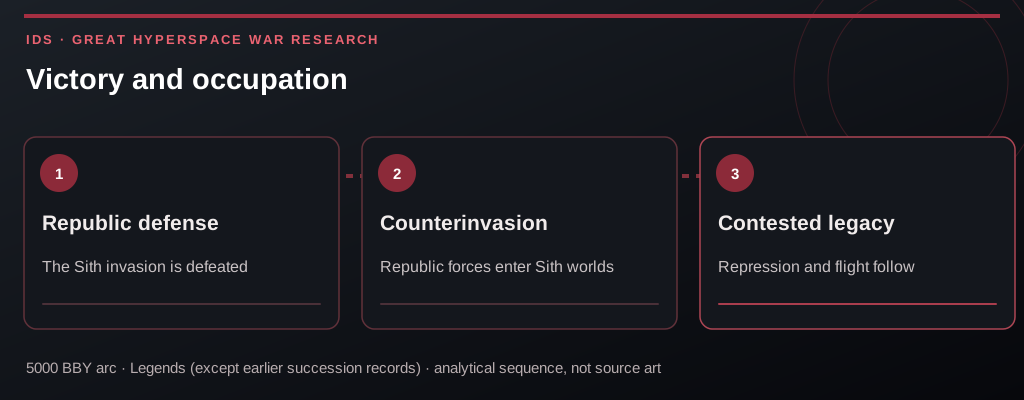
What the original history supports
The counterinvasion is primarily reconstructed from later Legends historical sources, not staged scene by scene in the original five-issue Fall of the Sith Empire comic. The question of whether security operations became indiscriminate punishment belongs to the editorial interpretation and must be tied to named sources.
Interpretation and evidence limit
This sequence does not equate all Republic personnel or all Sith populations with a single opinion. Later Sith accounts and Republic archives preserve politically interested memories of the campaign.
Legends · Postwar evidence review
Distinguishing a Republic campaign from later Sith memory
The Republic's move into defeated Sith territories happened after the primary invasion failed. The counterinvasion cannot be described as a third stage of Sadow's original attack or as the same episode as the two fleet battles at Korriban. Later accounts emphasize military destruction and attacks on institutional sites. The reasons individual Republic commanders gave for specific actions, however, are not equally well documented in the original narratives.
One account of violence against temples and archives may establish destruction at a named site without establishing that every citizen of the defeated empire was subject to an identical policy. The loss of the Veeshas Tuwan library on Arkania provides a particular example of contested institutional memory. The scholarly problem is not to deny the destruction but to distinguish which objects were destroyed, what evidence survived elsewhere, and which later reference work supplied the claim. These questions require an edition-level comparison of the printed Legends histories.
The later SWTOR HoloNet narrator, Gnost-Dural, interprets the war's conclusion as creating a grievance that endured inside the reconstituted Sith Empire. Vitiate's own accusation that the Jedi destroyed Nathema complicates that story because the novel tradition gives the ritual a different perpetrator. The historian can study how a political enemy used memories of the counterinvasion without treating those allegations as an independently verified account of everything the Jedi did.
Evidence question: Does the evidence for destroyed Sith sites prove that the Jedi caused the Nathema catastrophe?
Correction: No. The later Legends Nathema story attributes the planetary ritual to Vitiate. The counterinvasion and the Nathema ritual must be examined separately.
Compare all three aftermath histories →
Source trail: Gnost-Dural, BTC 1347. This reading distinguishes reported events, later retrospective accounts and IDS interpretation. Exact page/panel proofing remains pending.
Sources and further reading
- The Essential Guide to Warfare.
- The Old Republic: Revan.
- Post–Great Hyperspace War counterinvasion, Wookieepedia