Hero artwork: original IDS editorial reconstruction for this Legends episode. View the comic issue at Marvel for the original source.
By the end of 5000 BBY, the Great Hyperspace War had ended in a decisive Republic and Jedi victory. Naga Sadow had vanished to Yavin 4, Ludo Kressh was dead, and the old Sith Empire's organized military power had collapsed. Later Legends summaries describe casualties on a galactic scale.
The Republic survives the invasion
Coruscant and Empress Teta's worlds remained outside Sith control.
The old Sith Empire fractures
Leadership losses and civil conflict left the Sith heartland unable to mount a unified defense.
Victory becomes counterinvasion
Supreme Chancellor Pultimo authorized further operations inside Sith space rather than ending hostilities once the invasion threat was removed.
Anthropological assessment
The end of the war marks the moment defensive victory became a broader policy of destroying the defeated enemy's institutions. That distinction is central to understanding the disputed morality of what followed.
Great Hyperspace War / Legends chronology
The Republic wins, but the war's consequences continue
The end of the Great Hyperspace War brought an end to Naga Sadow's coordinated invasion of Republic worlds. Sith forces had been defeated on several fronts, internal conflict undermined the old Empire, and the principal invader eventually escaped to Yavin 4. The outcome restored Republic control of its threatened core territories. It did not eliminate every Sith group or prove that every inhabitant of Sith space had supported the invasion. Those differences became important once Republic leaders turned from defense toward operations inside the defeated Empire's territory.
The war's closing phase therefore raises two related but distinct questions: how the Republic survived the attack, and what the Republic believed it could do to the remaining Sith political order afterward. The counterinvasion affected communities far from the original front lines. New refugee movements and the rise of Vitiate's hidden Empire followed from a crisis in which existing authority and the sources of social protection collapsed. A history ending with a victorious fleet would leave out much of what the war meant to survivors.
Military victory versus political settlement
Defending Republic worlds was a different objective from dismantling enemy institutions after their armies had retreated. The moral and political consequences of those operations should be evaluated separately.
The history of defeat includes multiple survivors
Naga Sadow preserved a following on Yavin 4, while other Sith groups moved elsewhere. The collapse of one empire did not terminate Sith traditions or create a single common path for every refugee.
Did the Republic's victory permanently eliminate all Sith?
No. Several Sith groups survived in exile or concealment, and Vitiate's later state developed after the conflict.
Source tradition: Tales of the Jedi: The Fall of the Sith Empire; The Essential Guide to Warfare. The original Legends historical sequence is not treated as automatically confirmed current Canon.
Legends · Research field note
Historical perspective: The end of the Great Hyperspace War
A Republic victory reshapes the political order, but the defeated Sith tradition continues through later exiles.
Reading the evidence: This interpretation draws out the social implications of the recorded event without supplying undocumented conversations, numbers or motivations.
Research question: what would stronger evidence require?
Compare the source cited below with nearby chronology entries. Distinguish what is explicitly recorded from broader conclusions about political institutions, lived experience and historical consequences.
Legends · 5000 BBY · Source reading
A decisive victory and a disputed peace
Republic and Tetan forces defeat Sadow's invasion as Sith leadership fractures and loses naval strength.
The final Korriban fighting is distinct from later Republic operations in the Sith heartland. Defensive success and counterinvasion are different decisions.
Sadow's escape and continuing Sith communities prevent the war's end from being described as the extinction of Sith history.
Can all later Republic operations be dated to the final battle?
No. The major engagements belong to the 5000 BBY war, while later pursuits and counteroffensives require separate dates and sources.
Source: Kevin J. Anderson, Tales of the Jedi: The Fall of the Sith Empire #5 (Dark Horse Comics, 1997). Publisher's comic listing and cover →. The documented story is Legends; social interpretation is editorial analysis.
5000 BBY · Legends · Historical source lab
Victory, flight, and the political afterlife of war
Ending Naga Sadow's invasion did not instantly solve every crisis the fighting had produced. Empress Teta and other Republic defenders survived the campaign, while the old Sith Empire lost its central military strength and its leadership fractured. Sadow's escape toward Yavin 4 is a distinct event from the Republic's battlefield victory. The later incursion into Sith territory also needs its own account, because a policy of pursuing remnants and destroying archives could shape entire populations long after the invasion had ended. A historical timeline should therefore distinguish military surrender or defeat, the dispersal of survivors, and later cultural loss. Such separations prevent a single victory banner from standing in for generations of consequences.
Evidence boundary: historical fact versus interpretive analysis
This is a Legends fictional-history dossier. Characters, encounters and broad outcomes follow Tales of the Jedi and licensed secondary chronology. Assessments of power, institutions, consent and political legitimacy are IDS interpretations. Page-specific casualty counts, direct speeches and scientifically exact mechanisms should not be inferred from a general reference summary or comic cover.
Historical judgment · 5000 BBY
Test your historical judgment
Answer both questions to receive a score and corrections explaining the evidence.
Primary story series: Kevin J. Anderson and Dario Carrasco Jr., Tales of the Jedi: The Golden Age of the Sith #0–5 and The Fall of the Sith Empire #1–5. Marvel's Fall of the Sith Empire #1 describes Jori Daragon's warning and Naga Sadow's invasion. Marvel's Golden Age #2 describes the succession crisis. Not every page-specific incident can be independently established from publisher marketing summaries alone.
Original IDS study · Legends source reconstruction
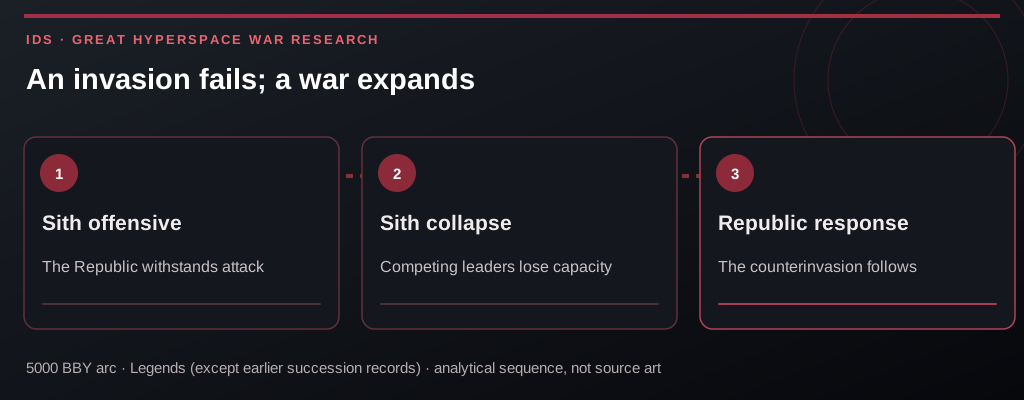
Evidence sequence: An invasion fails; a war expands
What the original history supports
A Republic victory over the invasion should not automatically be equated with the end of violence. The later counterinvasion pursued Sith institutions and worlds even after Sadow's fleet had been defeated. Separate episodes here help distinguish immediate defense from later state policy.
Interpretation and evidence limit
The comic and later historical references have different evidentiary roles: the comic depicts the war, while retrospective references describe its longer institutional consequences.
Legends · Postwar evidence review
When military victory is not the final historical outcome
At the end of the main campaign, the Republic had survived Sadow's attempt to destroy its political center and its allies, and the invading ruler had escaped. This was a decisive military reversal, but it cannot by itself account for the elimination of the old Sith government. Later accounts describe Jedi and Republic forces continuing into Sith space. Those events belong to the counterinvasion and should not be compressed into the moment at which the pursuit of Sadow ended.
The official SWTOR history is valuable because it explicitly asks how the Republic concluded the Great Hyperspace War. Its narrator, the later Jedi archivist Gnost-Dural, interprets the Republic's victory as a historical cause of a subsequent enemy's determination to retaliate. This is an in-universe argument about responsibility, not a surviving independent transcript of every attack on a Sith settlement. The earlier Fall of the Sith Empire comic, meanwhile, concentrates on Sadow, Teta, rival Sith fleets and the collapse of the immediate invasion.
Treat the end of the war as a boundary between related but different subjects: stopping an invading military force, destroying or occupying the defeated state's institutions, and tracing populations that survived outside Republic control. Those later populations did not share a single path. The surviving Massassi and Sadow at Yavin 4, Vitiate's emigrating group and the Omen crew on Kesh require independent source narratives.
Evidence question: Did Sadow's retreat simultaneously end every Sith community described in later Legends?
Correction: No. The old imperial campaign failed, but separate groups survived and followed different historical paths. The Republic counterinvasion is also a separate phase of the aftermath.
Compare all three aftermath histories →
Source trail: SWTOR Galactic History, BTC 1347. This reading distinguishes reported events, later retrospective accounts and IDS interpretation. Exact page/panel proofing remains pending.
Sources and further reading
- The Essential Guide to Warfare.
- Great Hyperspace War/Legends, Wookieepedia