
Fleeing the defeat over Korriban, Naga Sadow led Empress Teta's pursuing forces toward the Denarii system. There he used dark-side sorcery and ancient Sith technology to trigger a catastrophic stellar explosion. The blast destroyed pursuing gunships, transformed the system into the Denarii Nebula, and allowed the Corsair to disappear from Republic pursuit.
A retreat becomes an ambush
Sadow could no longer win a conventional fleet battle.
He used the pursuing Republic force's momentum against it by choosing the battlefield.
The Denarii system is destroyed
The catastrophe altered the entire star system rather than one military target.
Later travelers encountered the resulting nebula as a permanent geographic consequence of the war.
The route to Yavin 4
The destruction concealed Sadow's flight.
He escaped to Yavin 4 with surviving Massassi followers and disappeared from Republic knowledge.
Anthropological assessment
Denarii Nova turns war into landscape. A military decision left an astronomical feature that outlived every participant.
It also shows how defeated leaders can survive by abandoning institutions and territory while preserving a smaller loyal community.
Great Hyperspace War / Legends chronology
A retreat creates a new astronomical hazard
Naga Sadow's escape after the failure of his invasion led pursuing Republic and Koros forces toward the Denarii system. Facing defeat, Sadow turned to a form of catastrophic destruction rather than allow a conventional fleet engagement to decide his fate. Sith technology and dark-side sorcery were used to trigger an explosive stellar event. The battle therefore changed more than the balance of one fleeing fleet; it transformed the system into the Denarii Nebula and made the consequences of one military choice part of galactic geography.
The event belongs to the closing phase of the Great Hyperspace War, after Sadow's attempt to preserve control over the Sith Empire had deteriorated. He sought survival even at the cost of destruction to those who followed him and those attempting to end his rule. The catastrophe helped cover his flight toward Yavin 4, where he established a separate hidden stronghold with surviving Massassi. The narrative presents a fantastical Sith superweapon rather than a physical process that can responsibly be reconstructed using ordinary astronomical models.
The war outlasts its combatants
A fleet may disappear in a battle, but a transformed system can remain dangerous for travelers centuries later. Destruction becomes an inherited environmental condition, not just an event recorded in military casualty lists.
Escape and leadership have conflicting meanings
A leader can present retreat as strategic necessity while leaving followers and entire systems exposed to harm. The choices of Sadow in defeat reveal that preserving personal power and protecting a political community were not the same objective.
Did the Denarii catastrophe mark the construction of the Star Forge?
No. The Denarii Nova is associated with Sadow's retreat in the Great Hyperspace War, thousands of years after the Rakatan Star Forge was originally created.
Primary research context: Tales of the Jedi: The Fall of the Sith Empire #5; The Essential Atlas, Denarii Nebula. Legends continuity; later Canon references to these ancient events do not necessarily verify all Legends-era details.
Ancient Republic · Legends · Historical field note
Interpreting Conflict at the Denarii Nova
A battle's placement in chronology should be distinguished from unsupported claims about precise maneuvers or casualties.
Research distinction: The documented event anchors this article. Its political and cultural implications are analytical observations, not invented scenes or claims about undocumented participants.
Open the historian's evidence question
What is directly established by the cited account, and what is an interpretation of its significance? Avoid treating an approximate date or a short reference entry as evidence for exact dialogue, motives or casualty totals.
Historical interpretation · 5000 BBY · Legends
What the surviving story establishes
Naga Sadow's withdrawal from Korriban does not end Empress Teta's pursuit. His surviving ship still carries the possibility that the Sith leader will escape accountability for the failed invasion.
The Denarii incident is described as a star-scale catastrophe linked to Sadow's actions. The destruction of the system and the creation of the Denarii Nebula change the physical setting through which later travelers would navigate.
The destruction also enables Sadow to vanish from the immediate pursuit. Legends continues his story on Yavin 4, so the battle should be treated as an escape and environmental disaster rather than a confirmed death.
Is the precise astrophysical mechanism known from the original story?
No. The comic portrays Sith power and catastrophic stellar effects. Describing the event does not authorize invented calculations, weapon specifications, or exact casualty totals.
Original story or reference: Tales of the Jedi: The Fall of the Sith Empire #5. View the cited source listing →
Original IDS study · Legends source reconstruction
Evidence sequence: Denarii: retreat under pressure
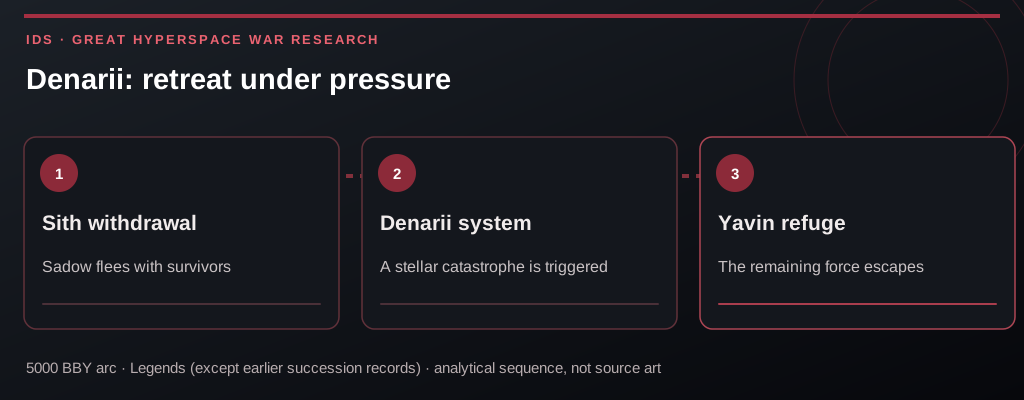
What the original history supports
The Denarii catastrophe follows the retreat from Korriban in the Legends Great Hyperspace War account. It should not be confused with Primus Goluud or the Cron Cluster: the sites, consequences and narrative contexts are separate.
Interpretation and evidence limit
The diagram is an editorial summary of the retreat. It is not an astronomical reconstruction and cannot establish exactly which individual ships survived.
5000 BBY · Legends · Original-source comparison
A staged death and a lasting spatial consequence
Denarii Nova is the final escape episode of the campaign, not a second description of the battle at Primus Goluud. The former involved the Denarii system's binary stars and Republic gunships pursuing the fleeing Corsair after Korriban. At Primus Goluud, Gav Daragon had been trapped in a meditation sphere; by the time Sadow fled toward Denarii, Gav was dead. Confusing the encounters erases the cause-and-effect sequence.
Using dark-side powers and Sith equipment, Sadow provoked destructive solar activity, destroying the pursuing craft and making observers believe he had perished. The catastrophe left a nebula remembered in later accounts. The original comic is evidence for what the fictional characters saw and believed, not for a physically modeled account of how the stars were destroyed. Exact distances, energy estimates and complete casualty totals cannot responsibly be reconstructed from this record.
Sadow's escape ended the Republic's immediate pursuit without restoring the Sith Empire's campaign. His followers reached Yavin 4, where the ruler tried to preserve his project beyond the reach of the powers that had defeated him. This helps explain the difference between eliminating an invading military organization and eradicating every cultural or religious continuity associated with it.
Historical judgment: Was the Denarii Nova catastrophe the event in which Gav Daragon died?
Correction and evidence: No. Gav died earlier at Primus Goluud. Denarii Nova concealed Sadow's later escape and caused the Republic to believe he had died.
Full Great Hyperspace War research route → · Previous related event → · Continue historical sequence →
Primary storyline: Tales of the Jedi: The Fall of the Sith Empire, Issue 5, End of an Empire (1997), Kevin J. Anderson and Dario Carrasco Jr. Publisher issue catalog →. Specific panel references and edition pagination still require original issue verification. Explanations of political institutions and warfare are IDS interpretations, not quoted text from the comic.
Sources and further reading
- Tales of the Jedi – The Fall of the Sith Empire.
- Daniel Wallace and Jason Fry, The Essential Atlas, 2009.
- Battle at the Denarii Nova, Wookieepedia