
After escaping the Battle at the Denarii Nova, Naga Sadow fled to the remote jungle moon Yavin 4 with surviving Massassi followers. The defeated Dark Lord no longer commanded the old Sith Empire, but he retained enough personnel, knowledge, and material to create a hidden stronghold beyond Republic awareness.
A defeated ruler builds a refuge
Yavin 4's isolation gave Sadow distance from both Republic pursuers and rival Sith.
The moon became the base for a surviving branch of Sith culture after the old empire collapsed.
The Massassi follow Sadow
Sadow's followers included Massassi warriors from the Sith caste system.
On Yavin 4, he subjected them to further alchemical experimentation and mutation.
Monumental construction begins
Massassi built enormous stone temples and ritual sites under Sadow's authority.
The architecture outlived Sadow and later became central to Rebel and Jedi history.
Anthropological assessment
Sadow's retreat shows how defeated elites can preserve power by moving to political peripheries.
Yavin 4 also demonstrates how monumental architecture can outlive the regime that ordered it and acquire completely different meanings for later societies.
Great Hyperspace War / Legends chronology
The defeated Sith Lord establishes a hidden refuge
After his escape from the destruction around the Denarii system, Naga Sadow arrived on Yavin 4 with Massassi followers. His empire in the Sith heartland was in collapse, but the isolated moon provided a place beyond immediate Republic reach. There Sadow continued dark-side practices and directed construction by the surviving Massassi. The stronghold must be understood as a continuation of some Sith personnel and knowledge, not the survival of the original Sith Empire in its previous institutional form.
Yavin 4 later became famous for monumental stone temples. The structures and the history of the Massassi would far outlive Sadow's own political project. Later Rebel and Jedi users occupied or interpreted the same ruins in entirely different ways. That long afterlife does not make all the groups historically continuous or morally equivalent. What links them is a landscape shaped by people living under radically different forms of power, with later inhabitants inheriting spaces whose original purposes they did not necessarily share.
A peripheral base can preserve a defeated elite
Rulers who lose their core territories can retain influence by retreating to places beyond effective surveillance. Geography gives survivors time to reorganize, though the resulting institution may be much smaller and more coercive toward those who follow them.
Architecture changes meaning through reuse
A temple ordered by a Sith ruler may become a military base or a place for later Jedi activity. Each reuse transforms its political meaning, while the physical building continues to carry evidence of its makers and those who labored under them.
Was the Rebel Alliance already using the Great Temple when Sadow arrived?
No. The Rebel base belongs to a much later period. The ancient Massassi structures predate those uses by thousands of years.
Primary research context: Tales of the Jedi: The Fall of the Sith Empire; Legends Yavin 4 and Massassi architectural history. Legends continuity; later Canon references to these ancient events do not necessarily verify all Legends-era details.
Historical interpretation · c. 5000 BBY · Legends
What the surviving story establishes
After the collapse of the invasion, Naga Sadow escapes beyond the immediate reach of Republic pursuers. Refuge on Yavin 4 is a separate phase from his earlier military command and defeats.
Massassi followers and the architectural remains associated with Sadow connect the history of political exile to forced labor, ritual spaces and the transformation of a local landscape.
Later users of Yavin 4 encounter structures that have outlived the political order responsible for their construction. That connection requires care: the precise Legends account of Sadow is not automatically a verified event in current Canon.
Does the survival of a temple prove every account of the site belongs to one continuity?
No. Canon and Legends contain their own histories of Massassi architecture on Yavin 4. Evidence from one continuity should not silently be transferred to the other.
Original story or reference: Tales of the Jedi: The Fall of the Sith Empire; later Legends Yavin 4 accounts. View the cited source listing →
Original IDS study · Legends source reconstruction
Evidence sequence: Yavin 4: retreat and continuity
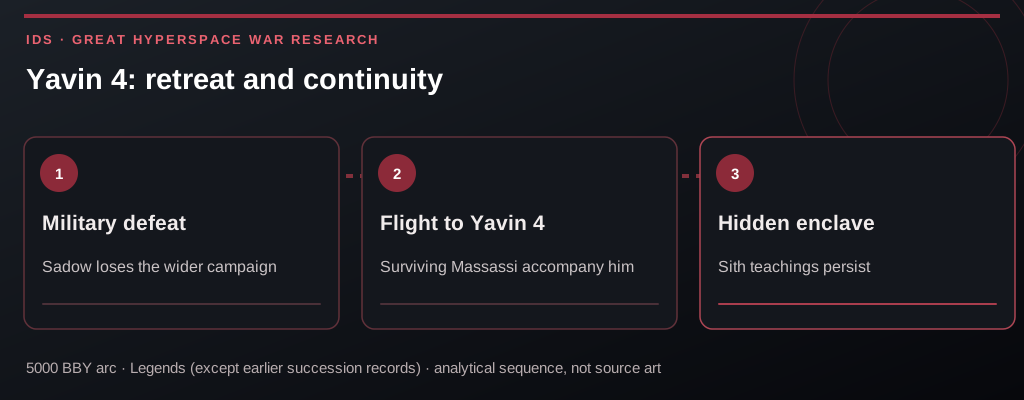
What the original history supports
Sadow's movement to Yavin 4 begins a concealed tradition that later writers connect to Freedon Nadd and Exar Kun. That retrospective influence is not evidence that the old Sith Empire immediately survived as a coherent state.
Interpretation and evidence limit
Yavin 4 was inhabited by Massassi, whose own lives and institutions should not be reduced to Sadow's legacy. The visual is an IDS interpretive sequence, not an original Massassi depiction.
Legends · Postwar evidence review
A defeated leader preserves a smaller following
Sadow's disappearance after Denarii Nova is a narrower story than the later rebuilding of the Sith Empire. The final comic follows a ruler whose attempt to invade the Republic has failed, but who has not been captured by the forces pursuing him. He reaches Yavin 4 with Massassi followers. The event illustrates how survival of a political figure and the collapse of the government he ruled can occur together. Reaching a remote sanctuary does not mean that Sadow still controlled the old network of Sith planets.
The Massassi must be described as participants in this story rather than interchangeable with the other Sith refugees. The established narrative follows their movement and their relationship with Sadow. It does not place Vitiate's exile fleet on Yavin 4 or make the independent Kesh colony a subordinate settlement. Later traditions about monumental construction on Yavin 4 belong to a longer history; they should not all be dated to the precise day Sadow escaped the Republic pursuit.
The surviving architecture and later occupation of the moon raise a material-culture problem. Monuments can remain meaningful after those who ordered them disappear, but meanings can change as different communities reuse the same site. This is interpretation, not evidence that a later Rebel user understood its builders' intentions. Verify specific temple-building claims against original published references before assigning a date or a named Massassi workforce to every structure.
Evidence question: Did Sadow's arrival on Yavin 4 establish the later hidden Sith Empire on Dromund Kaas?
Correction: No. The two narratives concern distinct leaders and surviving groups. Vitiate's exiles reached Dromund Kaas after their own long search.
Compare all three aftermath histories →
Source trail: Fall of the Sith Empire #5. This reading distinguishes reported events, later retrospective accounts and IDS interpretation. Exact page/panel proofing remains pending.
Sources and further reading
- Tales of the Jedi – The Fall of the Sith Empire.
- Yavin 4/Legends, Wookieepedia