
Illustration: original IDS reconstruction, not a film still or comic panel. Consult the source.
During the postwar counterinvasion, Republic forces again fought on and around Korriban. Unlike the two fleet battles that had ended the Great Hyperspace War, this engagement involved the broader campaign to occupy or neutralize Sith territory. Surviving Sith forces succeeded temporarily in driving Republic forces out of the Horuset system.
A temporary Sith victory
The Republic's initial postwar advance did not produce uninterrupted control of Korriban.
Sith defenders retained enough organization to force an enemy withdrawal.
Vitiate gathers surviving Sith Lords
During this same crisis, Vitiate summoned thousands of Sith Lords to Nathema.
The gathering removed a major portion of surviving Sith leadership from Korriban's political struggle.
Victory cannot restore the old Empire
Even though Republic forces were expelled, the Sith state remained shattered.
Military success at one world could not reverse the loss of fleets, leadership, routes, and regional cohesion.
Anthropological assessment
This Korriban battle shows the difference between battlefield victory and political recovery.
A society can repel an occupying force while still lacking the institutions needed to recreate the state that existed before defeat.
Ancient Republic / Sith successors · Legends
A local Sith victory amid the destruction of an empire
The Republic campaign that followed the Great Hyperspace War reached Sith space, including Korriban. This postwar phase was not the same as the earlier battles between Naga Sadow and Ludo Kressh near the Sith tomb world. The Republic was now trying to neutralize the power of the defeated enemy across its territory. During the fighting, surviving Sith defenders were reportedly able to drive Republic forces from the Horuset system for a time, demonstrating that the collapse of the old imperial government did not mean every military unit or fortified world had become defenseless.
The local victory was nevertheless unable to reverse the broader political breakdown. Sith leadership was divided, naval strength had been severely damaged, and refugees continued moving toward new centers of power or concealment. The later gathering organized by Vitiate on Nathema belonged to this wider environment of survival and political manipulation. The chronologies do not support a detailed reconstruction of every troop deployment at Korriban, so the event should be presented as a limited success within a destructive postwar counterinvasion, not a restoration of the Golden Age.
Battlefield success and political survival
One force can win a local engagement without restoring the institutions needed to govern a large state. Control of territory depends on supply, accepted leadership and networks of communication that remain functional after combat.
The memory of invasion produces new loyalties
A community facing an outside counterattack may define itself through shared danger even while its former rulers fight one another. Vitiate later used survival and vengeance as elements of a founding narrative, turning the postwar crisis into a basis for another authoritarian order.
Was this the same Korriban battle as Sadow's initial struggle with Kressh?
No. The counterinvasion followed the collapse of the Sith attack on the Republic and involved later fighting over control of Sith territory.
Research sources: The Old Republic: Revan; Legends post–Great Hyperspace War reference chronology. Legends chronology and source-specific events are kept distinct from interpretations; no unsupported eyewitness accounts, exact army counts or future Canon certainty are implied.
Contemporary background: The official SWTOR Korriban Holonet records the ancient empire's defeat and later reconstitution. Specific battle movements remain source-limited.
5000–4999 BBY · Legends · Source and interpretation
Korriban after Sadow's defeat
- Three events, not one
The original Fall of the Sith Empire comics show Sadow's fight with Ludo Kressh followed closely by a fleet battle involving Empress Teta. The separate counterinvasion that followed includes later fighting around Korriban. Calling all three encounters simply 'the Battle of Korriban' hides their different combatants and political purposes.
- The report of a temporary withdrawal
Legends historical compilations describe surviving Sith resistance and a period when Republic forces temporarily withdrew from the Horuset system. The public SWTOR Korriban HoloNet confirms the broader collapse and later survival of Sith institutions but does not reconstruct the exact movements, casualty count or date of that local engagement. Those tactical details are therefore not presented as settled.
- What survived an imperial collapse?
A counterattack could force a temporary change in control without replacing the lost Sith fleet, restoring the old dynasty, or healing disagreements among the remaining ruling class. Korriban retained symbolic importance because temples and tombs made it a center of Sith tradition even after the old government's defeat.
Did the later Sith counterattack restore the Empire of Marka Ragnos?
No. The reported withdrawal of Republic forces was a local military outcome. SWTOR's historical narrative describes a surviving Sith faction that ultimately moved into deep-space exile rather than restoring the former imperial state on Korriban.
Original source: SWTOR Korriban HoloNet; SWTOR Galactic History: The Great Hyperspace War. The Old Republic: Revan and Legends counterinvasion chronologies (local troop sequence not independently confirmed from publicly available primary pages). The interpretations here do not assert an exact date or eyewitness account beyond the source.
Legends · Source study · 5000–4896 BBY
The third Korriban engagement belongs to the aftermath
Korriban appears repeatedly in the closing history of the Great Hyperspace War, but repetition of a place does not mean repetition of an event. First Naga Sadow fought Ludo Kressh during his retreat. Next the forces pursuing Sadow under Empress Teta arrived and defeated the weakened fleet. The later counterinvasion involved an attempt to subdue the Sith homeworld and other parts of the old Empire after the war itself had turned against the Sith. This article concerns that last phase, including a temporary expulsion of Republic forces rather than the original fleet pursuit.
The strategic difference clarifies the meaning of victory. Surviving Sith defenders could momentarily push the Republic back from Korriban without rebuilding Naga Sadow's shattered interstellar state. Vitiate simultaneously called survivors to Nathema, where his promise of protection would become a separate disaster. Neither event provides evidence that ordinary Sith civilians agreed upon a single postwar policy. Local resistance, imperial restoration, and refugee flight were different responses to collapse, and no casualty figure should be inferred from a schematic battle map.
Connected histories and boundaries
Source trail: Licensed or official source. These establish a licensed fictional narrative; historical interpretation of migration, governance, colonization or destruction is IDS analysis. No unrecorded casualty figures or spoken orders are claimed.
Why this article stays separate from nearby events
The collapse of Naga Sadow's Sith Empire, the Republic's counterinvasion, Vitiate's ritual, the exile fleet's long voyage and the Dromund Kaas founding belong to a connected sequence, not one undifferentiated battle. Keep separate dates and documented causes.
Historical judgment · Legends
Test your historical judgment
Answer both questions and receive scored corrections explaining what the source material actually supports.
Original IDS study · Legends source reconstruction
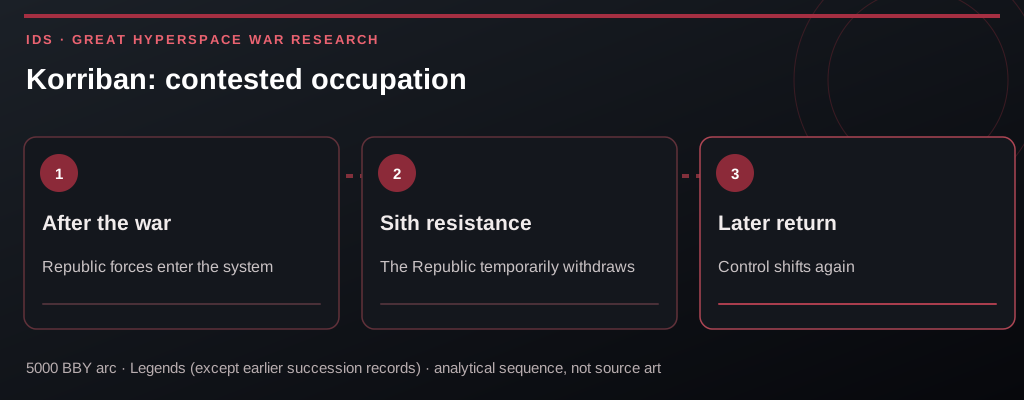
Evidence sequence: Korriban: contested occupation
What the original history supports
This action belongs to the later Republic counterinvasion, not to the battle between Sadow and Ludo Kressh on Korriban. Later sources differ on how early in the counterinvasion this temporary Republic retreat occurred. The article should preserve that uncertainty rather than assign a precise day.
Interpretation and evidence limit
The diagram distinguishes the reported changes of control without claiming a complete battle map or a definitive sequence among Nathema, the Horuset system, and neighboring worlds.
Sources and further reading
- The Old Republic: Revan.
- Postwar Battle of Korriban, Wookieepedia