
From Rekkiad, Revan and Malak traveled to Nathema. They found a world emptied of ordinary life and of the Force itself, the lingering result of Vitiate's ritual almost a thousand years earlier. Evidence there pointed them toward Dromund Kaas, capital of the hidden Sith Empire.
3960 BBY · Legends · Historical interpretation
NATHEMA · THE DEAD WORLD
Story evidence, dates and limitations
Revan and Malak followed the Rekkiad datacron to Nathema, a world devastated by Vitiate's ancient ritual. The later novel describes not only a lifeless surface but a terrifying absence in the Force, leading the pair to discover the truth about the Sith Emperor's earlier consolidation of power. The destruction was centuries old by 3960 BBY; the Jedi did not cause it simply by arriving. Nathema offered evidence pointing toward Dromund Kaas and the concealed imperial center.
Social history and consequences
The condition of a landscape can serve as testimony to an atrocity even when perpetrators control written accounts. Nathema is a fictional example of material absence as evidence: there are no ordinary living communities to interview, so the investigators reconstruct power from traces and contradictions. The case also requires attention to differences between archaeological interpretation and an exact contemporary witness account of Vitiate's ritual.
Research trail: The Old Republic: Revan; the Ritual of Nathema and Sith Emperor historical materials. Read chronological source references →. Original edition page citations remain to be checked. The event banner is original symbolic IDS art and is not an authentic screenshot.
A historical atrocity becomes evidence
The dead planet preserved the scale of Vitiate's power more clearly than a surviving archive could.
Revan and Malak encountered catastrophe as landscape.
Anthropological assessment
Nathema is an extreme example of landscape as testimony.
When communities and archives are destroyed, environmental absence itself can become historical evidence.
The Old Republic / connected history
A place where destruction became testimony
Nathema was the site of Vitiate's earlier ritual that had annihilated its inhabitants and produced the strange absence of the Force perceived by later visitors. Revan and Malak did not arrive to fight an occupying garrison. They came to examine a world whose condition pointed toward a power capable of destroying an entire society. The silence of Nathema served as evidence precisely because almost no ordinary life or functioning local political institution remained to speak for itself.
The encounter also illustrates the limits of description. The Force void is a fictional metaphysical condition depicted through the characters' experience. It should not be translated into ordinary physical measurements or invented biological effects. What the narrative supports is the extraordinary scale of the atrocity and the investigators' growing awareness that the hidden enemy was not simply another surviving Sith warlord. From Nathema they found the route toward Dromund Kaas.
An absent community is not an empty history
When a society is destroyed, the lack of buildings, records and living witnesses does not mean the past was insignificant. The landscape can carry the record of violence even when the people who once lived there cannot narrate it. Nathema's uncanny condition is a storytelling device through which the costs of one ruler's power become visible.
Investigating a perpetrator who is still in power
A ruined ancient world might normally be treated as an archaeological problem. Here the perpetrator still exercised authority elsewhere. Knowledge of the past therefore became urgent intelligence about a contemporary state. This is the link between the Nathema visit and the later infiltration of Kaas City.
Did Revan and Malak defeat Vitiate on Nathema?
No. Nathema revealed evidence of the Emperor's power; the subsequent attempt to reach him took place on Dromund Kaas.
Sources and dating: Drew Karpyshyn, The Old Republic: Revan. This is Legends, not current Canon. This account separates established plot from retrospective historical interpretation; no unshown conversations, casualties, or troop movements have been invented.
Source judgment · 3960 BBY
Test your historical interpretation
Choose your answers. The assessment shows corrections, a source-based explanation and a score.
3960 BBY · Legends · original-source analysis
Nathema · a world emptied by ritual
What the source establishes
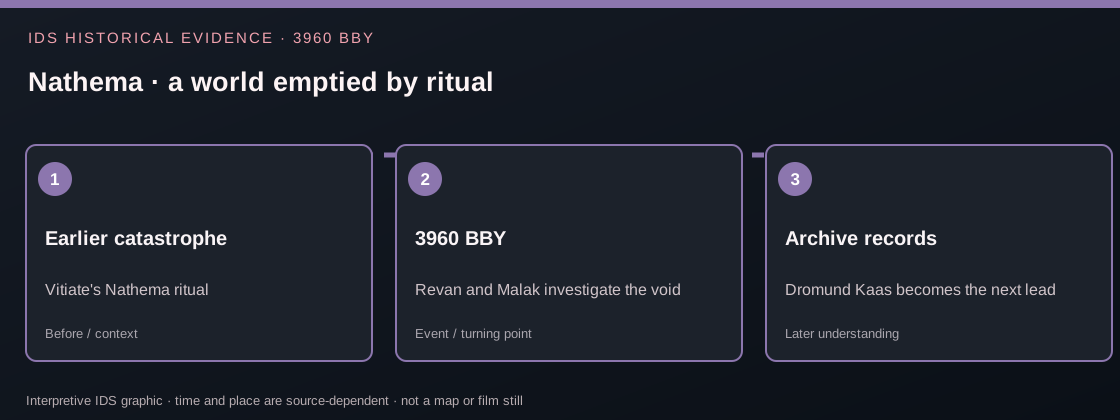
Revan and Malak came to Nathema after recovering intelligence on Rekkiad. They encountered a world devoid of ordinary life and of the Force presence they expected to perceive. Surviving records helped trace the atrocity to Vitiate and identify Dromund Kaas as the seat of a hidden Sith Empire.
Material culture and authority
A damaged or depopulated landscape can function as historical evidence when the records of its perpetrators are absent or concealed. The Force void in the novel is a fictional form of testimony to harm: it changes how Force-sensitive observers experience a place long after the deaths that caused it.
What the evidence does not resolve
The ritual had occurred centuries earlier, not in 3960 BBY. The article should distinguish the date the Jedi investigated Nathema from the date of its devastation, and should not invent a physical scientific mechanism for the Force void.
Test your historical reading: Did Revan and Malak witness the original Nathema ritual?
Explanation: No. They discovered its effects and surviving evidence much later.
Evidence trail: Drew Karpyshyn, The Old Republic: Revan (2011), Nathema investigations. Reference, notes and further bibliography →.
3960 BBY · Legends · Source-led history
Nathema: absence itself becomes evidence of mass destruction
Event documented in the narrative
In 3960 BBY, the datacron from Rekkiad guided Revan and Malak to Nathema. They encountered a dead world stripped not only of ordinary life but of the Force through a ritual performed by Vitiate centuries earlier. The abandoned society and surviving records revealed evidence about the Sith Emperor and directed their investigation toward Dromund Kaas. The novel presents Nathema as a landscape where destruction had exceeded the devastation of conventional war.
Institutions, culture, and power
Historical evidence need not consist entirely of written claims by rulers. A ruined physical environment can contradict an authority's effort to conceal violence. In the Nathema story, emptiness is especially significant because Force-sensitive investigators encounter the unnatural absence of an energy they normally expect to perceive. It is fictional evidence of an extraordinary ritual, not a real anthropological method of identifying atrocities. The vanished communities could not supply living testimony, so archives, architecture and remains acquired special importance. Nathema also reveals why a remote political center could remain unknown to the Republic long after its leader consolidated power.
Chronology and source limits
The event is dated through the later Revan novel, not through the 2003 game's playable mission sequence. The ritual preceded the visit by many centuries, and the visitors did not witness the original event.
Interpret the source: Did Revan and Malak witness Vitiate performing the ritual that devastated Nathema?
Answer and educational insight: No. They encountered the aftermath and reconstructed what had occurred from the ruined environment and surviving information.
Primary-source trail: The Old Republic: Revan; Ritual of Nathema historical accounts. Reference and bibliography ↗. Exact print pagination awaits reconciliation.
Sources and further reading
- Drew Karpyshyn, The Old Republic: Revan.