
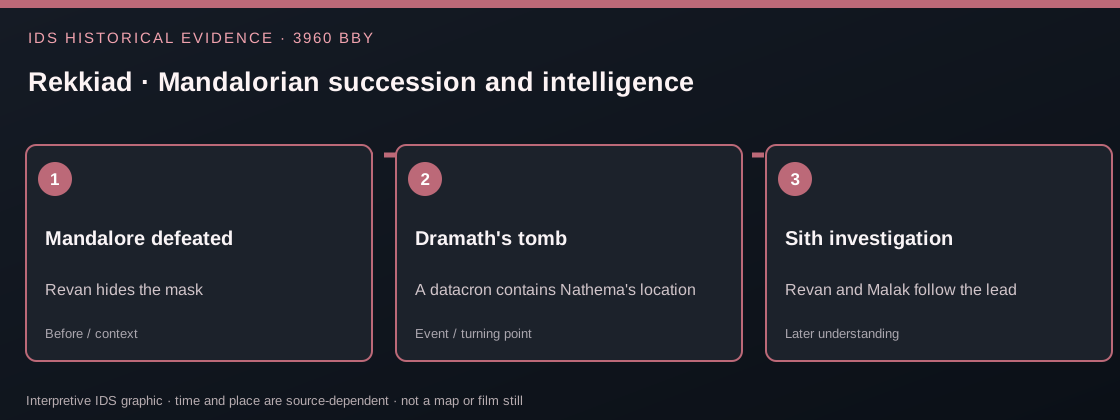
Revan and Malak followed Mandalore's evidence to the ice world Rekkiad, where they found the tomb of Dramath the Second, half-brother of the Sith Emperor. A datacron inside supplied coordinates to Nathema. Revan also hid Mandalore's Mask in the tomb, making it harder for the defeated clans to reunify under a new Mandalore.
3960 BBY · Legends · Historical interpretation
THE TOMB ON REKKIAD
Story evidence, dates and limitations
Revan and Malak pursued Mandalore's lead to Rekkiad. Inside the tomb of Dramath the Second they found a datacron that directed their search to Nathema. In the later Revan novel, the tomb also became the hiding place for Mandalore's Mask. It mattered because an ancient political family and an archaeological artifact preserved information about the unknown Sith Emperor. The Sith clues were not part of a normal Republic public archive.
Social history and consequences
The tomb illustrates the use of burial places and inherited objects as political and strategic archives. A relic meant to outlast its maker carried information powerful enough to redirect living commanders. Revan also used the sacred site to intervene in a different group's succession: by concealing Mandalore's mask, he frustrated the ability of the Mandalorians to reconstitute a recognized leader. The account therefore links archaeology, secrecy and competing institutions of legitimacy.
Research trail: The Old Republic: Revan (Drew Karpyshyn, 2011); Rekkiad and Dramath II reference entries. Read chronological source references →. Original edition page citations remain to be checked. The event banner is original symbolic IDS art and is not an authentic screenshot.
An ancient tomb becomes intelligence
The investigators used Sith funerary material as a map to a living hidden state.
Archaeology and military intelligence became the same activity.
Revan intervenes in Mandalorian succession
Hiding the mask deliberately disrupted the symbolic mechanism through which a new Mandalore might unite the clans.
Anthropological assessment
Rekkiad shows how control of heritage objects can become geopolitical strategy.
A symbol has political power only because communities agree that possession authorizes leadership.
The Old Republic / connected history
A tomb used as military intelligence
Revan and Malak followed the trail left by Mandalore to the frozen world Rekkiad. The tomb of Dramath the Second connected the Mandalorian leader's wartime knowledge to the family history of the Sith Emperor. Rather than functioning solely as a burial place, the site contained information that could direct visitors to Nathema. The same evidence had different meanings for different actors: a tomb for a long-dead member of the Emperor's family, a destination for Mandalore's encounter with Sith influence, and an intelligence lead for two investigators.
Revan also concealed Mandalore's Mask at the tomb. The choice was meant to make the defeated clans less able to reunite immediately under a recognized successor. This was a deliberate intervention in another society's leadership practice rather than simple collection of an object. The mask would return to the story years later when Revan helped Canderous Ordo find it and reconstruct Mandalorian authority in response to the larger Sith threat.
Who owns the past?
Burial objects and monuments can become strategically significant to people who were not part of the culture that produced them. The visitors sought actionable information in a tomb, while the mask represented a separate living community's authority. The episode joins two distinct questions: the ethics of accessing ancient remains and the political consequences of controlling a current leadership symbol.
A symbol can be hidden without losing its meaning
Revan could physically remove the mask from circulation, but the clans continued to remember the title of Mandalore. Its authority depended on collective recognition rather than magical control of every warrior. Absence made coordination difficult; it did not cause Mandalorian culture to disappear.
Was the mask originally a Sith relic found in Dramath's tomb?
No. It was Mandalore the Ultimate's leadership symbol, deliberately hidden there by Revan. The tomb's Sith datacron served a different investigative purpose.
Sources and dating: Drew Karpyshyn, The Old Republic: Revan. This is Legends, not current Canon. This account separates established plot from retrospective historical interpretation; no unshown conversations, casualties, or troop movements have been invented.
Source judgment · 3960 BBY
Test your historical interpretation
Choose your answers. The assessment shows corrections, a source-based explanation and a score.
3960 BBY · Legends · original-source analysis
Rekkiad · Mandalorian succession and intelligence
What the source establishes
After the Mandalorian Wars, Revan and Malak pursued information connecting the invasion to a hidden Sith power. On Rekkiad they reached the tomb of Dramath the Second. A datacron held information directing their search toward Nathema. Revan also used the tomb to conceal Mandalore's Mask so that possession of a symbol of Mandalorian legitimacy could not easily revive a unified war effort.
Material culture and authority
The same archaeological site held two kinds of political material: information about a forgotten Sith ruling family and an object central to Mandalorian leadership. The first was evidence in a threat investigation; the second could influence who claimed authority over dispersed clans.
What the evidence does not resolve
The 3960 BBY placement is reconstructed from the post-Malachor sequence in the novel. The tomb is not evidence that Dramath personally witnessed Revan's arrival, and the original account does not provide a fully mapped chamber plan.
Test your historical reading: Why is the mask's location a political fact, not merely a personal souvenir?
Explanation: Its possession was tied to recognition of Mandalore's authority among clans. Hiding it influenced succession and future coordination.
Evidence trail: Drew Karpyshyn, The Old Republic: Revan (2011), Revan's Rekkiad investigation. Reference, notes and further bibliography →.
3960 BBY · Legends · Source-led history
Rekkiad: a Sith tomb becomes an archive and a prison for political symbolism
Event documented in the narrative
After Mandalore the Ultimate died in 3960 BBY, Revan and Malak followed information he had provided to Rekkiad. They found the icebound tomb of Dramath the Second and retrieved a datacron pointing toward Nathema, one step in the investigation of a hidden Sith power. Revan also placed the Mask of Mandalore inside the tomb, depriving the defeated clans of a central object through which a successor could establish authority. The same tomb thus preserved Sith dynastic evidence and concealed a Mandalorian symbol of leadership.
Institutions, culture, and power
A burial site can function as an archive when artifacts survive longer than the institutions that created them. The datacron transmitted geographical and political knowledge across generations, enabling two living commanders to continue their search. Yet Revan's handling of the mask illustrates a different use of heritage: an outsider deliberately withheld a cultural object to fragment a defeated society's ability to reorganize. It is misleading to call the act neutral archaeology. Information was retrieved from one political tradition while an object was hidden from another, both decisions shaping future governance.
Chronology and source limits
Dramath the Second's relation to the Sith Emperor comes from later Old Republic fiction, not from a scene in the 2003 game. The mask's recovery by Canderous Ordo occurs later, in 3954 BBY.
Interpret the source: Did Revan discover the mask at Rekkiad for the first time?
Answer and educational insight: No. He hid Mandalore's already captured mask there, and others later recovered it.
Primary-source trail: Drew Karpyshyn, The Old Republic: Revan (2011); Rekkiad and Dramath II biographies. Reference and bibliography ↗. Exact print pagination awaits reconciliation.
Sources and further reading
- Drew Karpyshyn, The Old Republic: Revan.