
Mandalore's final words convinced Revan that the Mandalorian invasion had been encouraged by a hidden Sith power. Revan and Malak left the Republic's immediate postwar reconstruction and moved toward the Unknown Regions. Later accounts state that roughly a third of the Republic fleet followed their broader movement, while Revan and Malak themselves traveled to Rekkiad to verify Mandalore's story.
3960 BBY · Legends · Historical interpretation
THE HIDDEN SITH SEARCH
Story evidence, dates and limitations
The dying Mandalore's account convinced Revan that the Mandalorian invasion had been encouraged by an outside Sith power. Revan and Malak moved beyond immediate Republic reconstruction to investigate, following the clue toward Rekkiad. Later sources describe many forces remaining loyal to Revan after the war, but that should not be converted into a precise ship manifest for the two-person investigation. Their subsequent discoveries at Rekkiad, Nathema and Dromund Kaas occurred in sequence, rather than as one simultaneous expedition.
Social history and consequences
A commander whose personal followers have sustained him through war can draw loyalty beyond the state that formally commissioned him. Revan's private search illustrates the difficulty of distinguishing public military authority from the bonds created through battle and personal confidence. The initial investigation had a plausible security motive, but later Sith domination and Republic conflict revealed how independent authority could escape institutional oversight.
Research trail: The Old Republic: Revan; The Essential Guide to Warfare; postwar Revan biography. Read chronological source references →. Original edition page citations remain to be checked. The event banner is original symbolic IDS art and is not an authentic screenshot.
Victory opens a new security problem
Revan did not interpret Mandalore's confession as a closed wartime mystery.
He treated it as evidence of a larger enemy outside the Republic's known strategic map.
Personal loyalty follows Revan beyond the war
Troops and officers had become loyal to Revan through years of command.
That loyalty was increasingly attached to a person rather than to ordinary Republic institutions.
Anthropological assessment
The departure shows how charismatic wartime command can create organizations that survive the conflict they were built to fight.
When loyalty shifts from office to commander, demobilization becomes politically dangerous.
The Old Republic / connected history
The gap between wartime loyalty and Republican government
Revan and Malak's departure took place during the immediate aftermath of the Republic victory over the Mandalorians. Instead of remaining to participate in an ordinary process of reconstruction and demobilization, they pursued the possibility that the invasion had been manipulated by a hidden Sith enemy. The warning left by Mandalore the Ultimate pointed toward places and people beyond familiar Republic intelligence networks. Later Legends accounts associate the movement of a substantial body of fleet personnel with Revan, while distinguishing that larger political migration from the two Jedi's investigative route.
The precise disposition of every Republic vessel in the departure is not well established. The account is stronger where it follows Revan and Malak through Rekkiad, Nathema and Dromund Kaas. Their exit shows how victory can create a problem of loyalty: soldiers accustomed to obeying a successful commander may attach their identity to that person rather than to the institutions that commissioned the war. This dynamic matters for the later rise of Revan's Sith Empire, but it does not justify saying every departing soldier already knew its future direction.
The authority of an exceptional commander
Revan had earned influence through battlefield success. That charisma could mobilize action more quickly than Republic deliberation, but it also made decisions less accountable to established civilian authority. His disappearance left the Republic uncertain about the future of people and resources that had been committed to its defense.
A mission with an unverified premise
Mandalore supplied information about a hidden Sith power, but the visitors still needed evidence. Traveling to an ancient tomb and then a dead world was an investigation, not the pursuit of a publicly recognized enemy capital. The uncertainty should remain visible rather than be replaced by knowledge the characters obtained only later.
Did the departure itself prove that Revan and Malak were already ruling a new Sith Empire?
No. Their turn toward the Sith Empire and acquisition of the Star Forge belong to subsequent events. Their departure began as an investigation shaped by the warning at Malachor V.
Sources and dating: The Old Republic: Revan; Knights of the Old Republic II. This is Legends, not current Canon. This account separates established plot from retrospective historical interpretation; no unshown conversations, casualties, or troop movements have been invented.
Source judgment · 3960 BBY
Test your historical interpretation
Choose your answers. The assessment shows corrections, a source-based explanation and a score.
3960 BBY · Legends · original-source analysis
Republic aftermath · investigation beyond its reach
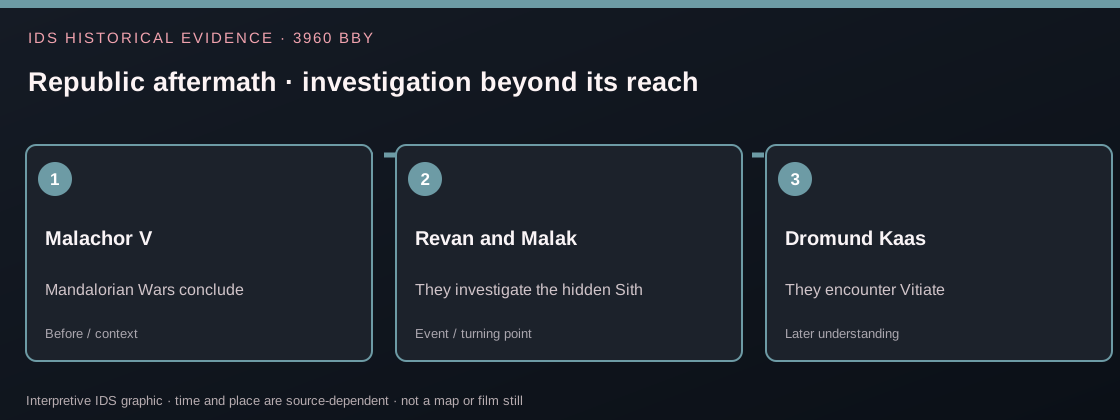
What the source establishes
After the Mandalorian Wars, information from the dying Mandalore the Ultimate convinced Revan that an outside Sith power had influenced the conflict. Revan and Malak departed from the Republic to investigate that threat, following leads through Rekkiad and Nathema before reaching Dromund Kaas.
Material culture and authority
War can produce commanders who operate with legitimacy among troops but little direct accountability to peacetime institutions. The distinction matters here: Revan's search was an attempt to understand an external threat, yet it placed two influential Jedi beyond the Republic's regular oversight.
What the evidence does not resolve
This initial journey in 3960 BBY should not be confused with Revan's later, separate departure in 3954 BBY after the Jedi Civil War. The novel supplies the retrospective sequence, while KOTOR and its sequel depict later consequences.
Test your historical reading: Did Revan leave Bastila Shan for the same investigation in 3960 BBY?
Explanation: No. That departure belongs to his later 3954 BBY journey. This entry concerns Revan and Malak immediately after the Mandalorian Wars.
Evidence trail: Drew Karpyshyn, The Old Republic: Revan (2011); Knights of the Old Republic II (2004). Reference, notes and further bibliography →.
3960 BBY · Legends · Source-led history
The search for an unseen enemy drains a victorious Republic army
Event documented in the narrative
After Malachor V in 3960 BBY, the dying Mandalore the Ultimate told Revan that an unseen Sith power had encouraged the Mandalorians' invasion. Revan and Malak took the warning seriously and led followers beyond the Republic's familiar sphere toward the frigid world Rekkiad. Later sources describe a sizable contingent of veterans and ships staying loyal to them during the investigation. The mission began as a purported security search for the architects of the preceding war, not as an openly declared Sith invasion of the Republic.
Institutions, culture, and power
A victorious commander's authority may outlive the emergency that originally justified it. Soldiers who had fought under Revan could understand loyalty as owed to the person who secured victory instead of exclusively to the Republic's civilian institutions. Leaving with war-trained followers created a political problem even before anyone openly proclaimed a new Sith state. The Republic could lose skilled personnel and warships at the very moment when damaged systems needed security and reconstruction. The episode illustrates how wartime trust and public command can become separate bases of power.
Chronology and source limits
The quantity of fleet units accompanying Revan varies by source and should not be turned into a verified census. This 3960 departure is also distinct from his second search in 3954 BBY after the Jedi Civil War.
Interpret the source: Was this the same departure as Revan leaving Bastila Shan in 3954 BBY?
Answer and educational insight: No. The 3960 journey followed the Mandalorian Wars with Malak; the later mission occurred after Revan had recovered some memories.
Primary-source trail: The Old Republic: Revan (2011); The Essential Guide to Warfare. Reference and bibliography ↗. Exact print pagination awaits reconciliation.
Sources and further reading
- Drew Karpyshyn, The Old Republic: Revan.
- Knights of the Old Republic II: The Sith Lords.