
After Malachor V, Meetra Surik returned to face the Jedi Council. She had already severed herself from the Force in order to survive the psychic shock of the battle. The Council judged her actions during the war and exiled her from the Order. Meetra surrendered her lightsaber and left known Jedi society.
3960 BBY · Legends · Historical interpretation
MEETRA SURIK · EXILE
Story evidence, dates and limitations
After Malachor V, Meetra Surik returned to face the Jedi Council. She had survived the Force shock at the battlefield by severing herself from the Force, although she initially did not understand what had happened to her. She surrendered her lightsaber and was exiled after the Council judged her wartime role. Her earlier choice to fight against the Council's counsel and the Council's later disciplinary decision are separate episodes, as is the actual psychic separation she experienced at Malachor.
Social history and consequences
A disciplinary ritual can formalize a separation that has already taken place socially or spiritually. The Council judged Surik through an institutional frame of duty and Force orthodoxy, while the consequences of the Mass Shadow Generator affected her as a survivor. The account presents disagreement over responsibility and loss, not a simple scene in which the Council itself first switched off Surik's powers. The decision also illustrates how returning to submit to judgment differed from the paths taken by other interventionist Jedi.
Research trail: Knights of the Old Republic II – The Sith Lords, Jedi Council and companion dialogue. Read chronological source references →. Original edition page citations remain to be checked. The event banner is original symbolic IDS art and is not an authentic screenshot.
She returns when most followers do not
Meetra chose institutional judgment rather than following Revan into the Unknown Regions.
That decision separated her path from the military movement she had served.
Exile formalizes an existing rupture
Meetra could no longer feel the Force in the ordinary Jedi sense before the Council pronounced sentence.
The judgment gave institutional form to a break that Malachor had already created.
Anthropological assessment
The trial shows how institutions attempt to reassert authority after members exercise extraordinary wartime autonomy.
Exile can function as punishment, boundary maintenance, and an admission that the institution no longer knows how to incorporate a transformed member.
The Old Republic / connected history
An exile imposed after the damage had already occurred
Meetra Surik's return to the Jedi Council was unusual because most of the Jedi who followed Revan did not voluntarily submit themselves to institutional judgment after Malachor V. She carried the consequences of the Mass Shadow Generator and the deaths it caused. Her severance from the Force had happened during the battle, before the Council could assign a punishment. The Masters nevertheless framed their judgment around her participation in a war the Council had refused to endorse, and she surrendered her lightsaber.
The later revelations in The Sith Lords make the tribunal more complicated than a simple punishment story. The Masters also feared the unusual condition that had allowed Meetra to survive a wound in the Force. Their explanation of that fear was incomplete at the time of exile. For Meetra, institutional authority therefore arrived after the traumatic event and failed to provide an adequate account of what she had experienced. The official judgment and her private reality diverged.
Institutional boundaries after a crisis
The Jedi Council had tried to limit participation in the Mandalorian Wars. The return of a famous veteran challenged the idea that the Order's authority had remained uncontested. Exile publicly reasserted a boundary between those who followed the Council and those who took their own wartime path.
The meaning of surrendering a lightsaber
The physical object represented membership, training and a moral vocation. Handing it over marked a formal break with the Order, but it did not erase what Meetra had done, learned or become. A symbol of expulsion cannot undo the underlying institutional and personal conflict.
Did the Council itself cause Meetra to lose her connection to the Force?
No. The game later establishes that Meetra severed her connection during the catastrophe at Malachor V. The Council formalized her exile afterward.
Sources and dating: Knights of the Old Republic II: The Sith Lords, Council trial and Dantooine revelations. This is Legends, not current Canon. This account separates established plot from retrospective historical interpretation; no unshown conversations, casualties, or troop movements have been invented.
Source judgment · 3960 BBY
Test your historical interpretation
Choose your answers. The assessment shows corrections, a source-based explanation and a score.
Legends · 3960 BBY · Primary story and historical judgment
Meetra's Jedi trial
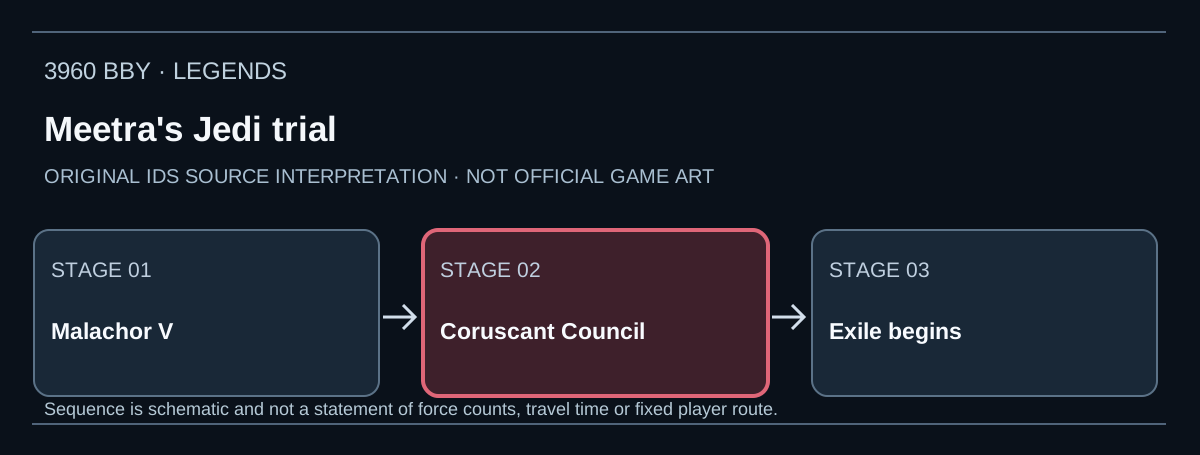
Returning was itself a political choice
After the Mandalorian Wars, Meetra Surik returned to face the Jedi Council rather than follow Revan and the other veterans deeper into galactic conflict. The meeting on Coruscant is recalled through KOTOR II dialogue and the reconstructed trial. The Masters opposed her decision to participate in the war and judged its consequences. Their sanction was not the cause of the Mass Shadow Generator's devastation. For Meetra, the severance from the Force was already part of surviving the deaths at Malachor. This distinction matters because a disciplinary verdict is not equivalent to the medical or metaphysical origin of a condition.
What the lightsaber represented
Meetra's surrender of her lightsaber was an institutional gesture marking expulsion from the Order she once served. A lightsaber is both a practical weapon and a recognized badge of Jedi training; relinquishing it signaled a change in standing. The Council's decision did not erase her experiences as a commander, personal relationships with surviving soldiers, or the memories of the battle. Exile was a legal-social status imposed after the larger moral rupture had occurred.
A later game supplies a contested memory
KOTOR II presents the judgment through fragments of dialogue and memories colored by the participants' arguments. It does not make every interpretation of the Council's motives equally established. Some Masters feared what they did not understand about Meetra, and their later recognition of her unusual state must not be projected back as if all of it were known in 3960 BBY. The article's date is Legends chronology, not a date shown in the official game's promotional synopsis.
Test your historical judgment: Did the Council's exile itself cause Meetra's original loss of connection to the Force?
Analysis: No. The psychic catastrophe at Malachor V and Meetra's self-protective severance preceded the Council's formal judgment. The exile made an existing rupture into a public institutional sanction.
Publication basis: Lucasfilm's KOTOR II retrospective. Official overviews identify the title, branching structure and larger conflict, not a transcript of every optional mission. Related chronology →
Sources and further reading
- Knights of the Old Republic II: The Sith Lords.