
- Date
- 3960 BBY
- World
- Malachor V
- Republic leaders
- Revan, Meetra Surik
- Mandalorian leader
- Mandalore the Ultimate
- Outcome
- Pyrrhic Republic victory
Historical narrative and evidence
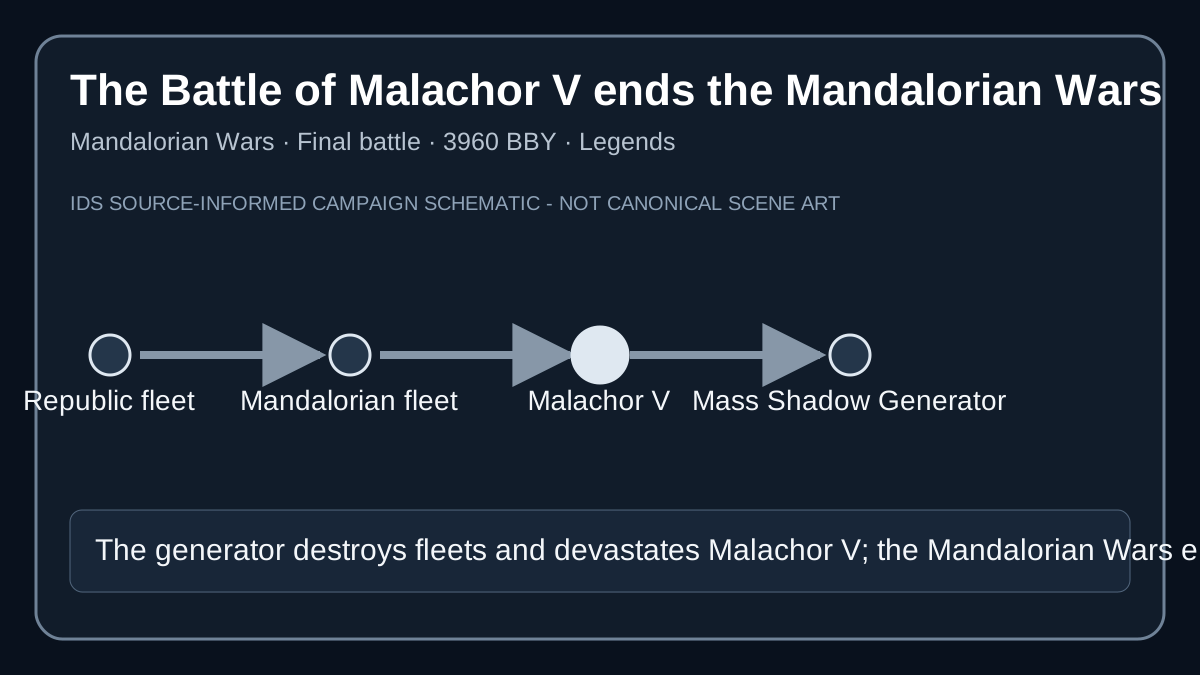
The Battle of Malachor V was the catastrophic final battle of the Mandalorian Wars in 3960 BBY. Revan drew the Mandalorians into a confrontation around a world already associated with the dark side. The Republic committed a huge fleet. Mandalore the Ultimate answered with Mandalorian forces on a similar scale. Revan's plan contained a hidden weapon: the Mass Shadow Generator, designed by the Zabrak engineer Bao-Dur and placed under the authority of General Meetra Surik.
3960 BBY · Legends · Source analysis
MALACHOR V: source and society
Historical evidence and chronology
In the final Mandalorian battle, Revan drew Mandalore the Ultimate's forces toward Malachor V with a Republic fleet arranged around a concealed gravity-based superweapon. Revan defeated Mandalore in single combat; Bao-Dur had designed the Mass Shadow Generator. In Knights of the Old Republic II, Meetra Surik commands the activation by signaling Bao-Dur. Some subsequent accounts instead attribute the final activation to Revan. The weapon devastated both fleets and fractured the planet. The source disagreement is editorially material, not a minor naming error.
Institutions, people and material consequences
Military triumph was inseparable from massive death, the loss of Republic personnel and enduring spiritual trauma. Surik's survival as a wound in the Force and the later Jedi Council confrontation show that a battlefield victory is not an ethical verdict. The weapon also made the world itself a site of remembrance and dread. The battle is therefore both military history and an account of the profound consequences of concentrating decision-making authority in a war-ending device.
Research trail: Knights of the Old Republic II – The Sith Lords; Star Wars: Revan; The Essential Guide to Warfare; Malachor V source contradictions. Further source and chronology notes →. IDS interpretations are editorial analysis. The locally hosted illustration is original conceptual art, not a comic scan or an exact battlefield photograph.
Revan designed a battle that the Mandalorians could not afford to ignore
By 3960 BBY, Revan had reversed much of the Mandalorian momentum. Malachor V offered a chance to end the war in one confrontation. The Republic force that entered the system appeared damaged and vulnerable enough to invite attack, drawing Mandalorian ships into the gravity well where the hidden weapon could be used.
The plan was strategically ruthless. Victory depended on concentrating enemy forces, but Republic ships and soldiers were also inside the kill zone. Revan accepted that risk because destroying the Mandalorian military in a single blow promised an end to years of war.
Revan defeats Mandalore the Ultimate
During the battle, Revan confronted Mandalore the Ultimate and killed him. Revan took Mandalore's mask, depriving the clans of the symbol needed to recognize a successor. According to later accounts, Revan also learned that an external Sith power had pushed the Mandalorians toward war.
The duel therefore had consequences beyond the death of one commander. It broke the political center of Mandalorian leadership at the same moment that the fleet was about to be destroyed.
Meetra Surik activates the Mass Shadow Generator
At the decisive moment, Meetra ordered Bao-Dur's Mass Shadow Generator activated. The device manipulated Malachor V's gravity on a catastrophic scale. Ships from both sides were pulled toward the planet and crushed. The surface was devastated, and thousands of combatants died.
The weapon ended the battle and effectively ended the Mandalorian Wars. It also created consequences that could not be contained by military victory. Malachor became a graveyard world, the remaining Mandalorian forces fragmented, and Meetra experienced the deaths around her with such intensity that she severed herself from the Force.
The victory becomes a wound in the Force
KOTOR II treats Malachor as more than a battlefield. The mass death created a wound in the Force, and Meetra's survival became central to the later conflict involving Kreia, Darth Nihilus, and Darth Sion. The end of one war therefore generated the conditions for another.
This is one of the clearest examples in Star Wars Legends of consequences moving across conflicts. Malachor does not remain in 3960 BBY. Its trauma reorganizes identities, teachings, and political choices for years afterward.
Battle sequence
The force appears vulnerable enough to draw the Mandalorians in.
Hundreds of ships converge around Malachor V.
The clans lose their leader and symbolic center.
Bao-Dur's Mass Shadow Generator is activated.
Republic and Mandalorian ships are destroyed together.
The Republic wins, but the battlefield creates lasting political and Force consequences.
Anthropological assessment
Malachor V is a study in how institutions justify catastrophic violence through emergency logic. Revan's strategy treated extraordinary destruction as acceptable because leaders believed only decisive victory could end the war. That reasoning appears repeatedly in real and fictional wartime institutions: the expected future cost of continued conflict is used to authorize extreme action in the present.
The battle also demonstrates how symbols and technology can dismantle a social order at the same time. Mandalore's death and lost mask disrupted political succession, while the Mass Shadow Generator destroyed the military force that might have held the clans together. The Republic did not merely win a battle. It shattered the organizational basis of its opponent. Yet the psychological and spiritual consequences show that violence on that scale also transforms the victors.
Evidence check
What is firmly established?
The date or date range, location, continuity, broad combatants, outcome, and campaign placement are retained only where the cited Legends sources support them.
What has IDS deliberately not invented?
Unnamed commanders, exact force sizes, casualty totals, dialogue, tactical phases, and civilian experiences are omitted whenever the surviving sources do not establish them.
Why use a schematic instead of borrowed battle art?
For events without a verified source-specific illustration, this page uses an original labeled reconstruction rather than presenting unrelated comic or game art as though it depicts the battle.
Historical judgment · 3960 BBY
Interpret the source evidence
Choose an answer to each question. The assessment explains the correct answer and any error, rather than only displaying a score.
3960 BBY · Legends · Late-war source audit
Malachor V in 3960: military victory and a moral catastrophe
What the chronology establishes
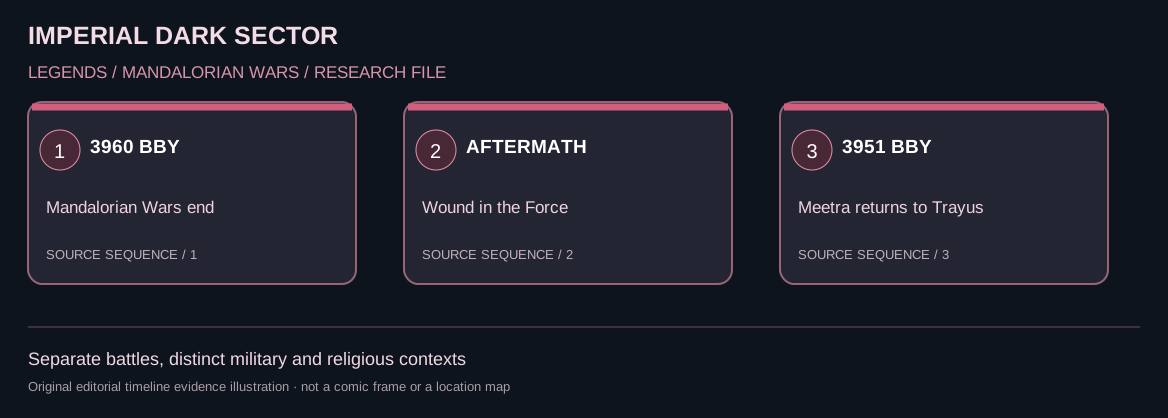
Revan drew the Mandalorian fleet into a final battle at Malachor V in 3960 BBY, defeated Mandalore the Ultimate and deprived the clans of their leader. Bao-Dur had designed the Mass Shadow Generator, a gravity-based superweapon. Meetra Surik activated it during the climactic battle, causing devastating losses among both Mandalorian and Republic forces and tearing apart the planet's surface. The battle concluded the Mandalorian Wars, although the damage to survivors and the Force continued long afterward.
Anthropological analysis
The Mass Shadow Generator turned a technical system into an instrument of political decision. Its activation concentrated responsibility for a war-ending result while distributing the losses across individuals who could not choose the timing or consequences. A pyrrhic victory can be militarily decisive without serving as ethical vindication. For Meetra, the catastrophe contributed to her severance from the Force and the history remembered by later generations of Jedi and Sith. The physical ruins of Malachor also became part of later spiritual and institutional conflicts rather than an empty backdrop.
Limits and dating
The war-ending Battle of Malachor V occurred in 3960 BBY. Meetra's later return to the Trayus Academy and final confrontation with Kreia belongs to 3951 BBY. Those separate events must not be silently merged.
Test your historical interpretation: Did the 3951 BBY Trayus Academy conflict end the Mandalorian Wars?
Explanation and correction: No. The Mandalorian Wars ended at Malachor V in 3960 BBY, nine years earlier.
Source: Knights of the Old Republic II: The Sith Lords; The Essential Guide to Warfare. Explore original-source leads ↗. Printed-page checks are pending.
Sources and further reading
- Star Wars: Knights of the Old Republic II: The Sith Lords (LucasArts/Obsidian, 2004), relevant dialogue, field records, and Mandalorian Wars material.
- The Essential Atlas, Daniel Wallace and Jason Fry (2009), Mandalorian Wars chronology and campaign mapping.
- The Essential Guide to Warfare, Jason Fry (2012), where applicable to later in-universe military-historical accounts.
Evidence limits: Linked publisher or Lucasfilm records identify the source editions. The map and dates in a battle reconstruction require the original book and game evidence, not the catalog synopsis; the diagram above is an IDS interpretation, not an original battle still.