
In 3959 BBY, Darth Revan and Darth Malak returned to Republic space at the head of a powerful new Sith military. The Star Forge supplied ships, droids, weapons, and matériel at a rate the Republic struggled to match. Revan established a Sith state centered on the war effort, took control of Korriban, and revitalized the Sith Academy there. The Jedi Civil War had begun.
3959 BBY · Legends · Evidence review
THE JEDI CIVIL WAR
Documented history and chronological boundaries
Revan and Malak returned in 3959 BBY with a Sith military sustained by the Star Forge. Revan's forces combined veterans of the Mandalorian conflict with defecting Jedi, ships and a Sith hierarchy strengthened on Korriban. The confrontation was not another Mandalorian campaign: the former Republic commander now led a rival state claiming galactic authority. The first major attack at Foerost is usually used to mark the opening of the Jedi Civil War.
People, political institutions and material life
The conflict demonstrates how a wartime network can become a competing political institution. Service under a charismatic commander and access to an immense manufacturing facility helped build a new coercive state. Korriban supplied training and symbolic continuity with older Sith traditions, while the Star Forge supplied ships and weapons. The episode is best interpreted as the construction of rival sovereignty, not a spontaneous change of opinion by every veteran.
Source trail: The 2003 Knights of the Old Republic game; Knights of the Old Republic Campaign Guide; Jedi Civil War summary. Explore source and bibliography →. The original conceptual banner is not documentary or game footage. Dialogue and print-page-level citations remain subject to primary-source checking.
A Republic war machine becomes a rival state
Many soldiers and officers who had served under Revan during the Mandalorian Wars followed him into the new conflict.
The Sith invasion therefore grew partly from institutions and personal loyalties created inside the Republic's own emergency mobilization.
The Star Forge changes the economics of war
The Rakatan station allowed Revan to replace losses and expand military capacity at extraordinary speed.
Republic leaders faced an enemy whose material supply seemed almost inexhaustible.
Korriban becomes a training center again
The Sith Academy recruited and trained Force-sensitive followers for the new empire.
Ancient Sith geography was reactivated for a modern political movement.
Anthropological assessment
The opening of the Jedi Civil War shows how wartime organizations can detach from the state that created them.
Revan's new regime combined personal military loyalty, ancient ideological symbols, and inherited supertechnology into a rival political order.
From a Republic emergency army to a rival order
The Jedi Civil War grew from a political and military transformation rather than an unrelated invasion. Revan and Malak had developed reputations during the Mandalorian Wars by acting when the Jedi Council refused to intervene directly. Their command networks consisted partly of people who had fought together under Republic authority. After the Mandalorian defeat, that shared history provided a basis for another military coalition, this time directed against the government many of its members had once defended.
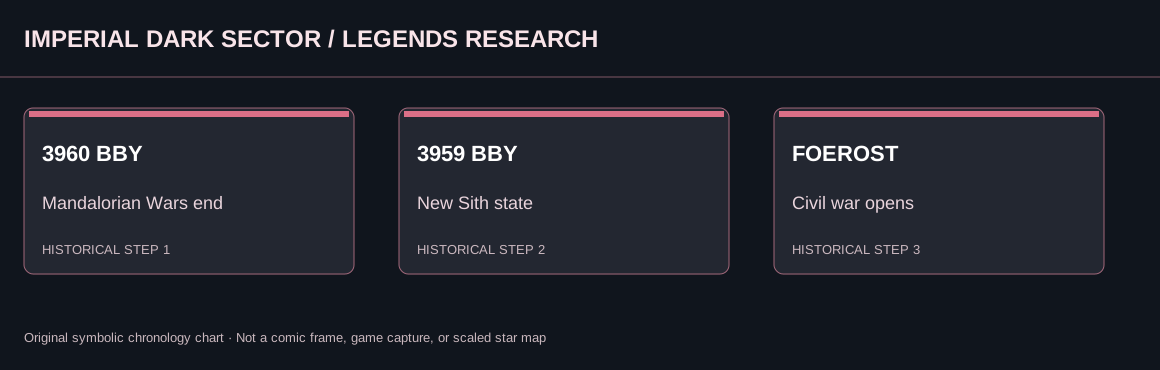
This is a crucial continuity point. The end of the Mandalorian Wars in 3960 BBY did not restore the Republic to a stable prewar condition. Institutions had been strained, casualties had accumulated, and Revan's authority over veterans had already become exceptional. When Revan returned with a Sith fleet in 3959 BBY, the Republic faced not merely a foreign enemy but a former commander whose followers understood its military organization.
Production changes the balance of power
The Star Forge enabled an extraordinary flow of ships, weapons and droids. That technological capacity supported the new Sith Empire's ability to fight a prolonged campaign. Revan's fleet did not have to rely solely on seizing and holding ordinary Republic shipyards, although those targets remained valuable. Foerost's importance becomes clearer when read alongside the Forge: control of manufacturing capacity and access to naval infrastructure were central to both sides.
The old Sith traditions enter a new conflict
Korriban served as a training center and source of historical legitimacy. Ancient Sith ruins and an academy helped the new regime present itself as the continuation of older traditions while pursuing present-day military goals. The name and symbols of the Sith supplied ideological depth; fleets and officers supplied immediate coercive power. Their combination gave the movement a political identity that extended beyond loyalty to Revan alone.
Dating the opening of the war
Reference chronologies commonly use the Battle of Foerost in 3959 BBY to mark the beginning of open conflict. The preceding discovery of the Star Forge and the decision to build a Sith military belong to the 3960 BBY transition. These phases can be connected without claiming that a single documented declaration began every part of the war at the same moment.
Anthropological extension: institutions and defection
A political institution can lose personnel without immediately losing its buildings or laws. Revan's secession demonstrates how group loyalties formed under emergency command can endure after the original mission is finished. Military experience, personal reputation, shared hardship and access to technology gave former Republic personnel reasons to follow a commander into a new political order. The Jedi Civil War was therefore also a conflict over which authority could legitimately command the people and resources once mobilized in the Republic's name.
Check the historical evidence
Which parts belong to established Legends continuity?
The event and its outcome are recorded in the cited original game or official reference material. When an RPG offers branching dialogue or endings, this article identifies the outcome used in the subsequent Legends chronology.
What does the illustration show?
The diagram is an original IDS sequence summary. It does not depict a screenshot, official character likeness, ship design or exact map coordinates. Verifying a suitable event-specific publisher illustration is a separate editorial task.
Interactive evidence test · 3959 BBY
Test your historical judgment
Answer both questions for corrections, documentary context and a score. You can revise answers and try again.
Legends · historical source review
The former Republic commander returns as a Sith
Revan and Malak return from the Unknown Regions as Sith Lords commanding forces formerly connected with the Republic. BioWare's historical account links their journey to the hidden Sith Empire of Vitiate on Dromund Kaas and then to the search for Rakatan Star Maps. The Star Forge eventually supplies Revan's power with an extraordinary industrial advantage. The name Jedi Civil War emphasizes the involvement of former Jedi fighting one another, but this is also a major Republic-Sith military conflict.
The episode challenges the idea that institutional labels predict a person's lifelong allegiance. Former defenders of the Republic may turn against it, taking knowledge of its military systems with them. Yet the record distinguishes a changed leadership from the loyalties of individual sailors and civilians, who should not all be assigned the same motives. The war begins after the Mandalorian defeat, and it later changes leadership when Malak betrays Revan. The two conflicts have linked protagonists but different immediate strategic goals.
Historical judgment: The Jedi Civil War is not a continuation of the Mandalorian campaign under another name. Publisher's related original account →. The analysis of political institutions is IDS interpretation, not game dialogue. Day-level event dates and player-defined decisions are not asserted.
Legends · Early Jedi Civil War source audit
3959 BBY: Republic veterans become the personnel of a rival Sith state
What the sources document
After the 3960 BBY end of the Mandalorian Wars and the search beyond known Republic space, Revan and Malak returned openly as Darth Revan and Darth Malak. Their new Sith regime drew on the Star Forge's industrial output, experienced Republic veterans who followed Revan, defectors from the Jedi and the revived Sith Academy on Korriban. The assault on the Foerost shipyards is conventionally treated as the 3959 BBY opening battle of the Jedi Civil War. The new conflict pitted a former Republic commander and many of his former comrades against institutions they had recently defended together.
Anthropological and political assessment
The transition from war hero to political opponent shows how military solidarity can be redirected. Soldiers followed the relationships and commanders created during the Mandalorian struggle, even as the central purpose of the organization changed. The Sith state sought legitimacy through a new governing ideology, through recognizable Sith sites such as Korriban and through the material ability to arm huge fleets. Meanwhile many Republic families and political institutions experienced the return of former defenders as betrayal. The label civil war is therefore appropriate: personnel and authority were being contested inside a previously shared political system, not only by an unrelated external invasion.
Source limitations
The Jedi Civil War lasted from 3959 to 3956 BBY in established Legends chronology. It is distinct from the 3976–3960 BBY Mandalorian Wars and the later Sith Civil War that followed Malak's defeat.
Check your historical judgment: Did Revan's Sith invasion take place while the Mandalorian Wars were still being fought in 3960 BBY?
Correction and insight: No. The Mandalorian Wars ended at Malachor V in 3960 BBY. The Jedi Civil War opened in 3959 BBY.
Sources: Knights of the Old Republic (2003); Knights of the Old Republic Campaign Guide; The Essential Atlas. Reference bibliography ↗. Original print/game scene citations remain under verification.
Sources and further reading
- Lucasfilm: Knights of the Old Republic (official product overview; game scenes supply event details).
- Star Wars: Knights of the Old Republic.
- Knights of the Old Republic Campaign Guide.
- Star Wars: The Old Republic, Timeline 8: “The Jedi Civil War.”