
After Lillia Venn's death and Candra Kitai's brief succession, the political structure built by Yaru Korsin and Nida Korsin finally collapsed. Red and Gold factions fought, split, and multiplied. Over the following centuries, conflict destroyed cities, infrastructure, and population until the Lost Tribe was reduced to a few thousand people. Later history called this long period the Time of the Rot.
3960 BBY · Legends · Historical interpretation
THE TIME OF THE ROT
Story evidence, dates and limitations
After Lillia Venn's death and Candra Kitai's brief reign, Red and Gold factional competition broke into additional armed political movements on Kesh. Later Lost Tribe histories named the long phase of destruction and decline the Time of the Rot. Over successive generations, war harmed settlements, infrastructure and population. This should not be described as one battle that instantly killed most inhabitants in 3960 BBY; 3960 marks the beginning of a much longer process.
Social history and consequences
This case illustrates how failures of succession and shared rules for distributing power can produce cumulative institutional erosion. Conflict can alter the material built environment as well as offices and titles: maintenance, settlement, communication and the preservation of archives become harder as fighting continues. Unlike the Republic–Mandalorian war, this struggle unfolded among the isolated Sith Tribe and affected Keshiri lives in distinct ways. That separation is essential to reconstructing a plural galactic history.
Research trail: Lost Tribe of the Sith: Sentinel; Fate of the Jedi references; Time of the Rot history. Read chronological source references →. Original edition page citations remain to be checked. The event banner is original symbolic IDS art and is not an authentic screenshot.
A succession crisis becomes a millennium of fragmentation
The Tribe's institutions had long depended on channeling elite ambition through accepted rules.
Once those rules lost legitimacy, faction formation became self-reinforcing.
Political conflict becomes demographic collapse
Centuries of fighting degraded infrastructure and sharply reduced the population.
A struggle among elites eventually threatened the survival of the society itself.
Anthropological assessment
The Time of the Rot demonstrates institutional path dependence in reverse.
Once mechanisms for peaceful succession fail, each cycle of violence can destroy the resources and trust needed to rebuild them.
Source judgment · 3960 BBY
Test your historical interpretation
Choose your answers. The assessment shows corrections, a source-based explanation and a score.
The beginning of the Time of the Rot: evidence, society and consequences
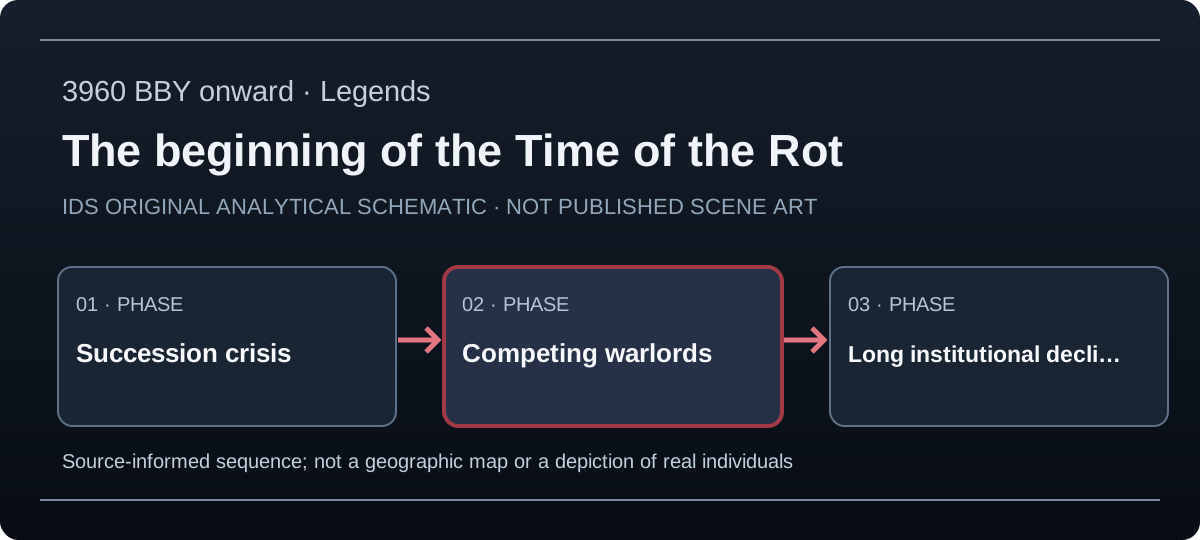
Collapse unfolds over centuries, not one night
Venn's death and Candra Kitai's brief tenure began an unstable period in Lost Tribe history, but the Time of the Rot was not an individual battle in 3960 BBY. Rival Sith factions broke into splinter movements and fought repeatedly. Over generations their conflicts weakened settlements, political offices and the mechanisms needed to maintain the built environment. Later episodes in John Jackson Miller's Lost Tribe cycle look back at this long decline rather than supplying a continuous eyewitness chronicle of every year.
The material cost of successive struggles
Political instability can damage a society even when no single conflict decides its fate. Roads, marketplaces, archives, residences and institutions of training depend on predictable labor and relative security. Repeated campaigns interrupt those systems. The result in the Lost Tribe was remembered as a decrease in population, the deterioration of settlements and a contraction of political capacity. Claims about an exact death toll or the destruction of any one building should not be invented without a more specific passage.
The Keshiri perspective remains distinct
The faction names chiefly identify the rival Sith governing elite. They should not be used as a shorthand for the beliefs or actions of every Keshiri person living under that order. Descendants of the stranded Sith had earlier claimed religious authority as the Protectors and ruled through forced hierarchies. A prolonged crisis among their leaders did not necessarily make the subject population politically free. The story's lack of detailed testimony from many Keshiri communities is a source limitation worth retaining.
A later ending changes how the period is remembered
By around 3000 BBY the isolated polity had suffered generations of dislocation before efforts at renewed unity emerged. The eventual search for Alanciar and the ambitions of leaders such as Varner Hilts belong to a later chapter, not the moment the crisis began. The historian's task is to separate trigger, long process and retrospective label. This is why the date on this article marks the beginning of the Time of the Rot, not its complete chronology.
Historical judgment: Is it accurate to place every consequence of the Time of the Rot in 3960 BBY?
Analysis: No. That date marks the crisis's opening, while later stories describe cumulative political and demographic consequences across many generations.
Original publication trail: Random House Worlds: Lost Tribe of the Sith collected stories →. The publisher verifies the collected edition and its historical scope. Individual scenes require the Purgatory, Sentinel, Pantheon or Secrets text; the catalog paragraph does not document every detail. The full galactic timeline →
Sources and further reading
- John Jackson Miller, Lost Tribe of the Sith: The Collected Stories, Random House Worlds (2012); the anthology includes the original eBook sequence. Individual scene claims refer to the named installment below.
- John Jackson Miller, Lost Tribe of the Sith: Pantheon.
- John Jackson Miller, Lost Tribe of the Sith: Secrets.