
Far from the Mandalorian Wars, the Lost Tribe of Sith on Kesh experienced a political deadlock. Rival Red and Gold factions could not agree on a new Grand Lord. They selected the elderly Lillia Venn as a compromise candidate because each side believed she would be weak and short-lived. Candra Kitai took Venn's former place on the Circle of Lords and became the crucial tiebreaker in the succession struggle.
3961 BBY · Legends · Historical interpretation
LILLIA VENN ELECTED
Story evidence, dates and limitations
On Kesh in 3961 BBY, the Lost Tribe of Sith's rival Red and Gold political factions were unable to agree on a new Grand Lord. They selected the elderly Lillia Venn as a compromise, believing she could be controlled or would soon die. Candra Kitai replaced her on the Circle of Lords, becoming a potentially pivotal vote. The original *Lost Tribe of the Sith* episodes place this succession crisis on Kesh, separate from the Republic's Mandalorian Wars.
Social history and consequences
An ostensibly weak compromise leader can acquire power through procedures intended to limit confrontation. Venn's age and position initially reassured rival elites, but the allocation of council seats and swing votes created opportunities for new coalitions. The case shows that political rituals can redistribute authority even where everyone expects continuity. The Red and Gold colors marked organized factions, not a universal binary dividing all Keshiri communities.
Research trail: John Jackson Miller, Lost Tribe of the Sith: Purgatory (2010); Kesh leadership chronology. Read chronological source references →. Original edition page citations remain to be checked. The event banner is original symbolic IDS art and is not an authentic screenshot.
A compromise candidate becomes ruler
Faction leaders selected Venn because they expected to manipulate the transition after her death.
Her age became a political calculation rather than merely a personal fact.
Candra becomes the pivotal vote
Candra's refusal to join either faction made her politically powerful.
Institutional rules turned neutrality into leverage.
Anthropological assessment
Venn's election shows how factional deadlock can elevate a candidate precisely because rivals underestimate her.
It also demonstrates how formal voting rules can make one seemingly neutral office decisive in succession politics.
Source judgment · 3961 BBY
Test your historical interpretation
Choose your answers. The assessment shows corrections, a source-based explanation and a score.
Lillia Venn chosen on Kesh: evidence, society and consequences
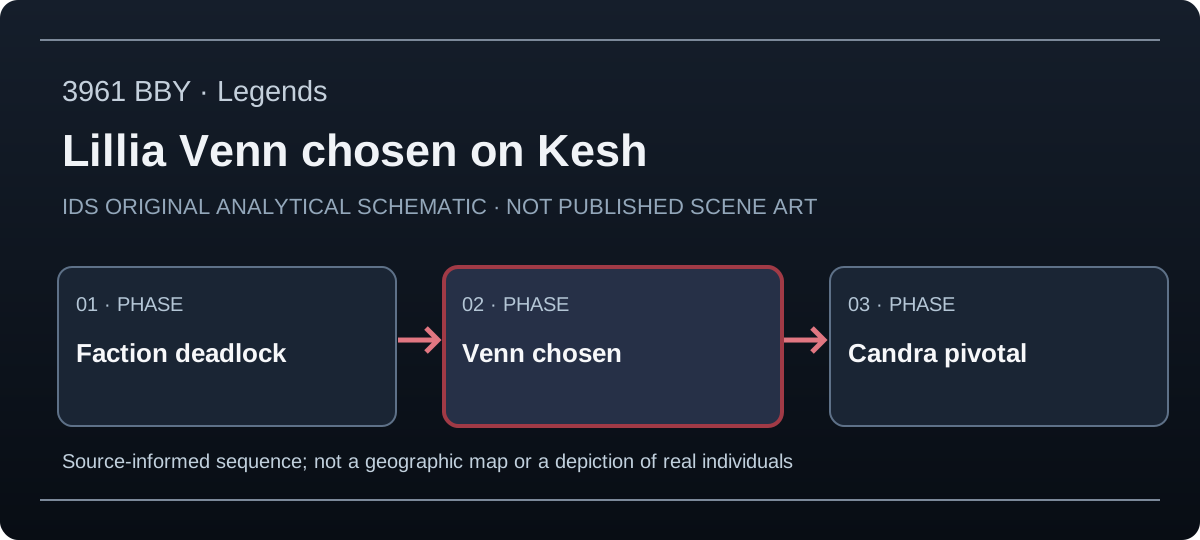
The Circle of Lords chooses a compromise
The Lost Tribe was separated from the wider galaxy, yet its governing class had its own parties and procedures. On Kesh, the seven-member Circle of Lords became unable to choose a successor because the Red and Gold factions opposed each other's preferred leader. The factions eventually selected Lillia Venn, the elderly High Lord whose age encouraged the expectation that she would not hold office long. Their compromise was therefore an attempt to postpone a struggle, not proof that the factions had reconciled. The choice also elevated Candra Kitai to the vacant High Lord's seat.
The decisive vote is an office, not a personal favor
Candra was politically independent rather than a member of either major faction. That position could make her the deciding vote in a later succession, transforming an apparently routine appointment into an important redistribution of leverage. Venn understood how vulnerable a leader could be when rival elites were waiting for her death. The official title of Grand Lord supplied public authority, while control of the council, guards and accusations supplied the means of exercising it.
Who was left outside the negotiation?
This was an internal contest among Force-sensitive Sith nobles. The conquered Keshiri population was not consulted on the identity of its rulers, and the Red and Gold colors did not represent all inhabitants of the planet. The same period overlapped chronologically with the Mandalorian Wars, but there was no evidence of communication or cooperation between this isolated political crisis and the Republic's campaigns. Keeping the two histories separate prevents an imagined galaxy-wide Sith command structure.
What the source can establish
John Jackson Miller's Lost Tribe of the Sith: Purgatory introduces the consequences of the succession and the interests of the council. The publisher's collected-stories description establishes the novel cycle and its focus on rival Sith communities and internal conflict; it does not independently date each council vote or reproduce the election scene. The original story, not the catalog paragraph, remains the source for the named factions, individuals and relationship among their offices.
Historical judgment: Did selecting a compromise ruler settle the conflict?
Analysis: No. Venn gained formal authority, but the factions still expected to control her succession. The unresolved struggle created incentives for a later purge.
Original publication trail: Random House Worlds: Lost Tribe of the Sith collected stories →. The publisher verifies the collected edition and its historical scope. Individual scenes require the Purgatory, Sentinel, Pantheon or Secrets text; the catalog paragraph does not document every detail. The Korsinata political purge →
Sources and further reading
- John Jackson Miller, Lost Tribe of the Sith: The Collected Stories, Random House Worlds (2012); the anthology includes the original eBook sequence. Individual scene claims refer to the named installment below.
- John Jackson Miller, Lost Tribe of the Sith: Purgatory.