
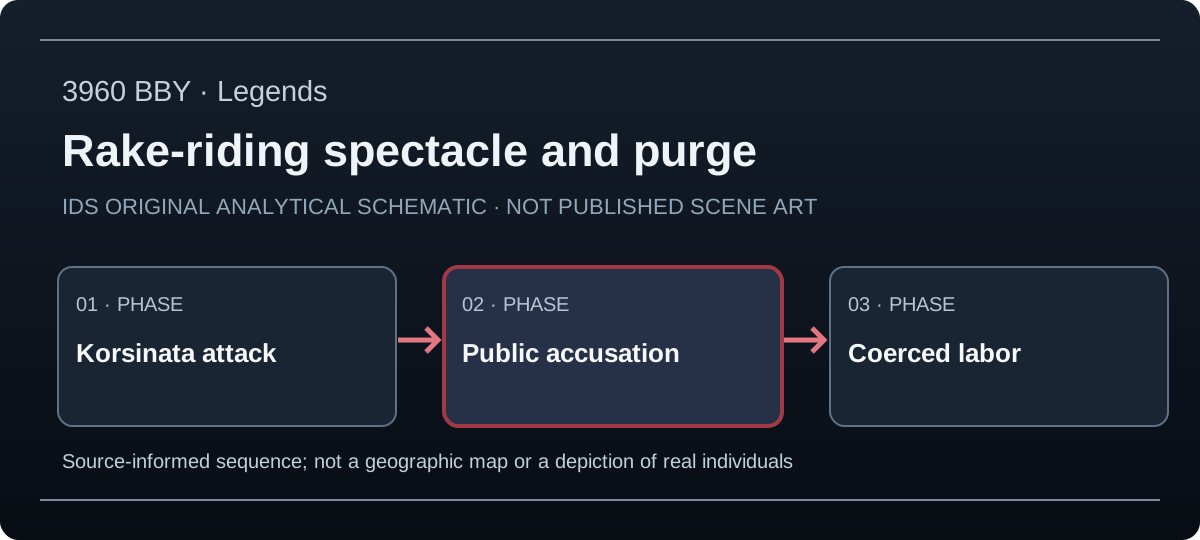
On Donellan's Day in 3960 BBY, uvak wrangler Campion Dey charged Grand Lord Lillia Venn during the rake-riding games at the Korsinata. Venn killed him and blamed his sponsors, High Lord Candra Kitai and her daughter Orielle. Later evidence strongly indicated Venn had arranged the attack herself so she could eliminate rivals Dernas and Pallima, remove Candra from the Circle, and install loyalists.
3960 BBY · Legends · Historical interpretation
THE KORSINATA INCIDENT
Story evidence, dates and limitations
In 3960 BBY, during the Korsinata celebrations, uvak wrangler Campion Dey appeared to attack Grand Lord Lillia Venn, who killed him. The blame was directed toward Candra and Orielle Kitai, and Venn used the accusation to remove political opponents and strengthen her own support. The source presents strong evidence of orchestration behind the incident rather than a straightforward genuine assassination bid by the Kitais. Its setting inside a public spectacle made the allegation immediately visible to rival elites.
Social history and consequences
Public ceremonies supply both audiences and symbols that rulers can manipulate. A perceived assault before the spectators offered Venn a justification to redraw the Circle of Lords and punish alleged conspirators, including forced status reduction. The coercion was not a natural consequence of ordinary festival rules. This reading distinguishes the staged public performance from the underlying political motive and warns against treating accusations as proof.
Research trail: Lost Tribe of the Sith: Purgatory; Lost Tribe of the Sith: Sentinel; Korsinata accounts. Read chronological source references →. Original edition page citations remain to be checked. The event banner is original symbolic IDS art and is not an authentic screenshot.
Public spectacle becomes political purge
A sporting festival provided the stage for Venn to manufacture a security crisis.
The visible attack made extraordinary punishment appear justified to observers.
Candra is made into a living warning
Rather than executing the Kitais, Venn enslaved and publicly humiliated them.
Punishment was designed as communication to other elites.
Anthropological assessment
The Korsinata episode shows how rulers can manufacture threats to legitimize purges.
Public punishment is not only about the person punished; it is a message directed at everyone who witnesses it.
Source judgment · 3960 BBY
Test your historical interpretation
Choose your answers. The assessment shows corrections, a source-based explanation and a score.
Rake-riding spectacle and purge: evidence, society and consequences
The arena makes an allegation public
Korsinata was more than a place to watch a game. At the Donellan's Day rake-riding contest, powerful Sith households sponsored competitors and displayed their standing before an audience. The flightless uvaks used in the blood sport had their wing muscles cut when young, making the animals' treatment part of the event's material history. Campion Dey, a competitor supported by Candra and Orielle Kitai, moved against Grand Lord Lillia Venn. The Grand Lord killed him and treated the attempt as a conspiracy involving the sponsors.
The accusation reorganizes government
The punishment was wider than Dey's death. High Lords Dernas and Pallima, leaders of the rival Red and Gold factions, were eliminated, while the Kitais lost their rank, property and freedom. Candra and Orielle entered the slave class over which their household had previously held power. Destruction of their belongings turned a change of legal status into a highly visible warning to other elites. Venn's allies gained authority in the Circle of Lords. These steps are the political stakes of the story; a single attempted attack did not automatically prove the targets were all conspirators.
Separating a public narrative from the plot
The original Purgatory story and its Sentinel continuation portray Venn's use of the supposed regicide as a planned opportunity to destroy rivals. The published outcome supports a reading of manipulation, but an editor should distinguish what the spectators saw, what Venn publicly claimed and what the narrative reveals through later events. Those are three different forms of evidence. It is also inaccurate to generalize a factional purge among Sith nobles into a spontaneous rebellion by all Keshiri.
Anthropology of staged danger
An arena made danger legible to a crowd. By declaring an attempted attack an offense against the throne, a ruler could turn coercion into an apparently legitimate response to an emergency. Punishment of families, confiscation of property and forced labor changed political alliances as well as private lives. The central question is not whether Sith culture was naturally violent, but how one leader used laws, spectacle and institutional control to make resistance risky.
Historical judgment: Did the public charge against the Kitais establish their guilt?
Analysis: No. Sponsoring the competitor was the basis of Venn's allegation. The narrative supplies reasons to suspect that the ruler exploited or arranged the incident herself.
Original publication trail: Random House Worlds: Lost Tribe of the Sith collected stories →. The publisher verifies the collected edition and its historical scope. Individual scenes require the Purgatory, Sentinel, Pantheon or Secrets text; the catalog paragraph does not document every detail. Orielle and Jelph at Tahv →
Sources and further reading
- John Jackson Miller, Lost Tribe of the Sith: The Collected Stories, Random House Worlds (2012); the anthology includes the original eBook sequence. Individual scene claims refer to the named installment below.
- John Jackson Miller, Lost Tribe of the Sith: Purgatory.
- John Jackson Miller, Lost Tribe of the Sith: Sentinel.