
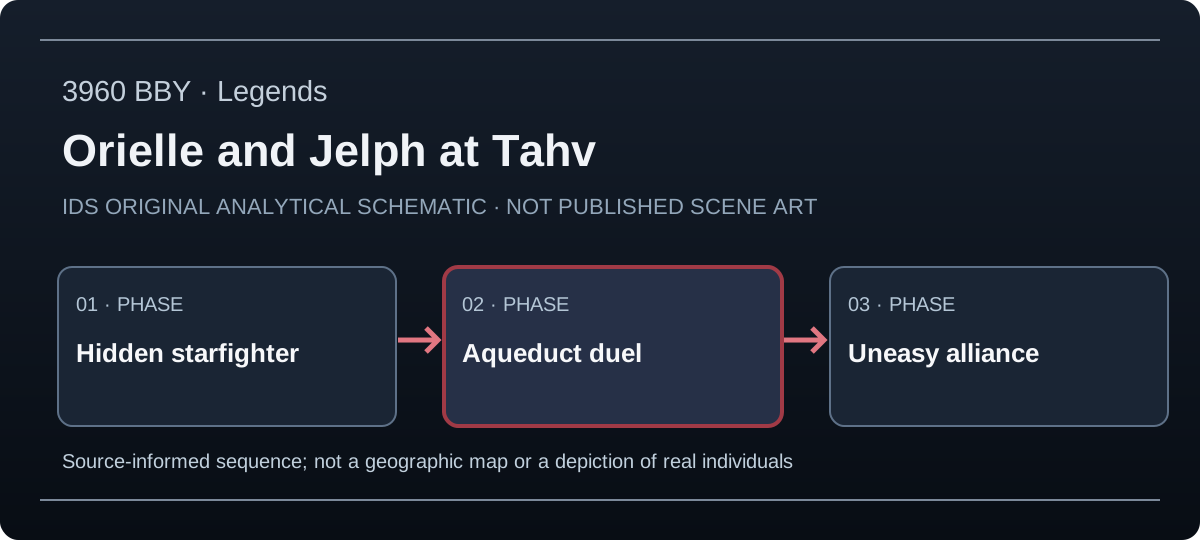
After Orielle Kitai discovered Jelph Marrian's hidden Aurek-class starfighter, she went to Tahv hoping the offworld technology could restore her family's status. Jelph followed her into the aqueduct system. Their confrontation became a brief duel before he revealed that he was a stranded Jedi Shadow and convinced her that Lillia Venn had manipulated the entire crisis.
3960 BBY · Legends · Historical interpretation
DUEL AT TAHV
Story evidence, dates and limitations
Former Jedi Shadow Jelph Marrian confronted the former Sith Saber Orielle Kitai in the aqueducts of Tahv after she discovered his concealed Aurek-class tactical strikefighter and attempted to use its existence to recover her family's position. Their brief duel ended with Orielle losing her lightsaber and Jelph revealing enough of his Jedi past to persuade her that cooperation was possible. They returned toward his farm while Grand Lord Lillia Venn followed the information about the ship.
Social history and consequences
The aqueduct encounter is a turning point because enemies defined by inherited institution and ideological training began to trust one another. Orielle's earlier belief in the value of offworld access reflected political desperation, not detailed knowledge of the wider Republic. The infrastructure of an urban water system provided the setting for a private negotiation beyond the highly visible political arena. A duel is not necessarily resolved by eliminating one's opponent.
Research trail: Lost Tribe of the Sith: Sentinel (2010); Duel in the Tahv aqueduct. Read chronological source references →. Original edition page citations remain to be checked. The event banner is original symbolic IDS art and is not an authentic screenshot.
An enemy identity becomes a basis for trust
Orielle had been raised in a Sith society hostile to Jedi.
Jelph's explanation nevertheless became credible because it matched the injustice she had experienced.
Political identity begins to loosen
The former Sith Saber had lost status, wealth, and institutional belonging.
Dispossession created space for her to reconsider assumptions that had once seemed unquestionable.
Anthropological assessment
The duel shows how personal crisis can destabilize inherited political identity.
People may reconsider ideology when institutions violate the moral expectations through which that ideology had made sense.
Source judgment · 3960 BBY
Test your historical interpretation
Choose your answers. The assessment shows corrections, a source-based explanation and a score.
Orielle and Jelph at Tahv: evidence, society and consequences
A starfighter changes the meaning of exile
After her family was stripped of privilege, Orielle Kitai took refuge with the farmer Jelph Marrian. She discovered an Aurek-class tactical strikefighter hidden on his property. To an isolated society whose founders had been marooned on Kesh, a working starship could represent escape, weapons and enormous political bargaining power. Orielle initially hoped that revealing the craft might restore her family's status. Jelph saw the same discovery as a threat: the Lost Tribe's expansion into a galaxy it had not contacted for generations.
The confrontation occurs away from the arena
Orielle traveled to Tahv and the city's raised aqueduct system, seeking to reach powerful members of the Circle of Lords. Jelph followed. She used the Force against him and the encounter became a duel, but it did not end in either combatant's death. Jelph disarmed her and revealed that he was a former Jedi Shadow whose mission had involved tracking Sith influence. Orielle's knowledge of his secret and his growing attachment to her forced both to reconsider the benefits of total secrecy or coercion.
Agreement does not erase an ideological conflict
They agreed to return to the farm, although they had spent years inside institutions that defined Jedi and Sith as enemies. Their arrangement was immediate and precarious. Orielle had already disclosed information about the discovery, while the Grand Lord was positioned to act on it. The later farm catastrophe cannot be understood without that earlier communications chain: a private discovery became a danger once competing authorities learned that offworld technology existed.
Why the aqueduct matters
Tahv's water infrastructure became the scene of a private decision rather than a public ceremonial punishment. The urban setting provides a contrast with the crowded Korsinata, where a ruler manipulated an audience. Both places are part of the same political crisis but organize encounters differently. A reader should also distinguish the book's relationship story from a claim that one fight immediately dissolved all Jedi-Sith antagonism. The protagonists negotiated their own choices; the institutions around them did not change overnight.
Historical judgment: Did Orielle's discovery remain a private matter after the duel?
Analysis: No. Word about the ship had already been passed into the political network, which is why the later visit to the farm was possible.
Original publication trail: Random House Worlds: Lost Tribe of the Sith collected stories →. The publisher verifies the collected edition and its historical scope. Individual scenes require the Purgatory, Sentinel, Pantheon or Secrets text; the catalog paragraph does not document every detail. The Night of the Upside-Down Meteor →
Sources and further reading
- John Jackson Miller, Lost Tribe of the Sith: The Collected Stories, Random House Worlds (2012); the anthology includes the original eBook sequence. Individual scene claims refer to the named installment below.
- John Jackson Miller, Lost Tribe of the Sith: Sentinel.