
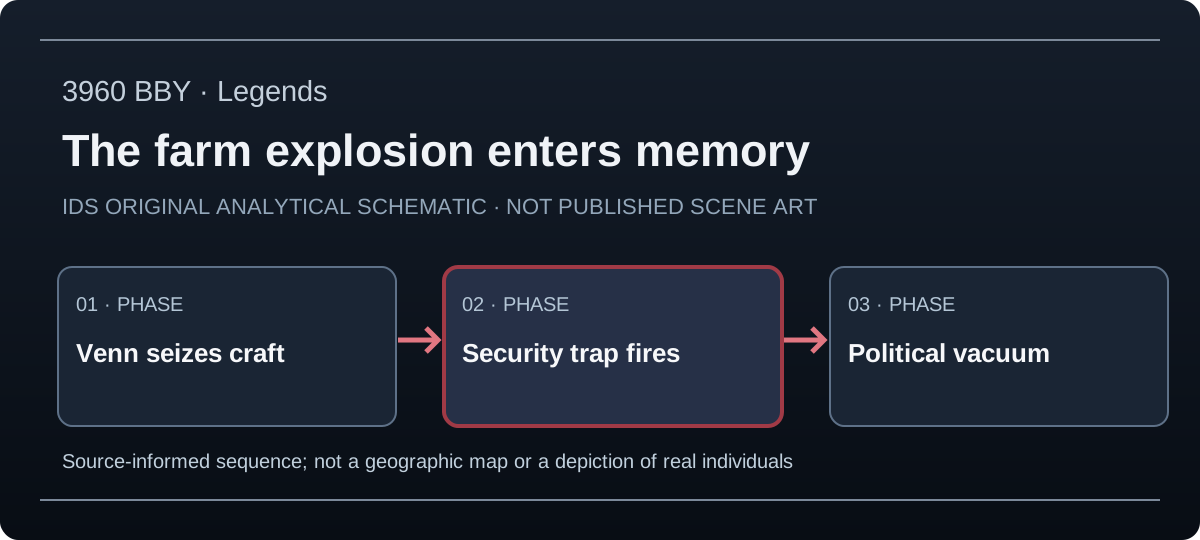
Lillia Venn learned of Jelph's starfighter and traveled to his farm with loyal Sith Lords and Sabers. She intended to escape Kesh and take her followers into the wider galaxy. When she tried to lift off, the ship's security system detonated buried proton torpedoes. The explosion destroyed the farm, killed Venn and her entourage, and collapsed part of the riverbank.
3960 BBY · Legends · Historical interpretation
THE UPSIDE-DOWN METEOR
Story evidence, dates and limitations
After learning of Jelph Marrian's concealed starfighter, Grand Lord Lillia Venn arrived with trusted Sith followers at his farm, intending to escape Kesh and expand her power beyond the isolated tribe. Marrian's improvised protective arrangement involving buried proton torpedoes detonated when the craft was disturbed. The explosion killed Venn and her retinue, destroyed the fighter and left a crater at the farm. The event was remembered by later Keshiri as the Night of the Upside-Down Meteor, not understood by all observers as the destruction of an offworld spacecraft.
Social history and consequences
The name of the disaster shows how communities describe an extraordinary event using what they can perceive, even when the technological cause is concealed. Local spectators witnessed an explosion without access to the craft's military origins. The loss of a potential link to the galaxy also ensured the Sith Tribe's continued isolation. Venn's death did not yield stable constitutional succession, and opposing factions soon exploited the resulting power vacuum.
Research trail: Lost Tribe of the Sith: Sentinel (2010); Night of the Upside-Down Meteor source record. Read chronological source references →. Original edition page citations remain to be checked. The event banner is original symbolic IDS art and is not an authentic screenshot.
A hidden connection to the galaxy is destroyed
The fighter represented the Tribe's first realistic route off Kesh in centuries.
Its destruction kept the population isolated.
A ruler's death destroys a fragile balance
Venn had purged rivals and restructured the Circle around herself.
Her sudden death therefore left no stable succession coalition.
Anthropological assessment
The event shows how technical objects can carry political possibilities far beyond their intended function.
One starfighter represented escape, conquest, status restoration, and the potential end of planetary isolation to different participants.
Source judgment · 3960 BBY
Test your historical interpretation
Choose your answers. The assessment shows corrections, a source-based explanation and a score.
The farm explosion enters memory: evidence, society and consequences
The weapon hidden inside a promise of travel
Grand Lord Lillia Venn followed information about Jelph Marrian's concealed spacecraft to his farm, taking loyal Sith followers with her. A functioning starfighter was a prize of extraordinary value for the Lost Tribe. Venn believed it might finally permit the stranded community's rulers to reach other systems and extend their ambitions beyond Kesh. The possible return to interstellar travel therefore carried political consequences far beyond the farm's ordinary agricultural setting.
Jelph's preparations determine the outcome
The former Jedi had hidden a defensive arrangement that included explosives connected to the craft. When Venn tried to take it, the trap detonated. The explosion destroyed the ship and farm and killed the Grand Lord along with members of her entourage. Jelph and Orielle survived by escaping into the river. Much of the immediate physical evidence vanished when the blast also altered the riverbank. The original Sentinel narrative is the source for these events, not a later drawing of a meteor falling from orbit.
An event acquires a local name
Later history called the explosion the Night of the Upside-Down Meteor. This is a useful example of historical naming. People who saw the flash or its consequences could describe the spectacle without understanding the technology, the prior political plot or the connection to the Republic. The label is part of the Lost Tribe's memory, not independent proof that a celestial body struck the ground.
No triumphant return to the galaxy
Venn did not escape Kesh; her death removed a ruler while leaving the Red and Gold struggle unresolved. The destruction of the craft closed one potential route to outside contact. The incident links technology, private secrecy and succession politics, but it does not itself account for every century of the Time of the Rot that followed. Long-term fragmentation requires a separate chronological discussion.
Historical judgment: Does the name 'Upside-Down Meteor' identify the literal cause of the blast?
Analysis: No. It is a later local name. The original story traces the explosion to the hidden starfighter and its defensive explosives.
Original publication trail: Random House Worlds: Lost Tribe of the Sith collected stories →. The publisher verifies the collected edition and its historical scope. Individual scenes require the Purgatory, Sentinel, Pantheon or Secrets text; the catalog paragraph does not document every detail. Candra Kitai's brief rule →
Sources and further reading
- John Jackson Miller, Lost Tribe of the Sith: The Collected Stories, Random House Worlds (2012); the anthology includes the original eBook sequence. Individual scene claims refer to the named installment below.
- John Jackson Miller, Lost Tribe of the Sith: Sentinel.