
The disappearance of Lillia Venn destroyed the arrangement holding the Circle of Lords together. Candra Kitai, recently reduced to slavery by Venn, briefly became Grand Lord. Her elevation could not stop the Red and Gold factions from attacking one another and splintering into additional rival movements.
3960 BBY · Legends · Historical interpretation
CANDRA'S BRIEF REIGN
Story evidence, dates and limitations
After Lillia Venn's disappearance in the farm explosion, rival Lost Tribe factions installed Candra Kitai as Grand Lord. Candra had recently suffered punishment and loss of status after Venn's manipulated assassination crisis. Her rapid elevation demonstrates the instability of factional politics in Tahv. Her brief reign did not resolve the Red–Gold split; the factions soon renewed fighting, and subsequent fragmentation transformed the Tribe's political system.
Social history and consequences
Candra's reversal from disgraced elite and coerced labor to Grand Lord illustrates the contingent character of rank within a divided regime. Personal office alone could not guarantee coercive power or shared recognition from rival factions. Even a newly elevated leader needed institutions that could channel disagreement and maintain compliance. The limited record of achievements should not be inflated into an imagined sweeping reform agenda.
Research trail: Lost Tribe of the Sith: Sentinel; Candra Kitai and the Time of the Rot histories. Read chronological source references →. Original edition page citations remain to be checked. The event banner is original symbolic IDS art and is not an authentic screenshot.
Status reverses with extraordinary speed
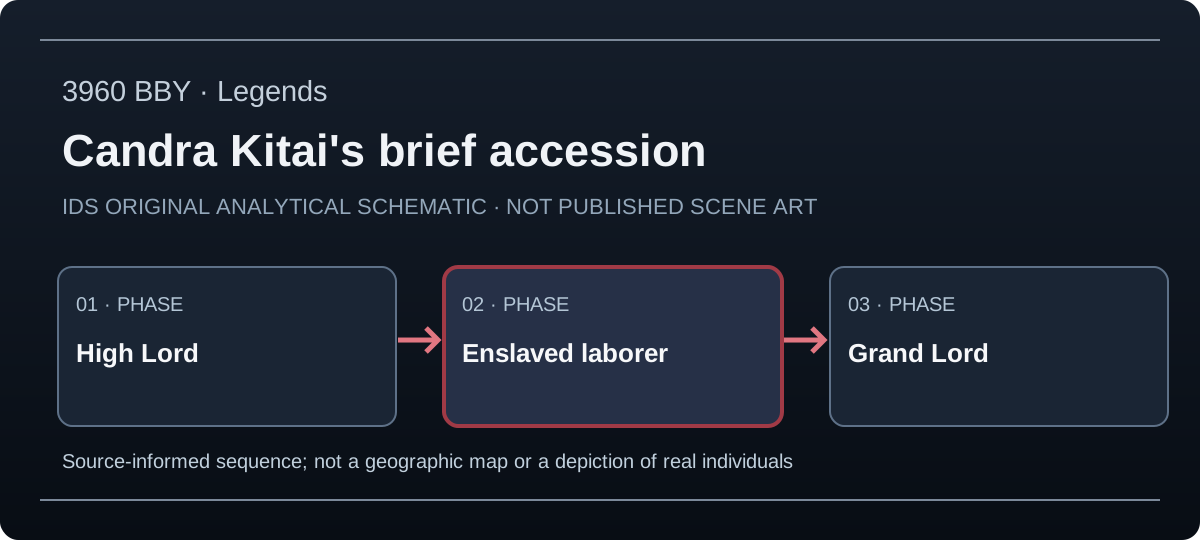
Candra moved from High Lord to enslaved zoo laborer to Grand Lord within the same political crisis.
Office depended less on a stable bureaucracy than on shifting factional power.
Leadership cannot restore a collapsed consensus
Candra possessed the title but not sufficient agreement among the Tribe's factions.
Formal office survived while effective central authority disappeared.
Anthropological assessment
Candra's brief rule shows the difference between holding an office and possessing a functioning state.
Institutions collapse when participants no longer agree that the office can settle competition.
Source judgment · 3960 BBY
Test your historical interpretation
Choose your answers. The assessment shows corrections, a source-based explanation and a score.
Candra Kitai's brief accession: evidence, society and consequences
A status reversal within the same ruling class
Candra Kitai's brief rule followed an unusually rapid sequence of reversals. She had held a politically pivotal seat in the Circle of Lords. After Campion Dey's failed attack at the Korsinata, Venn's accusation removed Candra from office, destroyed her household status and forced her into labor at Tahv's zoo. Her daughter Orielle also lost the privileges of a Sith Saber. The different treatment of servants, noble households and ordinary inhabitants reveals how power and enslavement were organized on Kesh.
An appointment after the farm disaster
When Lillia Venn died, the political system had to select another leader. Candra became Grand Lord even though she had recently been treated as an enemy of the state. Her rapid restoration did not mean that Red and Gold loyalists had accepted a stable settlement or a common succession rule. Rival elites fought one another as the central government's ability to command obedience weakened. The title was preserved, but the political order sustaining it was fractured.
The zoo as an unusually concrete record
One action associated with Candra's short reign was closing the zoo where she had been compelled to work. That decision matters because it links an experience of labor and humiliation to a documented use of office. It should not be inflated into a general abolition of slavery or a complete reform of Sith social hierarchy; the surviving account does not support such a claim. The same society continued to be structured by the conquest and exploitation of Keshiri inhabitants.
How to measure success
A history measured only by changes of leader can describe a quick succession as a return to normality. A social history asks whether the government could maintain institutions, prevent armed rivalry and protect people outside the ruling elite. The sources suggest that Candra's formal accession did not achieve those goals. The longer Time of the Rot belongs to the cumulative effects of fragmentation, not a single personal failure attributed solely to her.
Historical judgment: Does closing the zoo prove Candra freed all enslaved people on Kesh?
Analysis: No. The surviving source connects her to the closure of one institution. It does not establish a general emancipation policy.
Original publication trail: Random House Worlds: Lost Tribe of the Sith collected stories →. The publisher verifies the collected edition and its historical scope. Individual scenes require the Purgatory, Sentinel, Pantheon or Secrets text; the catalog paragraph does not document every detail. The Time of the Rot begins →
Sources and further reading
- John Jackson Miller, Lost Tribe of the Sith: The Collected Stories, Random House Worlds (2012); the anthology includes the original eBook sequence. Individual scene claims refer to the named installment below.
- John Jackson Miller, Lost Tribe of the Sith: Sentinel.