
The Battle of Foerost in 3959 BBY is conventionally treated as the opening battle of the Jedi Civil War. Revan's forces struck one of the Republic's major naval centers and captured significant military assets. The attack revealed that the commander who had saved the Republic from the Mandalorians now possessed a fleet capable of challenging it directly.
3959 BBY · Legends · Evidence review
FOEROST · OPENING STRIKE
Documented history and chronological boundaries
Legends chronology conventionally begins the Jedi Civil War with Revan's Sith attack on the naval center at Foerost in 3959 BBY. The assault threatened ship construction, maintenance and trained crews essential for Republic defense. It announced that an army drawing on Republic veterans now possessed the resources and intent to fight its former government. Foerost's battle should not be combined with its separate earlier engagements in the Great Sith War or later history.
People, political institutions and material life
Shipyards are more than weapons caches: they contain specialist labor, engineering knowledge, transport routes and a skilled industrial workforce. Losing a production center can reduce a government's future capacity even after the immediate battle ends. The event also disrupted the public narrative of Revan as the recent victor over Mandalore. Because surviving summaries give limited tactical data, claims about exact casualties or particular ship commanders need a more specific primary citation.
Source trail: Knights of the Old Republic Campaign Guide; Essential Atlas; Jedi Civil War Foerost chronology. Explore source and bibliography →. The original conceptual banner is not documentary or game footage. Dialogue and print-page-level citations remain subject to primary-source checking.
A shipyard is a strategic target
Foerost represented ships, repair capacity, personnel, and route access rather than symbolic territory alone.
Striking industrial infrastructure accelerated the Sith offensive while weakening Republic replacement capacity.
Revan returns as a political shock
Many Republic personnel remembered Revan as the commander who had ended the Mandalorian Wars.
The invasion therefore challenged institutional loyalties as much as military defenses.
Anthropological assessment
Foerost shows how civil wars are wars over legitimacy as well as territory.
The same reputation that had once mobilized Republic forces could now encourage defection and uncertainty when its holder claimed a new political allegiance.
Foerost places industry at the beginning of the war
Foerost was an important naval production and logistics center. Its seizure therefore affected the Republic's ability to build, maintain and supply fleets. Revan's forces were not simply searching for a symbolic early victory. Attacking a shipyard could provide material advantage while reducing the Republic's ability to replace what it lost elsewhere.
A former hero becomes an enemy commander
Revan had commanded Republic forces against the Mandalorians and gained influence among veterans. The attack on Foerost signaled that the same military figure now led a force challenging the state that had once given him supreme command. Republic officers faced both a material threat and a crisis of expectations about loyalty and leadership. Defection and uncertainty were particularly dangerous because the new Sith power included people familiar with Republic methods.
Do not confuse the Foerost conflicts
Foerost appears in more than one conflict of the Old Republic era. The earlier attack during the Great Sith War in 3996 BBY should not be merged with the 3959 BBY engagement. The century, combatants and political stakes differ. An illustrated chronology must label art and references accordingly so a comic image depicting the older battle is not misrepresented as the later one.
Why one battle can define a war's beginning
Historians often choose an opening battle as a convenient date for a conflict that had been developing for some time. Revan's turn toward the Sith and the discovery of the Star Forge predate the open invasion. Foerost marks the shift into a visible war between organized forces. It need not be presented as the instant when every underlying grievance or preparation began.
Anthropological assessment: legitimacy and logistics
Foerost demonstrates that civil war is a struggle over who can claim authority over the same people and infrastructure. Shipyard employees, military officers and political leaders may face competing demands from former comrades now on opposite sides. Control of material production gives those claims immediate consequences: armies cannot remain effective without ships, spare parts, labor and routes.
Evidence comparison
Which details are directly supported?
The original game and referenced published chronology support the major participants, outcome, and broad story sequence. The diagram does not claim exact geographical distances or tactical deployments.
Are alternate gameplay choices historical events?
Only the outcome adopted by the continuing Legends storyline is treated as fixed. Other choices remain genuine game possibilities, not simultaneously established events.
Interactive evidence test · 3959 BBY
Test your historical judgment
Answer both questions for corrections, documentary context and a score. You can revise answers and try again.
Legends · historical source review
Shipyards bring industrial labor into the war
The Sith opening assault on Foerost targets naval capacity near the beginning of the Jedi Civil War. A shipyard is valuable because a state relies on trained workers, tools, supply contracts, and transit routes to build and repair fleets. Damaging its production ability can shape distant battles that do not take place in the same system.
Industrial warfare produces political effects beyond the count of ships destroyed. A government must rebuild expertise as well as factories, while civilian communities may depend economically on production that becomes a target. This analysis does not establish that every technician was a combatant or that Foerost's entire population favored one side. The specific tactical record belongs to Legends reference sources for the Jedi Civil War; the broader BioWare account confirms the new Sith offensive without detailing every shipyard unit.
Historical judgment: Shipbuilding infrastructure is an institution, not only military equipment. Publisher's related original account →. The analysis of political institutions is IDS interpretation, not game dialogue. Day-level event dates and player-defined decisions are not asserted.
Legends · Early Jedi Civil War source audit
Foerost: seizure of ships turns industrial capacity into the first target
What the sources document
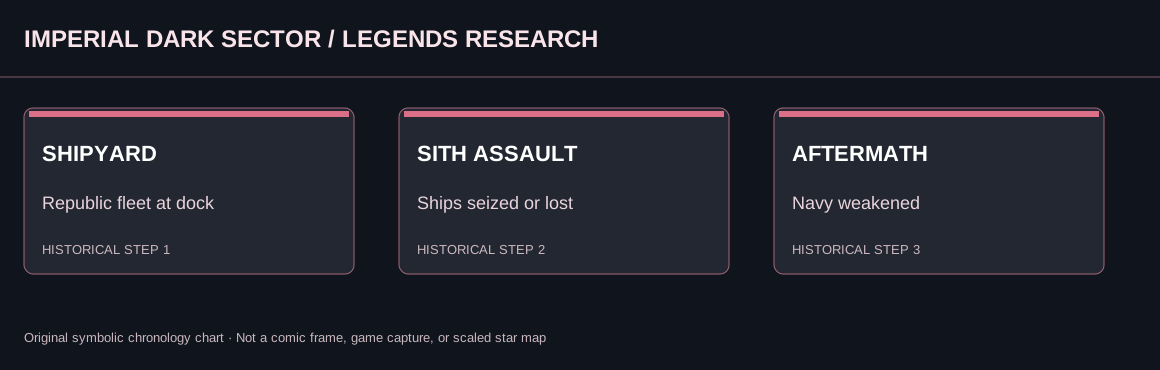
Revan's Sith fleet attacked Foerost's Republic shipyards in 3959 BBY in the opening phase of the Jedi Civil War. The assault seized a significant number of Republic military vessels and ruined others, undermining the government's ability to repair and replace losses. It also gave Sith forces immediate ships and exposed the vulnerability of a naval system whose strength depended on large concentrations of capital-intensive infrastructure. Foerost had previously been raided during the Great Sith War, but that earlier Krath-Mandalorian attack around 3996 BBY was a different event.
Anthropological and political assessment
Shipyards combine physical equipment, technical specialists, skilled labor and state investment into one institutional space. When an enemy seizes ships in dock, it gains usable matériel while depriving the former owner of future production and repairs. That double effect helps explain why the opening strike mattered more than an isolated battlefield score. The attack also challenged Republic confidence that its former officers and facilities remained aligned with the state. It should not be embellished with invented conversations between dockyard workers and Sith commanders simply because the broader campaign is dramatic.
Source limitations
Reference accounts disagree or are imprecise about the timing of Saul Karath's defection relative to early shipyard security breaches. This entry does not assign specific access codes to a named officer without reconciling those reports. No reliable complete ship-count or casualty total has been established here.
Check your historical judgment: Was the 3959 BBY Sith assault on Foerost the same raid conducted during the 3996 BBY Great Sith War?
Correction and insight: No. Both targeted Foerost, but the attackers, war contexts and dates were different.
Sources: The Essential Atlas; Knights of the Old Republic Campaign Guide; Jedi Civil War Foerost chronology. Reference bibliography ↗. Original print/game scene citations remain under verification.
Sources and further reading
- Knights of the Old Republic Campaign Guide.
- The Essential Guide to Warfare.