
- World
- Foerost
- Target
- Republic shipyards
- Method
- Sith illusion · surprise assault
- Captured
- 300+ warships
Foerost was one of the Republic's major shipbuilding centers. In 3996 BBY, Ulic Qel-Droma and Mandalore the Indomitable attacked it with Aleema Keto's support. Aleema used Sith illusion to conceal or misrepresent the attacking force, enabling the coalition to penetrate the shipyards and capture more than three hundred warships. Those vessels were then redirected toward the Republic capital.
3996 BBY · Legends · Comic source edition
Foerost: production capacity becomes an invading fleet
What the story confirms
Ulic Qel-Droma's Sith-aligned forces exploited Aleema Keto's illusions and Mandalorian support to take Foerost's shipyards. The operation deprived the Republic of a strategic production center and added a large number of warships to the coalition. The tactical detail is part of the Legends narrative; Marvel's issue synopsis alone offers a broader look at Kun and Ulic's attempted Sith resurgence.
What the usual retelling overlooks
A shipyard includes workers, expertise, supplies and the ability to repair or produce military vessels. The historical account names captured ships more often than those whose labor built them. This is a useful distinction between the military value an invader recognizes and the social relations that make the infrastructure function.
Why did taking Foerost threaten Coruscant beyond the loss of one installation?
Capturing a major Republic shipyard meant capturing warships, logistics and production infrastructure that could be redirected against the Republic itself.
Publisher's issue record: Marvel — The Sith War #2 →. An issue synopsis can verify the story's broad premise and publication details; specific scene details in the full comics still require panel-by-panel verification. The hero is an original labelled IDS illustration, not reproduced comic art.
Why shipyards matter more than one battlefield
Warships require factories, skilled labor, supply chains, docks, fuel, weapons, navigation systems, and crews. A shipyard concentrates years of institutional effort into usable military capacity.
Capturing finished or nearly finished ships allowed Ulic to bypass the time required to build an equivalent fleet.
Aleema turns perception into access
Her Sith illusion worked as a force multiplier because defenders acted on incorrect information about what was approaching.
The technique resembles other forms of deception warfare: success comes not from physically destroying every defense but from making defenders interpret reality incorrectly at a critical moment.
Republic production becomes Sith capacity
The strategic damage was double. The Republic lost ships it expected to use, while the enemy gained those same ships.
This is why infrastructure capture can be more consequential than infrastructure destruction. Destruction removes capacity from one side; capture transfers it.
The archive remembers fleets more clearly than labor
Sources focus on commanders and captured ships, but shipyards are populated institutions. Thousands of workers, technicians, suppliers, and families would have lived around the system that made the fleet possible.
Military histories often convert such places into abstract production numbers, hiding the social communities underneath.
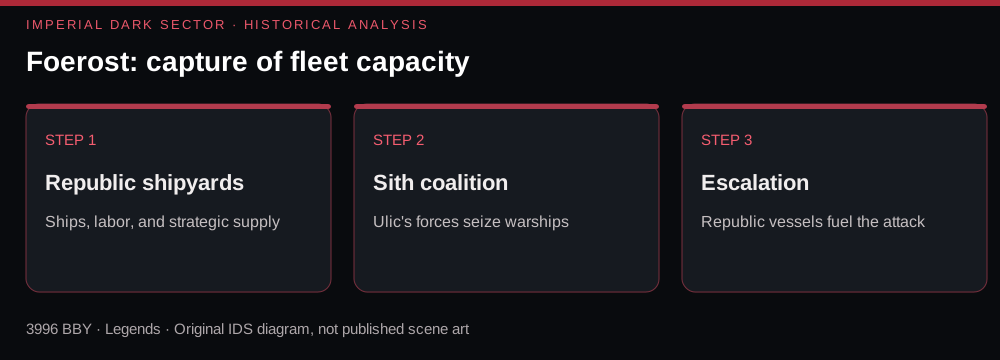
Event sequence
Mandalore joins Ulic.
Aleema conceals the assault with Sith illusion.
More than 300 Republic warships fall into Sith hands.
The captured fleet enables the assault on Coruscant.
Explore this entry
Why didn't Ulic just destroy Foerost?
Because its ships were more valuable intact. Capturing equipment can provide immediate operational power.
How could an illusion affect sensors and troops?
Legends Sith sorcery is depicted as capable of influencing perception at battlefield scale. The exact technical interface is less defined than the strategic effect.
Why is Foerost important to anthropology?
It reveals the hidden labor behind war. Ships are social products created by institutions, workers, and supply networks, even when history remembers only the admirals who seize them.
Anthropological assessment
Foerost shows how industrial infrastructure stores social power. A fleet is the accumulated result of labor, expertise, finance, and governance; seizing it transfers the products of those institutions to a new political actor.
The battle also demonstrates that deception can defeat organizations by exploiting how they classify information, not simply by overpowering their weapons.
Primary comic / historical analysis
A shipyard theft that became a fleet-level crisis
The assault on the Republic shipyards at Foerost depended on the interaction of Aleema Keto's Sith illusion, Ulic Qel-Droma's command and Mandalorian boarding expertise. The disguised vessel called Golthar's Sky appeared to seek repair, allowing the attackers to approach infrastructure intended to support the Republic's own navy. Once that deception worked, Krath and Mandalorian forces seized the shipyards and operational control of approximately three hundred completed warships. The critical prize was not only hulls or weapons, but the codes and procedures required to turn shipyard property into mobile military power.
Foerost converted a long-established Republic industrial investment into strength available to its enemy. The strategic effect had two sides: defenders lost assets they expected to deploy, while Ulic obtained ships he could use without waiting for new construction. Fleet Captain Orley Vanicus arrived too late to prevent the theft, but surviving records helped expose who had led the assault. That intelligence became immediately important because the captured fleet next threatened Coruscant. Foerost should therefore be read as the opening move in a connected operational campaign rather than a self-contained spectacular battle.
Security procedures create access
The deception worked through ordinary expectations about arriving ships and routine repair requests. A shipyard has to admit some traffic to function. Attackers exploited that openness instead of simply overpowering every defense from the beginning.
Workers exist behind the ship count
Sources preserve the number of vessels and the names of commanders far better than the experiences of shipyard laborers. A responsible account can identify that imbalance without inventing casualty totals, evacuation stories or detailed personal biographies.
Why did taking the ship codes matter beyond winning the battle?
The codes allowed the captured ships to be operated as a coherent fleet. The theft stripped the Republic of equipment and immediately provided Ulic with ships for the attack on the capital.
Issue evidence: Tales of the Jedi: The Sith War #1, 'Edge of the Whirlwind' (1995). The narrative distinguishes the comic's directly depicted action from historical consequences and IDS interpretation. Publication year is not the in-universe year; 3996/3997 BBY labels belong to Legends.
Sources and further reading
- Tales of the Jedi – The Sith War.
- The Essential Guide to Warfare.