
- Conflict
- Great Sith War
- Sith leaders
- Exar Kun · Ulic Qel-Droma
- Major allies
- Krath · Mandalorians · Massassi
- Outcome
- Republic/Jedi victory
By 3996 BBY, the crisis that had begun with the Krath and the fall of two Jedi had become a multi-front war. Exar Kun and Ulic Qel-Droma did not command a single conventional empire. Their power came from linking several organizations: the Krath state in the Empress Teta system, Mandalorian Crusaders, Massassi forces on Yavin 4, fallen Jedi recruited by Kun, and fleets captured or converted during the campaign. The Republic faced a coalition whose parts fought differently but reinforced one another.
3996 BBY · Legends · Comic source edition
The Great Sith War becomes a multi-front conflict
What the story confirms
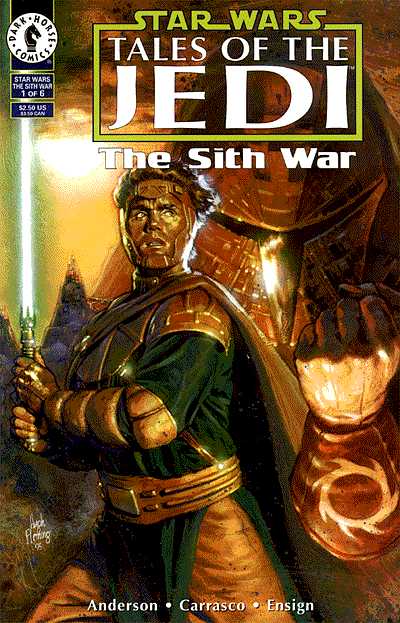
Marvel's first Sith War issue introduces the Mandalorians' recruitment into the conflict that brings warfare to Coruscant. The broader series depicts Sith alliances launching attacks against the Republic and its Jedi defenders. The coalition depended on access to shipyards, mobile warriors, Sith techniques and separate political loyalties.
What the usual retelling overlooks
The declaration of an era does not mean everyone in the Republic faced the same kind of violence. Shipyard workers, council members, soldiers and inhabitants of sacred Jedi worlds all entered the war through different vulnerabilities. Following the labor, networks and movement of people reveals more than a sequence of celebrated duels.
Were all Sith-aligned armies troops from one territorial empire?
No. Exar Kun and Ulic drew upon separate networks, including the Krath, Mandalorians, Massassi and converted Jedi. Their alliance was not a conventional unified state.
Publisher's issue record: Marvel — The Sith War #1 →. An issue synopsis can verify the story's broad premise and publication details; specific scene details in the full comics still require panel-by-panel verification. The hero is an original labelled IDS illustration, not reproduced comic art.
A war fought by a coalition rather than one state
Kun and Ulic assembled power from organizations with different political cultures. The Krath were Tetan aristocratic revolutionaries. The Mandalorians followed martial allegiance to Mandalore. The Massassi were a conquered Yavin 4 population. Fallen Jedi entered through personal loyalty, ideology, or corruption.
That diversity expanded the coalition's capabilities but made it dependent on charismatic leaders and unstable personal relationships.
The Jedi were not only soldiers—they were targets for conversion
Kun sought students and recruits inside the Jedi Order itself. Destroying or corrupting teachers and students weakened the Republic while simultaneously increasing Sith capacity.
This made the conflict institutional: every fallen Jedi represented both a lost defender and a potential new attacker with knowledge of Jedi methods.
Republic infrastructure is turned against the Republic
The attack on Foerost captured hundreds of Republic warships. Instead of building a fleet from scratch, Ulic appropriated the Republic's industrial output and immediately used it to threaten Coruscant.
War therefore became a contest over logistics and production, not only Force power.
The war reaches sacred worlds and ordinary populations
Coruscant, Ossus, Onderon, Yavin 4, and other systems became battlefields. The Cron Supernova transformed an entire stellar region and threatened the Jedi archive world before ground forces arrived.
The geographic breadth of the conflict meant civilians, archives, ecosystems, and transport systems were all exposed to strategic violence.
The coalition collapses through betrayal, defection, and overreach
Aleema betrayed Ulic at Coruscant and later died in the Cron catastrophe. Ulic killed his own brother Cay and was severed from the Force by Nomi Sunrider. Mandalore died after the Onderon campaign. Kun finally sacrificed the Massassi in a failed attempt to escape bodily death.
The war ended not because the coalition lost one central capital but because the relationships holding it together broke apart.
Event sequence
Brotherhood of the Sith forms.
Ulic gains Mandalorian allegiance on Kuar.
Foerost fleet is seized; Coruscant is attacked.
Cron Supernova devastates the region around Ossus.
Ulic defects after killing Cay; Jedi converge on Yavin 4.
Kun is defeated and the Great Sith War ends.
Explore this entry
Why is the Great Sith War only one year long?
The named war's climactic campaign is compressed into 3996 BBY, but its political and ideological prehistory spans several years. Short duration does not mean small impact.
Was there a single Sith Empire?
Not in the sense of the old Korriban empire. Kun's movement was a coalition connecting several existing forces under Sith leadership.
What made the coalition so dangerous?
It could attack in several modes at once: conventional fleets, Mandalorian ground forces, Sith sorcery, covert conversion of Jedi, and attacks on archives and sacred sites.
Anthropological assessment
The Great Sith War is best understood as a coalition war. Shared ideology and leadership temporarily made heterogeneous institutions act together without erasing their internal differences.
Its collapse shows the other side of that structure: when trust, personal loyalty, and charismatic authority fail, a coalition can disintegrate faster than a bureaucratic state.
Original comic / interpretive case study
Why the Great Sith War cannot be told as one duel
The Great Sith War was fought through a coalition rather than one government with uniform traditions. Exar Kun operated from Yavin 4 and recruited Jedi students; Ulic Qel-Droma coordinated Krath resources and the Mandalorian forces gained through his duel with Mandalore. The resulting campaign used military production, Force manipulation, ideological recruitment, family loyalties and attacks on major institutions. A list of famous battles captures only one dimension of that conflict. The Jedi's teaching networks and the Republic's shipbuilding and legal systems were also deliberate targets.
The defeat of the coalition did not simply restore the galaxy to the previous year. Ossus lost collections and communities; the Massassi were devastated; Mandalorian forces survived under new leadership; and Ulic's later life was defined by guilt and exile. The legal trial on Coruscant had been destroyed, while the Republic nevertheless preserved its broader political order. Describing the war as a Jedi victory must be reconciled with these losses. Periodizing the conflict as 3996 BBY also requires care: the Krath Holy Crusade and the formation of the Brotherhood preceded that date, and some older reference works use different years.
A campaign across different institutions
Foerost damaged industrial capacity, Coruscant targeted legal and political legitimacy, and Ossus attacked a center of memory and teaching. Each location played a different role in keeping the Republic and Jedi functional. The Sith coalition recognized those differences even when its members competed with one another.
A victory with uneven aftermaths
A victorious institution may preserve its government while local societies endure lasting destruction. The Massassi and the displaced inhabitants of Ossus cannot be treated as interchangeable with the commanders who received credit for the final outcome.
Is it accurate to say the Great Sith War began and ended in one uninterrupted week?
No. The label often highlights the decisive 3996 BBY phase, but the coalition formed from preceding Krath conflicts and earlier Sith developments. Its battles and consequences belong to a connected historical sequence.
Original issue: Tales of the Jedi: The Sith War #1–6 (1995–1996); Legends chronology. Dates and continuity refer to Legends; analysis of institutions, memory and aftermath is interpretation rather than a depiction of unshown dialogue or events.
Sources and further reading
- Kevin J. Anderson, Tales of the Jedi – The Sith War.
- The New Essential Chronology.
- Jason Fry with Paul R. Urquhart, The Essential Guide to Warfare.