
- World
- Kuar
- Combatants
- Ulic · Mandalore
- Stake
- Command of forces
- Result
- Mandalorian alliance with Ulic
Mandalore the Indomitable challenged Ulic Qel-Droma to settle the question of dominance through personal combat. The terms were not merely ceremonial: if Ulic won, Mandalore and his Crusaders would serve him. On the Plains of Harkul, Ulic defeated the Mandalorian leader but spared his life. Mandalore responded by pledging honor, troops, and future campaigns to Ulic.
3996 BBY · Legends · Evidence and cultural history
Duel on Kuar: the Mandalorian oath
What the sources establish
Mandalore the Indomitable challenged Ulic Qel-Droma on the Plains of Harkul on Kuar. The stakes were political: the defeated party would submit its forces. Mandalore fought from a Basilisk war droid and exploited an elevated chain platform, but Ulic won and spared him. The subsequent pledge transferred Mandalorian military capacity into the Sith coalition.
What can be misunderstood
This was not a duel without broader consequences. A personal contest served as a mechanism for moving a whole military organization into another faction. The Mandalorian warlord could honor the outcome without the two societies sharing a religious tradition, legal system or common political vision. Marvel's first Sith War issue confirms Mandalorian recruitment into the larger war; the duel's physical choreography depends on the comic and supporting Legends references.
Did Ulic kill Mandalore the Indomitable on Kuar?
No. Ulic defeated but spared Mandalore, whose oath committed his Crusaders to the Sith-aligned campaign. The leader died later on Onderon.
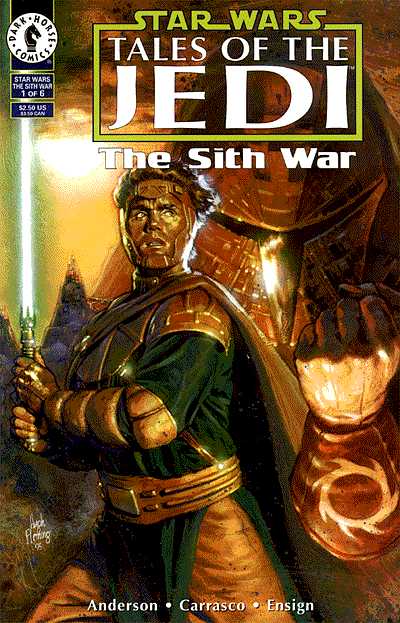
Source tradition: Tales of the Jedi — The Sith War #1; The Essential Guide to Warfare. Read the publisher record / sourced reference →. The hero is an original IDS conceptual drawing, not licensed comic art. For stories reconstructed through later reference books, original page/panel verification is still needed.
A duel can function as a political institution
In this context, personal combat carried consequences normally associated with treaties or succession. Mandalore's followers accepted the outcome because the contest fit a legitimate martial framework.
The transfer of allegiance therefore depended on shared recognition of the ritual, not merely fear of Ulic's individual power.
Ulic's mercy was strategically useful
Killing Mandalore would have removed a rival but risked fragmenting the Mandalorian force. Sparing him preserved a recognized commander capable of delivering followers to the new alliance.
Mercy and calculation are not mutually exclusive. The same act can have ethical meaning and strategic value.
The alliance transforms the scale of Ulic's war
The Krath already controlled Tetan resources, but Mandalorian support added experienced mobile warriors, Basilisk war droids, and an independent martial network.
Ulic's power stopped being confined to one political system and became capable of wider offensive operations.
Kuar had already been reshaped by Mandalorian conquest
Mandalorians had conquered Kuar years earlier and devastated its native population. The duel therefore took place in a landscape already transformed by Mandalorian violence.
The famous duel can overshadow that earlier history unless the planet is treated as more than a neutral arena.
Event sequence
Mandalorian Crusaders conquer Kuar.
Mandalore challenges Ulic.
Ulic defeats but spares Mandalore.
Mandalore swears service to Ulic.
Joint forces strike Foerost.
Explore this entry
Why did Mandalore's followers accept Ulic?
Because their leader publicly bound himself under the terms of a recognized martial challenge. Authority was carried through Mandalore's office and oath.
Did Ulic become Mandalore?
No. Mandalore retained his title and command role while acknowledging Ulic as superior ally.
Why is this more than a cool duel?
Because it converted one person's victory into a major shift in alliance structure and troop availability.
Anthropological assessment
Kuar demonstrates how political authority can be embodied in ritualized personal performance. In some systems, proving individual martial superiority can carry institutional consequences far beyond the participants.
The event also shows why symbolic legitimacy matters: followers obey not simply because Ulic won a fight, but because the fight was recognized as a valid way to settle leadership.
Primary comic / historical analysis
One duel, an alliance of very different institutions
Mandalore the Indomitable's challenge to Ulic Qel-Droma on Kuar used combat to decide a question normally associated with treaty making or political succession: who could command the Crusaders. The location mattered. Kuar had already suffered Mandalorian conquest, and the warriors who witnessed the confrontation belonged to a tradition that recognized a fighter's right to establish authority by victory. Ulic survived the contest and spared Mandalore, allowing the defeated ruler to transfer allegiance without the immediate disappearance of his command structure.
The outcome joined Ulic's Krath and Sith ties to a Mandalorian military organization with its own norms, officers, equipment and history. A personal victory did not magically transform Crusaders into Krath aristocrats. Mandalore continued to command people who understood their obligations through a Mandalorian framework, while Ulic gained access to troops and the Basilisk war droids captured in earlier conquests. The alliance was powerful precisely because the groups contributed different capabilities. Those differences also meant it relied on personal relationships more than on a stable joint government.
The meaning of sparing an opponent
Ulic could have killed Mandalore. Instead, he preserved a respected intermediary through whom the Crusaders could obey their new ally. Mercy was capable of being both an individual decision and a strategic means of maintaining continuity within another command hierarchy.
The geography under the arena
Kuar was an inhabited world transformed by Mandalorian conquest before the duel occurred. Centering only two commanders risks turning the planet into neutral scenery and forgetting that earlier violence made this political encounter possible.
Did the duel make every Mandalorian a formal member of the Krath?
No. Mandalore accepted Ulic's authority under the terms of the challenge and brought Mandalorian forces into an alliance; the Crusaders retained a distinct identity and military structure.
Issue evidence: Tales of the Jedi: The Sith War #1, 'Edge of the Whirlwind' (1995). The narrative distinguishes the comic's directly depicted action from historical consequences and IDS interpretation. Publication year is not the in-universe year; 3996/3997 BBY labels belong to Legends.
Sources and further reading
- Tales of the Jedi – The Sith War.
- The Essential Guide to Warfare.