
- World
- Onderon / Dxun
- Mandalorian leader
- Mandalore the Indomitable
- Defenders
- Beast Riders + Republic
- Outcome
- Mandalorian defeat
Late in the Great Sith War, Ulic Qel-Droma sent Mandalore the Indomitable and much of the Mandalorian force against Onderon. The target carried symbolic weight: Onderon had already survived centuries of Beast Wars, the Naddist uprising, and repeated Sith interference. This time its Beast Riders faced Mandalorian warriors mounted on Basilisk war droids while Republic forces moved to reinforce the defenders.
3996 BBY · Legends · Evidence and cultural history
Onderon: the end of Mandalore the Indomitable
What the sources establish
As the Great Sith War collapsed, Mandalore the Indomitable attacked Onderon with Basilisk war droids. The defenders included Beast Riders whose society had recently gained political recognition after the earlier Beast Wars. Republic reinforcements aided the defense. Mandalore retreated toward Dxun and died there after the failed invasion; his distinctive mask later passed into the leadership tradition of another Mandalore.
What can be misunderstood
The Battle of Onderon in 3996 BBY should not be confused with the 4000 BBY Battle of Iziz or the 3998 BBY Freedon Nadd Uprising. Each involved different forces and a different political settlement. The fate of Mandalore's mask illustrates how an office may persist after its incumbent dies: the object served as a token of continuing authority across changes of leadership.
Is this the same conflict as the Battle of Iziz that ended the Beast Wars?
No. The Beast Wars ended around 4000 BBY. The 3996 BBY Mandalorian attack occurred during the later Great Sith War.
Source tradition: Tales of the Jedi — The Sith War #6; Knights of the Old Republic II, Mandalorian historical accounts. Read the publisher record / sourced reference →. The hero is an original IDS conceptual drawing, not licensed comic art. For stories reconstructed through later reference books, original page/panel verification is still needed.
Mandalorian shock troops return to a world shaped by war
Onderon's defenders had a military culture built around dangerous terrain, mounted combat, and long experience fighting for Iziz and the wilderness. The Beast Riders were therefore not an improvised civilian militia.
Mandalorian Basilisk riders met a society whose own political history had already made mounted warfare central to its identity.
Republic reinforcements reverse the assault
The Beast Riders held long enough for Republic forces to arrive. Captain Vanicus informed the Mandalorians that Ulic Qel-Droma had surrendered after the disaster on Ossus.
Mandalore refused to surrender. His loyalty was tied not only to Ulic personally but to a warrior code in which retreat without contest carried its own political cost.
The pursuit ends on Dxun
Mandalore attempted to escape toward Dxun, Onderon's jungle moon, but crashed. The moon's predators killed him after the formal battle had effectively been lost.
His death is a reminder that environments remain active participants in war. A commander who survived fleets and Jedi did not survive Dxun's ecology.
The mask preserves the office
A surviving Mandalorian later recovered Mandalore's mask and assumed the title. The symbol allowed leadership to continue even though the individual leader had died.
The office of Mandalore therefore depended on collective recognition of a material object and the tradition attached to it.
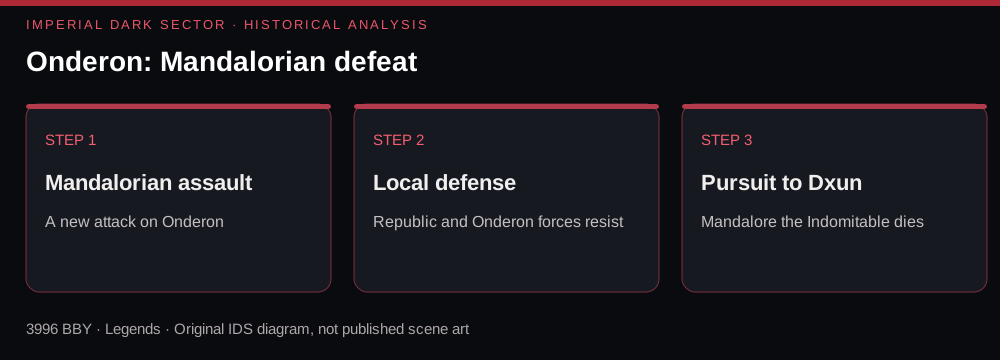
Event sequence
Mandalore attacks Onderon for the Sith coalition.
Onderonian riders meet Basilisk-mounted Neo-Crusaders.
The defenders gain the advantage.
Mandalorians learn Ulic has surrendered.
Mandalore refuses to capitulate.
His craft crashes; predators kill him; the mask survives.
Explore this entry
Why attack Onderon?
Onderon was strategically useful and symbolically important within the same political network that had repeatedly resisted dark-side movements. Ulic also had deep personal history there.
Did Mandalore's death end Mandalorian expansion?
No. The title survived, later leaders rebuilt Mandalorian power, and within two decades Mandalore the Ultimate would lead the vastly larger Mandalorian Wars.
Why is the mask important?
Mandalorian political legitimacy attached to the title and its recognized symbols, allowing succession even when the previous leader died far from a formal capital.
Anthropological assessment
The Battle of Onderon illustrates how offices survive through symbols. A mask can carry political continuity when followers collectively agree that wearing it transfers authority.
It also shows how local military traditions matter. The Beast Riders were effective not because they copied Mandalorian warfare, but because Onderon's own environment and history had already produced a distinct mounted combat system.
Original comic / interpretive case study
The same planet, a different Mandalorian war
The 3996 BBY Battle of Onderon belongs to Ulic Qel-Droma's Great Sith War coalition and should not be mistaken for the Mandalorian Wars beginning in 3976 BBY. Mandalore the Indomitable brought troops equipped with Basilisk war droids against a world already shaped by generations of Beast Rider warfare, royal disputes and Naddist uprisings. Onderonian defenders possessed their own knowledge of mounted combat and difficult terrain. The two martial cultures therefore met in a landscape that had already been a repeated center of galactic intervention.
Republic reinforcement and news of Ulic's defeat altered the political meaning of continuing the attack. Mandalore refused to accept surrender and attempted to retreat toward Dxun, where his craft crashed and wildlife killed him. A new leader later inherited the title of Mandalore through a recognized symbol. The sequence separates a military defeat, the death of an individual and continuation of a martial office. It also distinguishes this Great Sith War Mandalore from Mandalore the Ultimate, who fought against Revan decades afterward.
Warriors confront an inhabited environment
Dxun's ecology influenced the fate of a commander who had survived battle. The jungle moon was not neutral background. Onderonian residents and earlier Mandalorian groups had long adapted to its dangers, while a retreating force could still be defeated by those conditions.
Office survives despite a person's death
The mask and title of Mandalore carried leadership recognition beyond one ruler. Later Mandalorian history illustrates how succession, memory and collective agreement could sustain authority when a commander was killed.
Is this the same Mandalore killed by Revan at Malachor V?
No. Mandalore the Indomitable died after the 3996 BBY Onderon fighting. Mandalore the Ultimate died in 3960 BBY, during the later Mandalorian Wars.
Original issue: Tales of the Jedi: The Sith War #6; Great Sith War Legends chronology. Dates and continuity refer to Legends; analysis of institutions, memory and aftermath is interpretation rather than a depiction of unshown dialogue or events.
Sources and further reading
- Tales of the Jedi – The Sith War.
- The Essential Guide to Warfare.
- Knights of the Old Republic II: The Sith Lords.