
In 4000 BBY, the centuries-long Beast Wars culminated in the Battle of Iziz. Queen Amanoa's attempt to use the Jedi against the Beast Riders collapsed after Ulic Qel-Droma, Cay Qel-Droma, and Tott Doneeta learned that Princess Galia's abduction had been arranged with Beast-Lord Oron Kira. When diplomacy failed, Beast-Lord Modon Kira called the wilderness armies to attack Iziz.
4000 BBY · Legends · Historical evidence
The battle that changed Iziz
What happened
Ulic Qel-Droma, Cay Qel-Droma and Tott Doneeta sought peace between Queen Amanoa and the Beast Riders. Galia's apparently hostile abduction concealed her relationship with Oron Kira, whose father Modon later sent Beast Rider forces against Iziz when negotiations failed. Master Arca Jeth arrived and helped turn the battle against the queen's dark-side regime.
Political and cultural consequences
The Jedi came to recognize that the wilderness people were more than the outlaws described by royal propaganda. Cay's loss of an arm shows the violence of the fighting, but the original comic and audio adaptation disagree about the precise cause: a defender's blade in the comic, Novar's shot in the audio version. The sources should not be collapsed into one falsely exact scene.
Who cut off Cay Qel-Droma's arm?
The comic depicts a royal defender with a blade. The audio adaptation instead has Novar shoot it off. They differ.
Source: Tales of the Jedi: Ulic Qel-Droma and the Beast Wars of Onderon #1–2; audio adaptation. This is Legends history. Original publication page citations remain under review. The illustration is a clearly labelled IDS symbolic interpretation, not a licensed comic frame.
A staged abduction exposes the political conflict
Galia and Oron used the palace raid to escape the Naddist royal order and force negotiations.
The Jedi initially misunderstood the raid because they had been invited by Amanoa and lacked local knowledge.
The Beast Lords march on Iziz
After talks failed, Modon Kira mobilized Beast Riders from across the wilderness.
Iziz's fortifications, wave gunners, ion cannons, and royal guards turned the capital into a major battlefield.
Arca Jeth changes the balance
Amanoa used the dark side to strengthen Naddist defenses and frighten opponents.
Arca Jeth arrived and used Jedi battle meditation, weakening the queen's influence and helping the Beast Riders break through.
Cay Qel-Droma loses an arm
A royal defender severed Cay's arm during the battle.
Cay later replaced it with a mechanical arm built from an XT-6 droid, making the battle part of his personal technological history.
Anthropological assessment
The Battle of Iziz shows why outside mediators need local knowledge.
The Jedi arrived assuming the royal government represented legitimate order, then had to revise that understanding after encountering the political history hidden by the palace's account.
4000 BBY · Legends · Source and social history
The Battle of Iziz: a peace mission changes sides
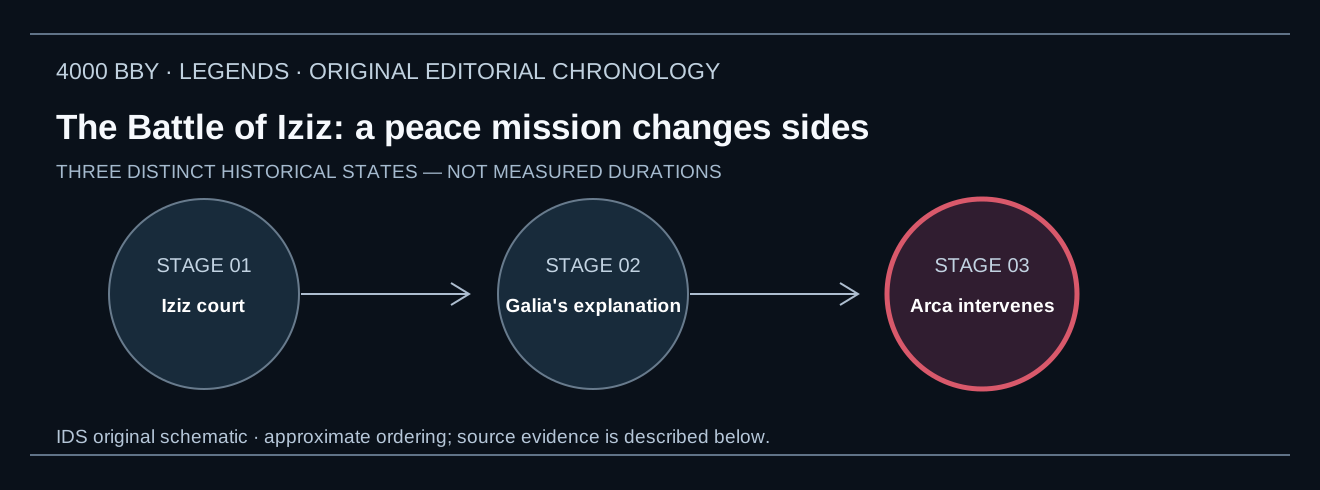
What the Jedi believed when they arrived
Ulic and Cay Qel-Droma and Tott Doneeta traveled to Onderon on Arca Jeth's assignment to resolve the Beast Wars. Queen Amanoa presented the Beast Riders as an external danger to the city. A sudden raid and the apparent kidnapping of Princess Galia initially reinforced that account. The original story then changed the Jedi's understanding of the conflict: the princess explained that she was not merely a captive and had intended to leave Iziz to marry Oron Kira. The shift from rescue to political mediation explains why the battle cannot be summarized as a victory over kidnappers.
Why Arca's arrival matters
The Jedi discovered that Amanoa's regime was tied to the dark-side legacy of Freedon Nadd. Their attempts to end the conflict eventually drew them into direct opposition to the royal authority that had requested their aid. Arca Jeth's arrival changed the balance through his use of the Force and influence over the conflict. Marvel's retrospective identifies him as the figure who quelled the fighting and corrected Ulic's misreading of the dark-side presence. It does not give a comprehensive casualty register, exact city coordinates or an independent account of what every wilderness settlement wanted.
The difference between victory and settlement
Iziz was not simply an army camp: people lived inside a highly defended city and outside its walls under generations of exile politics. The battle broke the most immediate Naddist control, but a political settlement required recognition of outsiders as legitimate members of Onderonian society. Galia and Oron Kira's marriage belongs to that separate settlement process. The later Freedon Nadd Uprising also shows that an old religious-political movement can survive a battlefield defeat.
Source judgment: Was Galia abducted without her knowledge by the Beast Riders?
Explanation: No. The original comic story and Marvel's recap describe a planned appearance of abduction: Galia wanted to leave Iziz and marry Oron Kira. The Jedi's understanding changed when they learned this.
Original publication context: Marvel's original-series retrospective. Public publisher summaries identify the story and creative edition, but precise birth years and off-panel histories often come from Legends reference chronology and require full print verification. Related timeline event →
4000 BBY · Legends · Source audit
Iziz: military defeat, religious authority and an incomplete peace
The event established by the sources
The Battle of Iziz ended the long conflict between Queen Amanoa's Naddist monarchy and the Beast Riders of Onderon. The account begins with a misunderstanding: Jedi visitors initially treated Princess Galia's apparent abduction as hostile, although she and Beast-Lord Oron Kira had arranged their meeting. The dispute exposed the way the queen's court had described wilderness communities. Armed fighting followed, and Arca Jeth's arrival shifted the balance against Amanoa's use of dark-side power. The battle removed her authority and opened a path toward unification, but it did not destroy every Naddist network.
Institutions, culture and power
The case separates three forms of control. Iziz's defenders possessed walls and military systems. Amanoa claimed a religious legitimacy tied to Freedon Nadd. The Beast Riders maintained political structures and mobility outside the city's control. The Jedi's first assumptions privileged the walled capital's description of its opponents. Their changed understanding matters because recognition of another community's leadership can alter who is treated as a legitimate political participant. The later Freedon Nadd Uprising in 3998 BBY also demonstrates that removing a ruler does not eliminate institutions and loyalties embedded in ordinary administration.
Where the evidence stops
The original comic and the audio adaptation differ about how Cay Qel-Droma loses his arm. A comparison of versions belongs in source notes, not a composite scene claiming both injuries occurred. A peace settlement should not be presented as a guarantee of lasting political agreement.
Check your interpretation: Did winning the Battle of Iziz permanently remove every Naddist network?
Correction and insight: No. Organized Naddists launched another uprising approximately two years later.
Source trail: Tales of the Jedi: Ulic Qel-Droma and the Beast Wars of Onderon 1–2; audio adaptation; Tales of the Jedi Companion. Source bibliography ↗. Publication-page verification is still required.
4000 BBY · Legends · Source-critical reading
Why the Battle of Iziz cannot stand for every step of the peace
The 4000 BBY Battle of Iziz is a decisive event, but it must not absorb all the surrounding episodes into one battle report. The first comic introduces a misleading apparent kidnapping of Galia, the Jedi's journey to the Beast Riders and the discovery of her plan to marry Oron Kira. These are political developments that alter the Jedi's understanding before the final confrontation. Marvel's public retrospective verifies that outline and explains that Arca Jeth's arrival changes the conflict.
One source-critical distinction concerns the injury suffered by Cay Qel-Droma. The original comic and the later audio dramatization describe the mechanism differently. An editor should not combine the two into a single unsupported scene or imply that both versions establish the same weapon. The page's current source note records that discrepancy; it is an example of why adaptations should be labeled as adaptations, not treated as independent eyewitness evidence.
Victory at Iziz removed the immediate Naddist rule under Amanoa, but a viable political settlement also required recognizing the Beast Riders' leadership and the Galia–Oron relationship. The separate ending of the Beast Wars and the later binding ceremony should remain separately navigable because battles, authority transfers and kinship agreements describe different processes. The subsequent 3998 BBY uprising shows that no simple victory declared the ideological conflict permanently finished.
Historical judgment: Is the Battle of Iziz identical to the 3998 BBY Freedon Nadd Uprising?
Explanation: No. The uprising followed roughly two years later, after the 4000 BBY battle and the political settlement.
Compare all nine connected Onderon dossiers →
Source comparison: Marvel's 2017 history of the 1993 Tales of the Jedi; Tales of the Jedi Companion for earlier Legends chronology. The publisher retrospective is not a substitute for precise print-page verification of reference-only dates.
Sources and further reading
- Tales of the Jedi: Ulic Qel-Droma and the Beast Wars of Onderon.
- Battle of Iziz, Wookieepedia