
In 4000 BBY, the Post-Manderon period ended and the era conventionally called the Old Sith Wars began. The new period would include the final Beast Wars crisis, the Freedon Nadd Uprising, Krath Holy Crusade, Great Sith War, Great Hunt, Mandalorian Wars, Jedi Civil War, Sith Civil War, and Dark Wars before ending around 3950 BBY.
4000 BBY · Legends · Historical evidence
The Old Sith Wars period begins
What happened
The Old Sith Wars is a label applied to roughly fifty years of connected Legends events, from about 4000 to 3950 BBY. It groups the end of the Beast Wars, Freedon Nadd Uprising, Krath Holy Crusade, Great Sith War, Mandalorian Wars, Jedi Civil War and other conflicts without saying that every war began together.
Political and cultural consequences
A period label is a historical interpretation, not an official decree read aloud in the Republic. Different communities experienced these conflicts through very different institutions, interests and identities. The Great Sith War centered on Exar Kun belongs several years later, not automatically to the opening date of the wider era.
Did Exar Kun's Great Sith War begin exactly in 4000 BBY?
No. It falls several years later, around 3996 BBY. The Old Sith Wars refers to the broader era.
Source: The Complete Star Wars Encyclopedia; The Essential Guide to Warfare. This is Legends history. Original publication page citations remain under review. The illustration is a clearly labelled IDS symbolic interpretation, not a licensed comic frame.
An era boundary rather than one declaration
No Senate proclamation in 4000 BBY announced an 'Old Sith Wars period.'
The label is a later historian's way of grouping interconnected conflicts.
Onderon becomes the first crisis of the new period
The final Beast Wars battle brought Jedi, Naddist Sith influence, and Republic integration into direct contact.
Those relationships fed directly into later Naddist and Krath conflicts.
Fifty years of recurring conflict
The period ends around 3950 BBY after the Sith Civil War.
Different wars had different causes, but fallen Jedi and Sith legacies repeatedly linked them.
Anthropological assessment
Period labels create coherence from events that participants experienced separately.
Calling 4000–3950 BBY the Old Sith Wars helps modern readers see patterns, but it should not erase the distinct political causes of each conflict.
Tales of the Jedi / Legends research
The Old Sith Wars are a historian's category
The label Old Sith Wars groups several conflicts whose participants did not necessarily understand themselves as fighting one uninterrupted war. Around 4000 BBY, the conflict on Onderon and the survival of Freedon Nadd's influence formed part of an environment in which new Sith movements would emerge. The category later came to include the Great Sith War and the sequence of wars leading toward the Jedi Civil War and Dark Wars. Its starting point helps organize historical research, but it must not be confused with a sudden declaration by one central Sith government.
The period contained different political actors: royal Naddists on Onderon, aristocratic Krath in the Empress Teta system, Exar Kun's Brotherhood, later Mandalorian formations and still later Revan and Malak's Sith regime. Their relationships changed over time. Calling them one uninterrupted Sith Empire would give readers a misleading picture of institutions and chronology. A useful period guide explains continuity of ideas, artifacts and conflict without inventing continuity of government where it is not supported.
An archive divides time after the fact
Labels like Old Sith Wars are created retrospectively to make large historical patterns more legible. Their boundaries can differ between reference works. The page therefore acts as a reading guide rather than a claim that every conflict shares one formal start date.
Objects and teachings connect otherwise separate wars
Sith texts, tombs and the memory of previous rulers passed through generations and shaped later actions. That material continuity matters, but it does not transform separate movements into one identical organization.
Did all Sith forces from 4000 to 3950 BBY serve the same emperor?
No. The umbrella term includes distinct conflicts and authorities. It is a historical classification, not the name of a single continuous government.
Original source: Tales of the Jedi comics; Knights of the Old Republic games; Legends Essential Chronology. This is Legends. Political and anthropological interpretations are distinguished from scenes actually depicted in the comics, with approximate dates left explicit.
4000–3950 BBY · retrospective period · Legends · original-source analysis
Old Sith Wars · a historical classification
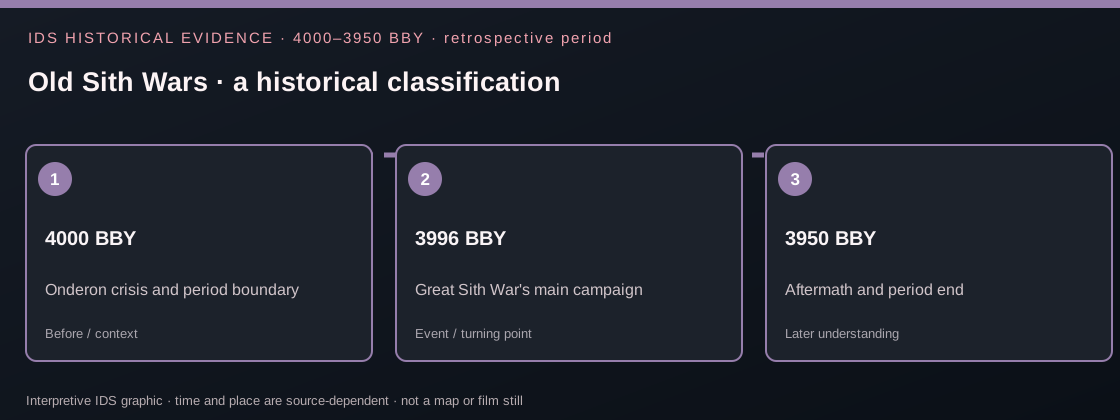
What the source establishes
Reference chronologies use Old Sith Wars to group several distinct conflicts beginning around 4000 BBY and extending through the crises after the Jedi Civil War. Other summaries emphasize 3996 BBY as the major Great Sith War year. The broad period label does not mean one uninterrupted military operation began in 4000 BBY.
Material culture and authority
Historical eras are categories imposed after events. The label creates a convenient sequence linking Sith wars, Mandalorian campaigns, Jedi disagreements and regional political crises, but it can flatten the different actors, causes and institutions involved. A useful chronology keeps the larger label without erasing those distinctions.
What the evidence does not resolve
Some summaries give the narrower main-war dates 3996–3950 BBY while others include the 4000 BBY early crisis. Both conventions should be identified as retrospective editorial periodization, not as an in-universe Senate declaration.
Test your historical reading: Is the Old Sith Wars start date identical to the Battle of Yavin 4 in 3996 BBY?
Explanation: No. The era begins around 4000 BBY in broad chronologies; the 3996 BBY battles are one later phase.
Evidence trail: The Complete Star Wars Encyclopedia (2008); The Essential Guide to Warfare (2012); The New Essential Chronology (2005). Reference, notes and further bibliography →.
c. 4000–3950 BBY · Legends · Source audit
Old Sith Wars: one period containing several different conflicts
The event established by the sources
The Old Sith Wars is a retrospective label for approximately fifty years of Legends history. The period begins near the final Beast Wars events on Onderon and reaches through the Jedi conflict with Freedon Nadd's followers, the Krath, Exar Kun's Brotherhood of the Sith and the later struggles involving Mandalorians and the Sith movements associated with Revan and Malak. The Great Sith War is narrower than the entire period. In particular, Exar Kun's galaxy-wide conflict took place around 3996 BBY rather than at the initial boundary of 4000 BBY.
Institutions, culture and power
Period names provide continuity for readers but can create a misleading impression that a single government fought the same war for fifty consecutive years. The Naddist faction was shaped by Onderon's monarchy, the Krath emerged among an aristocratic family in the Empress Teta system, and Revan's movement belonged to a different generation. People who experienced the Mandalorian campaigns did not necessarily identify themselves through earlier royal conflicts. Keeping their institutions separate shows the changing social bases of Sith allegiance, Jedi military involvement and Republic reconstruction.
Where the evidence stops
The period label is not a decree contemporaneously adopted throughout the Republic. Exact start and end dates are conventions in Legends references. They do not establish that every regional conflict occurred continuously between the two years.
Check your interpretation: Is the Great Sith War itself identical to the whole Old Sith Wars period?
Correction and insight: No. The Great Sith War forms one portion of the broader 4000–3950 BBY historical period.
Source trail: The Complete Star Wars Encyclopedia; The Essential Guide to Warfare; The Essential Atlas. Source bibliography ↗. Publication-page verification is still required.
Sources and further reading
- The Complete Star Wars Encyclopedia.
- Jason Fry with Paul R. Urquhart, The Essential Guide to Warfare, 2012.
- Old Sith Wars, Wookieepedia