
Around 4000 BBY, Satal and Aleema Keto, heirs of the Empress Teta system's aristocracy, began organizing the secret society called the Krath. The movement took its name from a frightening childhood legend and mixed elite boredom, occult experimentation, recovered Sith material, and resentment toward existing authority. Within a few years it would seize control of the Tetan government and become a major participant in the Great Sith War.
c. 4000 BBY · Legends · Historical evidence
The Krath move from secret lore toward power
What happened
Satal and Aleema Keto, heirs to Empress Teta's aristocracy, became fascinated with Sith relics and teachings. They recruited other privileged young people into a group called the Krath. The campaign guide places their original organization around 4000 BBY, while some Legends summaries emphasize a 3997 BBY founding date. The political coup is a separate later milestone.
Political and cultural consequences
A fashionable private circle can become politically dangerous when its members possess wealth, connections and inherited prestige. Access to rare Sith objects was an opportunity to claim special knowledge. The Krath's later rise to power and holy crusade cannot be assigned to the first day of the circle's existence simply because later authors describe it as one movement.
Did the Krath seize the Tetan government in 4000 BBY?
The campaign guide dates the early group to c.4000 BBY and its coup to c.3997 BBY. Other source summaries differ on the founding year.
Source: Knights of the Old Republic Campaign Guide; Tales of the Jedi; The New Essential Chronology. This is Legends history. Original publication page citations remain under review. The illustration is a clearly labelled IDS symbolic interpretation, not a licensed comic frame.
A cult born among privileged heirs
Satal and Aleema were not socially marginal outsiders.
Their wealth and position gave them access to artifacts, travel, contacts, and followers.
Ancient Sith material becomes fashionable knowledge
The cousins treated Sith history first as esoteric fascination.
The boundary between elite entertainment and political ideology collapsed as they gained real dark-side power.
A secret society becomes a government
The Krath later used droids, assassins, Sith magic, and noble networks to seize the Empress Teta system.
The movement's origin in aristocratic leisure did not limit its capacity for mass violence.
Anthropological assessment
The Krath demonstrate that radical movements can emerge from privileged groups as readily as from excluded ones.
Access to wealth and cultural capital can allow elite experimentation to become institutional power very quickly.
Tales of the Jedi / Legends research
The Krath begin as an aristocratic fascination with power
Satal and Aleema Keto emerged from the political elite of the Empress Teta system, giving their experiments with Sith lore an unusual starting point. The early Krath were not a movement of people excluded from the ruling society. Their founders had education, status and material access that could be turned toward private ritual and forbidden study. The group's name and practices became a way to distinguish an elite circle before it developed into an openly dangerous political force.
The chronology needs an explicit distinction between early organizing around 4000 BBY and the more clearly documented Krath foundation and political development around 3998–3997 BBY. Those dates should not be treated as two unrelated cults. They describe stages in the transformation of a private society into a movement willing to use Sith teaching and violent political power. The transformation later mattered to Ulic Qel-Droma and the wider Great Sith War.
Elite rebellion against inherited order
The Krath's leaders possessed privileges that allowed them to seek out rare information and experiment outside ordinary oversight. Their dissatisfaction should not be equated with the material deprivation of ordinary residents. The political consequences came partly from the power they could already access.
From curiosity to a governing project
An interest in forbidden lore is not itself the capture of government. The Krath became historically important as ritual secrecy intersected with authority over soldiers and the Tetan political system. A timeline should keep those transitions visible.
Are the 4000 BBY origins and 3998 BBY formal founding mutually exclusive?
Not necessarily. The references use different definitions of founding. IDS distinguishes early organization from the later formal movement and political seizure.
Original source: Tales of the Jedi: The Freedon Nadd Uprising; Dark Lords of the Sith; later Legends chronology. This is Legends. Political and anthropological interpretations are distinguished from scenes actually depicted in the comics, with approximate dates left explicit.
c. 4000 BBY · Legends · Historical source and institutions
The early Krath are a secret elite circle, not yet the later war state
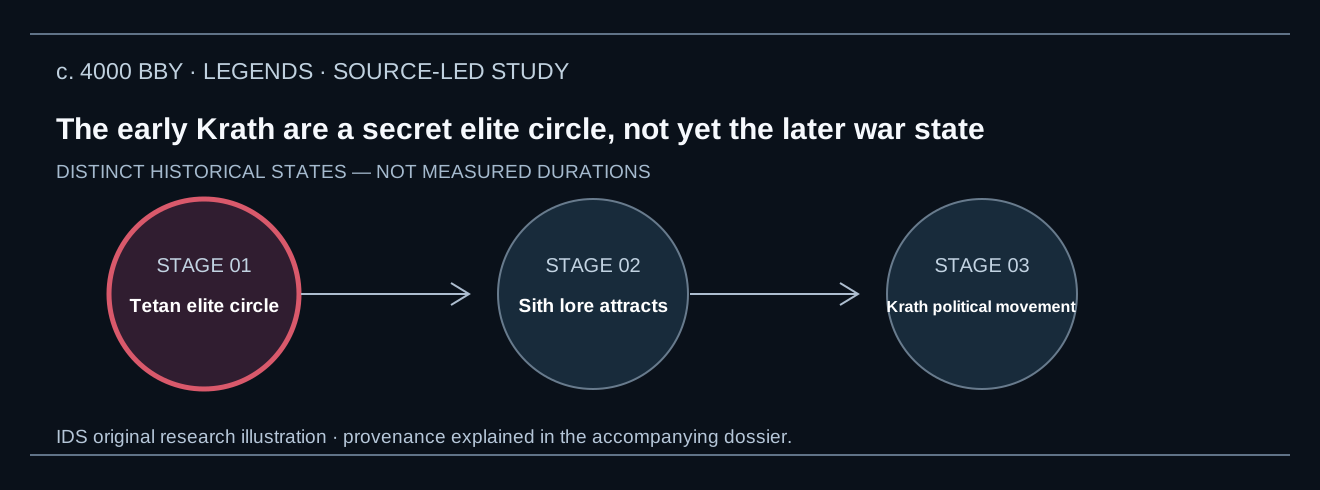
The first network grew within the aristocracy
Satal and Aleema Keto were members of the Empress Teta system's elite whose fascination with Sith history developed into the movement known as the Krath. At its beginnings, this was a secret circle of privileged individuals drawing significance from forbidden knowledge and a fearsome mythic name. The social location of its founders matters: they had resources, leisure and access to institutions that ordinary residents did not share. This does not mean everyone in the Tetan nobility supported the movement from its beginnings.
The difference between an interest circle and coercive rule
The Krath later became capable of taking over a political system and waging war against the Republic and Jedi. Projecting that military apparatus backward onto the first gatherings makes a developmental sequence look inevitable. Its early identity was built through association, secrecy, status competition and the handling of Sith artifacts. The original Dark Lords of the Sith comics supply the later central plot; a tentative dating of the first circle to approximately 4000 BBY is reference chronology, not a dated transcript of its first meeting.
A second archive entry describes organizational expansion
IDS also maintains a later record of the Krath's formal rise and another extensive article about its eventual campaigns. They should not be presented as three independent secret societies founded by the same individuals. A historical analysis tracks a single network through phases: formation, acquisition of power and the transition into overt violence. The named date is approximate, and an additional primary-source pass should examine where the original comic establishes each phase before a more exact year is claimed.
Source judgment: Did the first circle of Tetan aristocrats already have the later Krath war machinery?
Explanation: No. The early circle formed through elite fascination with Sith material. Its later military and governmental power was a separate development.
Publication provenance: Marvel: Tales of the Jedi — Dark Lords of the Sith #1. The publicly available summaries are evidence of the source corpus and selected scenes; dates from later companion or reference chronology must be independently checked against print. Continue related event →
Sources and further reading
- Tales of the Jedi.
- Krath, Wookieepedia