
Around 4000 BBY, swoop racing on Taris captured attention across the galaxy. Race organizers used hyperspace-beacon networks to distribute results beyond the planet, while Czerka Corporation funded events and profitable gambling. The Lower City's dangerous local sport became the center of the Galactic Swoop Racing Circuit.
Communications turn a local sport into mass entertainment
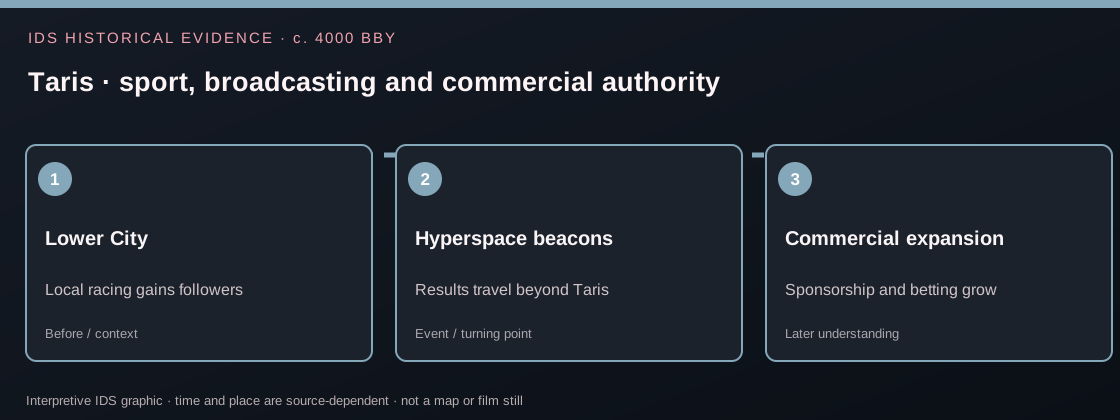
Race results traveled through hyperspace-beacon networks.
Audiences did not need to be physically present on Taris to participate as fans or gamblers.
Corporate funding scales the spectacle
Czerka investment connected racing to sponsorship and gambling.
Entertainment became another arena in which corporate power shaped urban life.
A global spectacle rooted in an unequal city
Racing flourished in Taris's Lower City despite severe class and species inequalities.
The glamour of the sport existed alongside social conditions created by the earlier civil war.
Anthropological assessment
Swoop racing shows how communication infrastructure creates shared popular culture across enormous distances.
It also demonstrates how entertainment can obscure inequality by turning a marginalized urban space into a profitable spectacle for outside audiences.
Old Republic / evidence and interpretation
How a local sport became a galactic industry
Taris's Lower City provided the social setting for the growth of swoop racing into a spectacle known well beyond its original participants. The sport required trained riders, maintenance crews and local organizers, while hyperspace communication allowed results and stories to reach audiences on other worlds. Commercial sponsorship and gambling expanded its reach. This combination of local skill and remote finance made racing a part of galactic popular culture, even though the neighborhoods where it grew remained deeply unequal.
The racing scene should be understood separately from the later 3956 BBY event in which Bastila Shan was exploited by the Black Vulkars as a racing prize. One describes the rise of an entertainment institution; the other shows how a gang used an existing sport during the Sith occupation. The earlier boom helped make a competition widely recognized and financially valuable, but not every racing event had the same participants or political purpose. The stated date is approximate and should not be mistaken for the invention of swoop vehicles.
Media networks turn local events into shared culture
Fans need not be present at the track if they can receive results and narratives through interstellar communication. Once attention flows beyond the neighborhood, outside investors and gamblers may influence how competition is organized. Popularity reshapes the sport's social meaning and the distribution of its profits.
Spectacle can hide everyday inequality
The Lower City remained a stratified place even when its racing scene attracted galaxy-wide attention. Prestige and money attached to events did not guarantee equal treatment for every resident. This contrast is part of the anthropology of entertainment: cultural visibility does not always translate into political influence.
Did Bastila's 3956 BBY rescue mark the invention of Taris swoop racing?
No. The race took place within a well-established local and galactic racing culture. The sport's earlier expansion is a separate and approximately dated development.
Research basis: Knights of the Old Republic game and Legends Taris background. Legends. Analysis is separated from direct source events. The page does not invent dialogue, casualty totals or an unsupported exact visit order.
c. 4000 BBY · Legends · original-source analysis
Taris · sport, broadcasting and commercial authority
What the source establishes
By approximately 4000 BBY, swoop racing on Taris had grown into a widely followed sport. Organizers used hyperspace beacon networks to circulate race results, and corporate money and betting helped expand its audience. The later KOTOR game in 3956 BBY shows racing as an established institution.
Material culture and authority
Sports can organize social belonging and money flows at the same time. On Taris, stadium competition and gang sponsorship sat inside a city stratified by residential level, wealth and species. The scale of galactic viewership is a story of communications infrastructure as much as athletes.
What the evidence does not resolve
The exact day of a first galactic broadcast, the earliest sponsor contract and a historical ranking of every racer around 4000 BBY are not directly recorded in the game. Later gang conflicts should not be backdated to the origin of the sport.
Test your historical reading: Does the 4000 BBY boom mean the Hidden Beks and Black Vulkars were already fighting their later war?
Explanation: No. The racing boom preceded the gang conflict associated with the later 3976–3956 BBY period.
Evidence trail: Knights of the Old Republic (2003); Knights of the Old Republic Campaign Guide and Taris/Legends chronology. Reference, notes and further bibliography →.
Sources and further reading
- Star Wars: Knights of the Old Republic.
- Taris/Legends, Wookieepedia