
- World
- Taris
- District
- Lower City
- Groups
- Hidden Beks / Black Vulkars
- Conflict ends
- 3956 BBY
In 3976 BBY, rivalry between the Hidden Beks and Black Vulkars escalated into open violence in the Lower City of Taris. The conflict lasted roughly twenty years and became part of the urban world later encountered during the Jedi Civil War. It grew inside a city whose architecture already separated populations vertically by wealth and status.
3976 BBY · Legends · Source analysis
The Lower City's divided streets
What the historical record establishes
Legends timelines place the beginning of the Hidden Bek–Black Vulkar rivalry in 3976 BBY and its resolution around 3956 BBY. In the original game, Gadon Thek and Brejik describe the local struggle through a later succession dispute. The text does not establish precisely which incident occurred in the first year. The city was already vertically divided, and the Lower City's swoop gangs became enduring centers of competition and protection.
People, institutions and consequences
The street conflict outlasted individual disagreements because it intersected with access to transport, neighborhood security, criminal markets and prestige earned in the swoop circuit. A later leadership struggle is better treated as a stage in a longer rivalry unless dated independently. Economic and spatial inequality shaped the setting, but neither the game nor the reference chronology provides a reliable annual count of street casualties.
Source trail: Star Wars: Knights of the Old Republic (2003), Taris Lower City dialogue; Bek–Vulkar gang war chronology. Original publication or game reference → Supplementary chronology →. IDS interpretations are marked as analysis; illustrated hero is original symbolic artwork, not an official scene.
A city built as hierarchy
Taris physically separated elites, workers, marginalized aliens, and the Undercity across different levels. The Lower City was not simply poorer; it was a distinct social environment with different institutions, risks, and forms of authority.
Gang power becomes easier to understand when formal state protection is unevenly distributed across that geography.
Swoop racing as sport, economy, and identity
The Beks and Vulkars were not only armed gangs. They were embedded in swoop racing culture, which provided prestige, money, recruitment, and public performance.
Competition over racing and territory could therefore fuse entertainment with organized violence.
A conflict that outlives governments around it
The war continued through the Mandalorian Wars and into the Jedi Civil War. That endurance shows how local conflicts can persist beneath much larger galactic crises.
For Lower City residents, the gang war may have been more immediate than distant Senate debates even while armies reshaped the galaxy.
Explore this entry
Why did swoop gangs matter politically?
Because they controlled local territory, organized followers, distributed protection, and shaped mobility. In neglected districts, such groups can become alternative institutions rather than merely criminal outsiders.
Why keep this on the same timeline as major wars?
Because galactic war does not suspend ordinary urban conflict. Local violence, inequality, and subcultures continue, and sometimes become more important as central authority weakens.
Anthropological assessment
The Bek-Vulkar conflict shows how inequality can produce competing institutions of belonging. Gangs can simultaneously provide identity and protection while reproducing violence and coercion.
It also reminds the timeline not to treat 'the war' as the only history happening in wartime. Urban residents can experience multiple overlapping systems of insecurity at once.
Historical judgment · 3976 BBY
Test your historical interpretation
Choose two answers. Your assessment includes an explanation and a correction for each question, not just a score.
c. 3976 BBY · Legends · evidence file
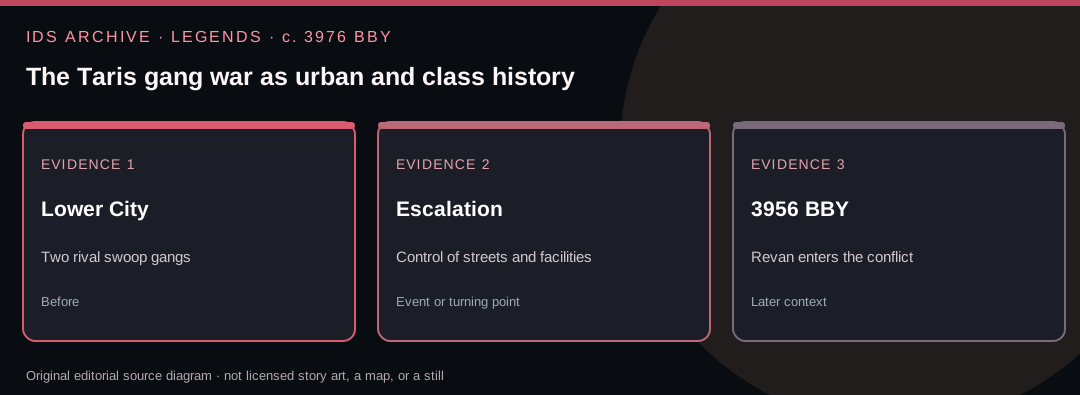
The Taris gang war as urban and class history
Published evidence
By the events of Knights of the Old Republic in 3956 BBY, the Hidden Beks and Black Vulkars are rival Lower City gangs. Later reference chronology dates the start of their conflict around 3976 BBY, so the duration is calculated rather than shown across twenty years of play.
Institutions and culture
Swoop racing is both recreation and an economy. Competitions distribute recognition and access to valuable equipment, while the built environment of Taris physically separates social classes. Gang identity emerges within that unequal urban setting.
What remains unverified
The game documents a mature rivalry but not a fully observed twenty-year conflict. Named casualties, gang memberships at the start, or a map of all territories in 3976 BBY cannot be reconstructed from the later playable scenes.
Check the historical record: Does the 3956 BBY game show how the war began twenty years earlier?
Explanation: No. It shows the later conflict; the earlier start date is retrospective chronology.
Sources and further reading
- Star Wars: Knights of the Old Republic.
- Knights of the Old Republic Campaign Guide.