
- World
- Taris
- District
- Lower City
- Gangs
- Hidden Beks · Black Vulkars
- Duration
- 3976–3956 BBY
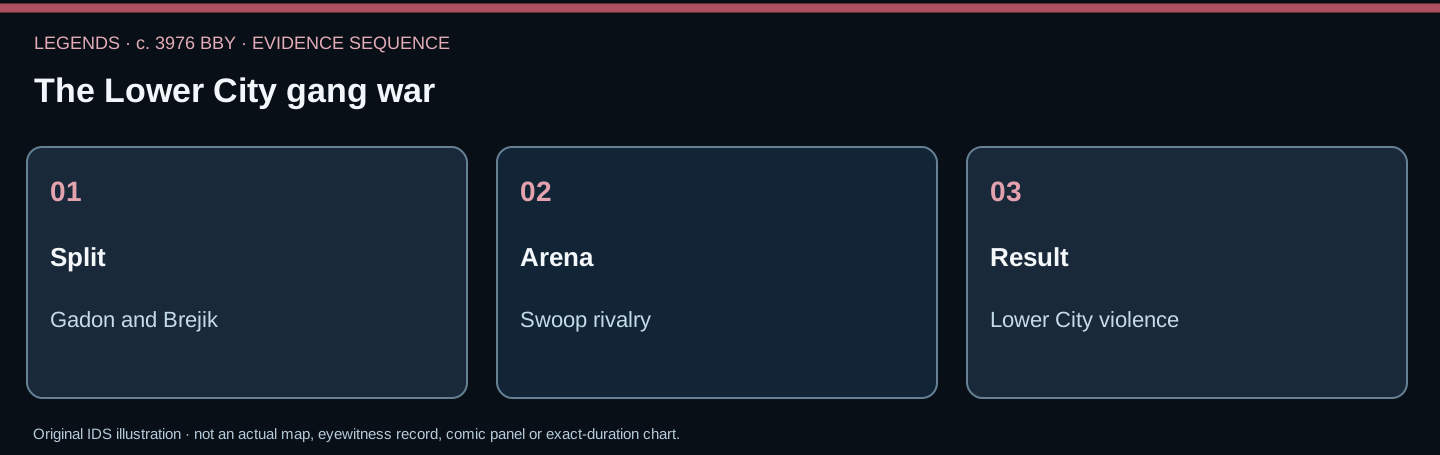
In 3976 BBY, conflict between the Hidden Beks and Black Vulkars escalated into open gang warfare in Taris's Lower City. The split centered on Brejik, Gadon Thek's adopted son and former Bek, who defected to the Vulkars after a succession dispute. Swoop racing, neighborhood control, and repeated violence became linked for the next twenty years.
3976 BBY · Legends · Source analysis
Leadership and succession
What the historical record establishes
Gadon Thek's reputation and Brejik's expectation of future leadership are central to the history that leads to the Black Vulkar–Hidden Bek feud. After a swoop accident impaired Gadon's vision, Brejik expected him to relinquish control. Gadon continued leading the Beks, and Brejik took over the rival Vulkars. Reference chronology dates the gang war from 3976 BBY, but a full year-by-year sequence for Gadon's accident and Brejik's defection is not securely established.
People, institutions and consequences
The episode is a succession dispute inside an organization with political influence but without an established public constitution. Gadon retained authority that Brejik believed he should inherit. The resulting conflict moved from one organization's internal hierarchy into the streets of the Lower City. Swoop racing provided a visible arena of competition, but it did not exhaust the rivalry's social and economic consequences.
Source trail: Knights of the Old Republic (2003), Gadon Thek and Taris quest dialogue; Bek–Vulkar reference chronology. Original publication or game reference → Supplementary chronology →. IDS interpretations are marked as analysis; illustrated hero is original symbolic artwork, not an official scene.
A succession dispute reorganizes urban violence
Brejik's break with the Beks transformed personal grievance into competition between organizations.
Leadership disputes can realign whole networks of followers.
Swoop racing becomes political space
Racing served entertainment, prestige, recruitment, and intergang competition.
Sport and street power were difficult to separate in the Lower City.
A succession dispute becomes a twenty-year street war
Brejik had expected to inherit leadership of the Hidden Beks after Gadon Thek lost his sight in a swoop accident. When Gadon refused to hand him control, Brejik defected and took leadership of the rival Black Vulkars.
The result was not a brief personal feud. Competition over territory, swoop racing, protection, and Lower City influence hardened into a conflict that outlived its original grievance by decades.
Explore this entry
Why place a gang war beside the Mandalorian Wars?
Because residents of Taris experienced overlapping forms of insecurity. Galactic war did not replace local political violence.
Did the conflict last until Taris was destroyed?
Yes. The Bek–Vulkar conflict continued into 3956 BBY, when Revan's arrival and the Sith bombardment transformed the city entirely.
Anthropological assessment
The Bek–Vulkar war shows how urban subcultures can become systems of governance where formal authority is weak.
Gangs controlled territory, protection, and social identity as well as criminal markets.
Historical judgment · 3976 BBY
Test your historical interpretation
Choose two answers. Your assessment includes an explanation and a correction for each question, not just a score.
c. 3976 BBY · Legends · Source and society
A struggle for succession becomes an urban security crisis
The division between the Hidden Beks and Black Vulkars did not begin as a war between species or a dispute imposed entirely from outside Taris. Brejik's relationship with Gadon Thek and contested succession to leadership helped split an organization into rival gangs. The conflict expanded through competition for swoop-racing influence and neighborhood power.
Taris's Lower City provided the social setting in which these organizations fought. Control of transport routes, racing infrastructure, information and protection could acquire political importance even without formal public office. However, the source does not record every street encounter between the first split and the period depicted in the game, and this article should not invent a precise annual breakdown of raids.
The date commonly used for the beginning of the feud is a retrospective Legends calculation, not a direct timestamp from the player's first conversation with Gadon. The later game establishes the rivalries and leading personalities. It does not provide a census of every civilian affected in the twenty-year period.
Check the historical interpretation: Did the Hidden Beks and Black Vulkars initially divide because they were different species?
Explanation: No. The recorded origin emphasizes leadership and succession, with the rivalry later spreading across Lower City society.
Compare a related history → · Explore the complete timeline →
Reference: Star Wars: Knights of the Old Republic (game), Gadon Thek and Brejik story. A summary or creator commentary is distinguished from an independently checked printed issue/page; no invented dialogue, visual details or casualty totals.
Sources and further reading
- Star Wars: Knights of the Old Republic.