
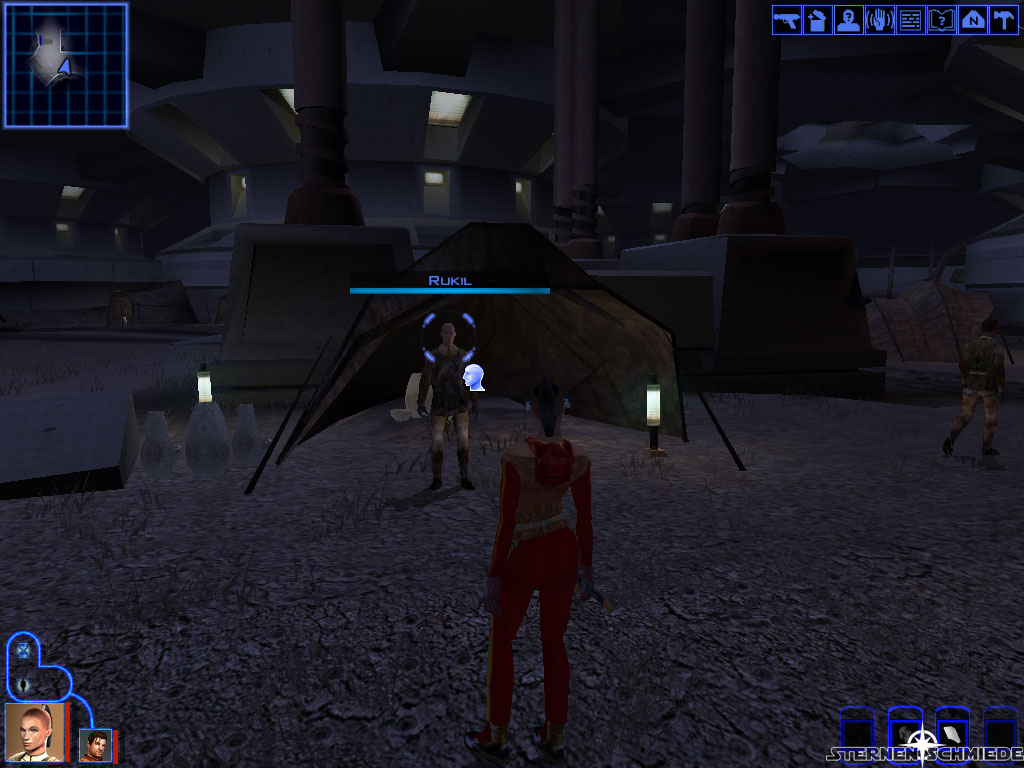
Also in 3976 BBY, open conflict began between the Hidden Beks and the Black Vulkars in Taris's Lower City. Swoop gangs were not merely recreational clubs. They offered protection, identity, employment, criminal opportunity, and social belonging in districts where official institutions were weak or hostile.
3976 BBY · Legends · Source analysis
Everyday life and unequal security
What the historical record establishes
The Hidden Beks and the Black Vulkars fought in Taris's Lower City across a conflict dated from 3976 to 3956 BBY in Legends reference chronology. The city's vertical geography segregated affluent Upper City residents, Lower City communities and the vulnerable Undercity population. By the time Revan arrived in 3956 BBY, residents described the gang violence as a longstanding danger.
People, institutions and consequences
The conflict illustrates how the same city can contain sharply different experiences of safety and mobility. Swoop crews could provide belonging and material support while also imposing threats on civilians. It would be misleading to treat every Lower City resident as a gang member or to assume that sport alone caused a twenty-year armed feud. This article foregrounds neighborhood consequences rather than repeating the succession narrative.
Source trail: Knights of the Old Republic (2003), Taris Lower City and Undercity encounters; Bek–Vulkar chronologies. Original publication or game reference → Supplementary chronology →. IDS interpretations are marked as analysis; illustrated hero is original symbolic artwork, not an official scene.
A vertically segregated city
Taris physically placed elites above poorer and more heavily alien districts. Architecture turned hierarchy into geography.
The Lower City therefore developed institutions that did not depend on upper-city legitimacy.
Why swoop gangs mattered
The Hidden Beks and Black Vulkars combined racing culture with territorial power. Their garages and contacts gave members access to transport, weapons, information, and protection.
Violence between them was both criminal competition and a struggle over social space.
The conflict outlives its founders
By 3956 BBY the feud was still shaping Lower City life. Mission Vao, Gadon Thek, Brejik, and Revan would later move through institutions whose rivalry had already lasted two decades.
Explore the event
Were the Hidden Beks simply the 'good gang'?
The game presents them more sympathetically than the Black Vulkars, but they were still a gang operating through territorial control and swoop culture. The useful distinction is relative practice, not a simple lawful-versus-criminal binary.
Why does city design matter here?
Because Taris literally separated populations by elevation. The Lower City was socially distant from elite government even when it was physically part of the same metropolis.
Quick facts
| World | Taris |
|---|---|
| District | Lower City |
| Groups | Hidden Beks, Black Vulkars |
| Duration | Begins 3976 BBY; still active in 3956 BBY |
Anthropological assessment
The Taris gang war shows how informal institutions grow when formal government distributes protection unevenly. Gangs can become social infrastructure when residents do not expect neutral state authority.
Taris's architecture matters because inequality was built into the city itself. Moving upward or downward also meant moving between different legal, economic, and ethnic worlds.
Historical judgment · 3976 BBY
Test your historical interpretation
Choose two answers. Your assessment includes an explanation and a correction for each question, not just a score.
3976 BBY · Legends · Evidence-led expansion
Taris's Lower City gang war was more than a racing rivalry
Historical sequence
By 3976 BBY, conflict between the Hidden Beks and Black Vulkars had hardened into a gang war within Taris's Lower City. Swoop racing shaped the social visibility of both groups, but criminal networks, neighborhood influence and local security mattered as well. Legends accounts place the conflict's continuation into the era of Revan's visit to Taris, many years later. A rivalry that appears in a later game is therefore part of an older urban history.
Institutions and everyday experience
The architecture of Taris sorted people physically by wealth and social position. Upper, Lower and Undercity communities faced unequal access to security, transportation and political influence. In the Lower City, a gang could offer work and belonging to some while exposing others to intimidation and violence. Those functions should not be treated as praise for coercive organizations. Nor should every Lower City resident be categorized as a member of a criminal group. The war is a case study in how city infrastructure, policing and informal organizations can reinforce one another over time.
Limits of the evidence
The 3976 BBY start is supplied by a retrospective chronology, not a published transcript of a single first confrontation; the later game takes place after the war had developed.
Historical judgment: Was the Bek–Vulkar conflict simply a professional swoop competition?
Correction and explanation: No. Racing was part of it, but the conflict involved broader control of Lower City neighborhoods and economic networks.
Source: Star Wars: Knights of the Old Republic (2003); Taris Lower City Legends history. Source bibliography ↗. Original-edition pages remain to be checked.
Sources and further reading
- Star Wars: Knights of the Old Republic.
- Knights of the Old Republic Campaign Guide.