
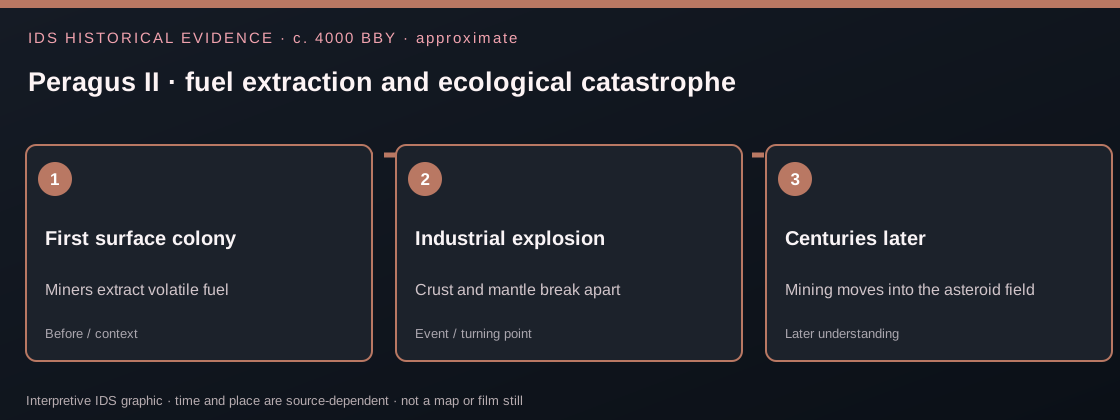
Conventional Legends chronology places a short-lived surface mining colony on Peragus II around 4000 BBY to exploit the planet's abundant low-grade starship fuel. The effort was short-lived. An accidental blast ignited unstable material below the surface, tearing away a large section of crust and mantle and creating the asteroid field later associated with the planet.
A world valuable because ships need fuel
Peragus's strategic importance came from an ordinary logistical commodity rather than rare weapons technology.
Regional transportation depended on reliable energy supplies.
Extraction triggers planetary-scale damage
A small ignition event propagated through unstable fuel deposits.
Industrial risk expanded from a workplace accident into geological transformation.
Later miners return to the debris
The original surface project was abandoned after the disaster.
Millennia later, the asteroid field itself became the site of renewed fuel extraction.
Anthropological assessment
Peragus shows how extractive economies externalize risk into landscapes.
The same resource that made settlement economically valuable also made the world physically vulnerable to the technologies used to exploit it.
Tales of the Jedi / Legends historical dossier
An early extraction project reshapes the planet
The first fuel-mining settlement on Peragus II took advantage of deposits useful for starship operations. The world was valuable because transport depended on reliable fuel, not because its inhabitants controlled a rare mystical artifact. Extracting that resource required equipment, labor and a willingness to work in a highly unstable geological environment. In the Legends background to Knights of the Old Republic II, the first industrial disaster destroyed a major section of the planetary surface and helped create the asteroid field from which later miners recovered fuel.
The conventional chronology places the first colony around 4000 BBY, but some accounts are less precise, referring to a disaster many generations before the events of the second game. The date should therefore be treated as approximate. The original colony and the later Peragus Mining Facility are distinct institutions occupying related environments. Confusing the two would erase the long history of exploitation and risk that preceded Meetra Surik's escape in 3951 BBY. The early project explains why a shattered planet could remain attractive to subsequent extractive industries, even after catastrophe.
Ordinary materials can become strategic resources
Fuel is essential to civilian shipping, trade and military operations. Its availability affects people who never work in a mine. The history of Peragus therefore belongs to transport and economic systems as well as the mining settlement itself.
Disaster does not necessarily end extraction
The early accident transformed the environment but left fuel-bearing debris that later generations could mine. This is a case in which the material aftereffects of an industrial collapse were drawn back into economic circulation, exposing different workers to danger.
Was the 4000 BBY colony the same facility destroyed during Meetra's escape?
No. The initial planetary colony and the later mining installation belonged to different periods. The later Peragus disaster happened in 3951 BBY.
Evidence and dating: Knights of the Old Republic II: The Sith Lords, Peragus background and mining facility accounts. This account identifies a Legends source and distinguishes its dated events from interpretive comparisons and later plot developments.
c. 4000 BBY · approximate · Legends · original-source analysis
Peragus II · fuel extraction and ecological catastrophe
What the source establishes
Peragus II was mined for ship fuel long before Meetra Surik arrived at the later asteroid facility. During the early surface operation, an accident ignited unstable deposits. The explosion tore material from the crust and mantle and left a ring of debris. The later asteroid mining facility, seen in 3951 BBY, belonged to a different phase of extraction.
Material culture and authority
Peragus illustrates technological risk becoming a feature of a landscape. The original settlement had a direct incentive to remove valuable fuel, but inadequate protection against ignition turned the resource into the cause of planetary damage. Centuries later workers adapted their practices by forbidding blasters and trying to control ignition hazards.
What the evidence does not resolve
The first colony's date around 4000 BBY is a conventional approximation; the KOTOR Campaign Guide says the disaster occurred hundreds of years before 3959 BBY. The exact date, number of miners and first blast site coordinates are not provided.
Test your historical reading: Was the mining colony founded around 4000 BBY the same asteroid station destroyed in 3951 BBY?
Explanation: No. The earlier surface operation ended in a planetary disaster. A later facility was built among its asteroid debris.
Evidence trail: Knights of the Old Republic II: The Sith Lords (2004), Peragus dialogue and datapads; Knights of the Old Republic Campaign Guide. Reference, notes and further bibliography →.
Sources and further reading
- Star Wars: Knights of the Old Republic II: The Sith Lords.
- Peragus II, Wookieepedia