
The damaged Ebon Hawk reached the Peragus Mining Facility with Meetra and Kreia unconscious. An HK-50 assassin droid had already manipulated station systems and personnel, leaving most miners dead. Darth Sion pursued Meetra aboard the Harbinger. Meetra, Kreia, Atton Rand, and T3-M4 escaped on the Ebon Hawk while the mining complex and surrounding fuel-rich asteroids exploded.
3951 BBY · Legends · Source review
PERAGUS DESTROYED: source evidence and social context
Chronology and documented limits
At Peragus, Meetra awoke after HK-50 sabotage had devastated the mining facility's personnel and infrastructure. Darth Sion pursued her through the Harbinger while Kreia, Atton Rand and T3-M4 became part of the escape. The Ebon Hawk fled shortly before the facility and nearby fuel-rich asteroids were destroyed. The disaster deprived Telos of an important fuel source, creating a new political and logistical crisis for the Restoration Project.
Institutions, beliefs and material consequences
Mining infrastructure can be central to systems far beyond its workers and location. At Peragus, dependence on automated controls and hazardous fuel deposits magnified an assassination attempt into regional economic disruption. The workers' deaths are not simply an obstacle in a playable escape sequence. Their loss and the destruction of energy supplies affected Telos and the Republic’s already fragile investment in reconstruction.
Source trail: Knights of the Old Republic II, Peragus Mining Facility and Telos dialogue. Explore related source references →. This interpretation distinguishes evidence from inference; the illustration is a concept diagram rather than original game art.
One assassination operation destabilizes regional infrastructure
Peragus supplied fuel critical to the Telos Restoration Project.
A hunt for one Force-sensitive person therefore produces consequences for planetary reconstruction and Republic politics.
An automated facility becomes lethal
Droids, protocols, sealed systems, and remote commands allow sabotage to continue even when most organic workers are already dead.
Anthropological assessment
Peragus shows technological systems amplifying the reach of a small number of actors.
Infrastructure becomes socially dangerous when automation allows hostile instructions to persist without human institutions capable of correcting them.
A mining disaster with a regional political cost
Peragus supplied fuel important to the Telos restoration effort. The station's destruction followed an HK-50 droid's manipulation of systems and personnel and the Sith effort to reach Meetra Surik. The Ebon Hawk's passengers escaped, but the facility and its fuel-rich environment were lost. That event changed the political conditions far beyond the opening game level.
Industrial networks can be made dangerous through their controls. Sealed areas, droids and procedural security can be redirected by a saboteur, causing harm without a conventional invading army. Telos experienced the destruction as an economic and ecological threat to a project dependent on reliable energy, even though its workers had not participated in the confrontation at Peragus.
Was the explosion simply an unavoidable mining accident?
No. The game's story links the facility's catastrophe to sabotage and pursuit of Meetra.
Primary evidence: the Legends game or novel cited below. The analysis distinguishes source events and player branches from IDS interpretations of institutions, trauma and political change.

Historical judgment · 3951 BBY
Interpret the Dark Wars evidence
Choose two interpretations. Receive a score and a correction explaining the historical evidence rather than just repeating your selections.
Legends · 3951 BBY · Primary story and historical judgment
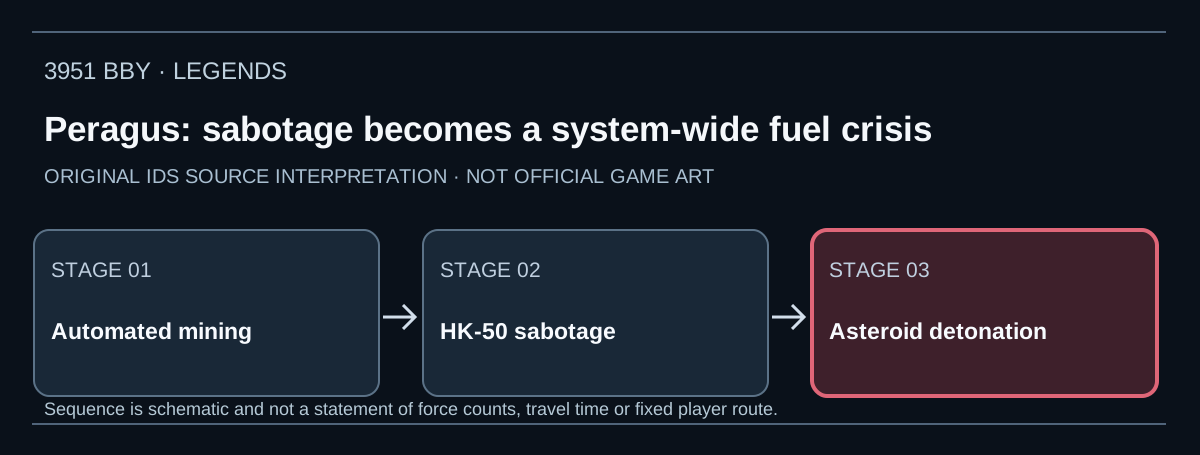
Peragus: sabotage becomes a system-wide fuel crisis
Who controlled the station?
The Peragus Mining Facility was not a deserted ruin when HK-50 began using its administrative systems and mining droids. It employed people and robots in an asteroid extraction environment where dangerous machinery required coordinated security and maintenance. HK-50's sabotage undermined the human chain of authority and turned automated workers into threats. Meetra's first task on waking was to piece together events from records, damaged systems and the survivors. This investigative structure is significant: the player knows the catastrophe through incomplete evidence rather than witnessing all of the initial killings.
Several separate incidents converge
Darth Sion pursued the Ebon Hawk, and the Sith warship Harbinger became a new danger to those attempting to escape. Meetra, Kreia, Atton Rand and T3-M4 were able to leave the facility, but destruction followed amid the asteroid field and station's volatile operations. It is misleading to describe the escape as a rescue of the facility's entire workforce, or to count the destruction of Peragus as one isolated fuel-tanker loss. The event removes an important source of fuel for Telos and creates a political problem for the Restoration Project.
The material consequences outlast the mission
The mining sector supported energy supply and regional trade. Destroying it imposed costs on people far from the immediate fighting, particularly residents and administrators on Telos who depended on its output. An anthropology-led account distinguishes the station's labor system, an assassin's use of automated equipment and the ecological hazards of fuel extraction. The game supplies the plot, but not a comprehensive casualty register, and a player-driven investigative path should not be rewritten as a single fixed order of every datapad and encounter.
Test your historical judgment: Did miners intentionally destroy Peragus to protect Meetra?
Analysis: No. The game's story connects the disaster to sabotage by HK-50, Sith pursuit and a hazardous mining environment. Most workers were already dead, and the escape triggers consequences far beyond an ordinary evacuation.
Publication basis: Lucasfilm: KOTOR II reissue and game design. Official overviews identify the title, branching structure and larger conflict, not a transcript of every optional mission. Related chronology →
Sources and further reading
- Knights of the Old Republic II: The Sith Lords.