
In 3955 BBY, Supreme Chancellor Tol Cressa initiated the Telosian Restoration Project. Telos IV had been devastated by Saul Karath's bombardment three years earlier. The Republic chose the planet as a test case for ecological and economic restoration, constructing Citadel Station above the world and supporting efforts to rebuild the surface.
3955 BBY · Legends · Source review
RESTORING TELOS: source evidence and social context
Chronology and documented limits
The Republic initiated the Telosian Restoration Project after Saul Karath’s devastation of Telos IV in 3958 BBY. The project is commonly dated to 3955 BBY and involved an orbital Citadel Station, controlled surface zones and restoration technology. Telos became a test case for ecological repair with implications for the recovery of other damaged Republic worlds. The precise completion dates of its numerous projects cannot be inferred from the program’s founding.
Institutions, beliefs and material consequences
Ecological repair required more than planting vegetation: it relied on funding, institutions, scientific expertise, transport, security and the political power to enforce access rules. The station’s administrators and competing corporate interests affected local choices, while refugees and surviving Telosians experienced reconstruction unevenly. A successful experiment would have been a model for rebuilding after war, but the investment also created a strategically vulnerable facility.
Source trail: Knights of the Old Republic II: The Sith Lords, Citadel Station and restoration quests. Explore related source references →. This interpretation distinguishes evidence from inference; the illustration is a concept diagram rather than original game art.
Reconstruction becomes a demonstration project
Telos was intended to prove that devastated ecosystems could be repaired.
Success could provide techniques and political hope for other war-damaged worlds.
G0-T0 droids emerge from the restoration effort
Aratech produced infrastructure-planning droids to support recovery.
The project would later connect directly to the droid G0-T0 and the Republic's economic crisis.
Anthropological assessment
Telos shows reconstruction functioning as political symbolism as well as environmental work.
A state rebuilding one highly visible world can use that project to communicate that recovery remains possible across the wider polity.
What the Republic hoped to rebuild
The Telosian Restoration Project was more than a construction contract. Supreme Chancellor Tol Cressa sought to prove that a world devastated by a Sith bombardment could regain environmental and economic stability. Citadel Station supplied a base for managing infrastructure and the developing recovery of the surface, but a station in orbit did not itself mean Telos had been restored.
Rehabilitation required technology, workers, steady fuel supplies and governance. The later Peragus catastrophe showed how regional logistics could imperil the project. Planning droids made for the restoration also became connected to the unusual history of G0-T0. Telos therefore joins ecology, public confidence and automated decision-making within one long institutional experiment.
Was Telos fully restored in 3955 BBY?
No. The event records the beginning of a difficult project whose environmental and political consequences continued for years.
Primary evidence: the Legends game or novel cited below. The analysis distinguishes source events and player branches from IDS interpretations of institutions, trauma and political change.
Historical judgment · 3955 BBY
Interpret the Dark Wars evidence
Choose two interpretations. Receive a score and a correction explaining the historical evidence rather than just repeating your selections.
Legends · 3955 BBY · Primary story and historical judgment
Telos rebuilds through contested institutions
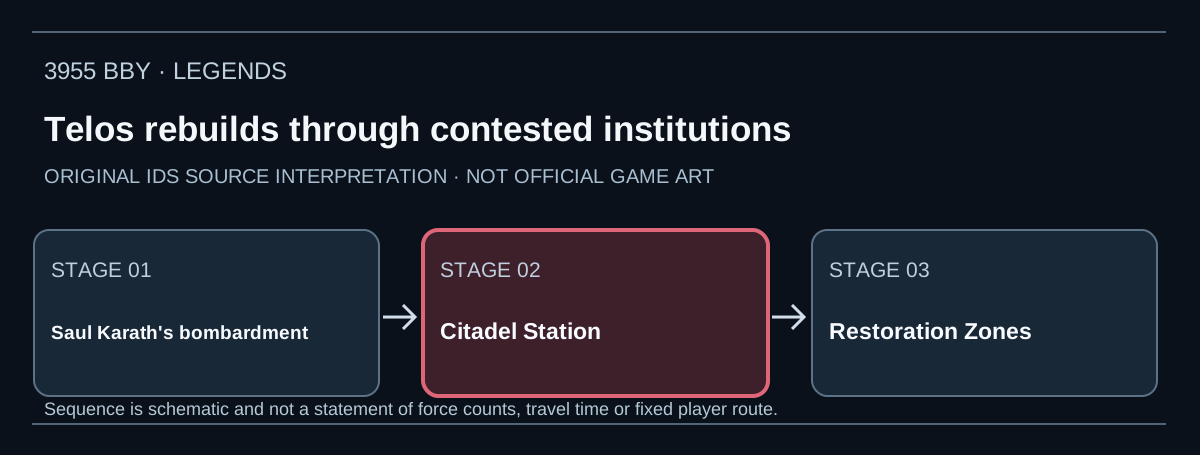
The Republic tries to reverse environmental destruction
Telos IV was devastated when Saul Karath turned against the Republic during the Jedi Civil War. The later restoration initiative aimed to recover a living planet, not merely retake a port or garrison a ruined military base. Citadel Station served as an orbital population center and administrative platform while restoration zones on the surface were tended by machines and personnel. The station's separation from the surface shaped everyday access to housing, employment, equipment, food and transportation. Rebuilding therefore depended on the continuity of public infrastructure rather than one dramatic repair.
Ecology becomes a matter of government credibility
For Supreme Chancellor Tol Cressa, Telos had symbolic value as an early test of whether the Republic could repair worlds destroyed in its wars. Funding and the management of restoration zones also exposed disagreement between public environmental goals and corporate profit. Czerka's influence, the Ithorian restoration movement and Telos Security did not constitute one unified organization. Those competing interests demonstrate that a recovery project can remain politically contentious even when all parties speak of reconstruction.
An experiment connected to later failures
The endangered fuel supply following the Peragus disaster threatened operations at Citadel Station. Its vulnerability demonstrates how rebuilding one world can depend on mining and transit elsewhere. The later Sith attack on Telos is a separate event in 3951 BBY; it should not be folded into the original launch year. Similarly, the G0-T0 administrative experiments associated with Republic recovery require source-by-source dating instead of treating all droid interventions as a single Telos project.
Test your historical judgment: Was Telos's restoration simply a military fortification programme?
Analysis: No. It combined environmental recovery, settlement, supply, finance and claims about the Republic's ability to repair a devastated world. Defense mattered later, but rebuilding was a broader institutional project.
Publication basis: Lucasfilm's KOTOR II support record. Official overviews identify the title, branching structure and larger conflict, not a transcript of every optional mission. Related chronology →
Sources and further reading
- Knights of the Old Republic II: The Sith Lords.
- Knights of the Old Republic Campaign Guide.