
- World
- Onderon
- Capital
- Iziz
- Naddist leaders
- King Ommin · Warb Null
- Outcome
- Uprising defeated
Two years after the Beast Wars appeared to end, Onderon discovered that political reconciliation had not destroyed the older Naddist movement. During preparations to remove the sarcophagi of Queen Amanoa and Freedon Nadd from Iziz to Dxun, several hundred Naddists burst into the spaceport from below the city. Led by Warb Null, they seized the remains and retreated into Iziz's immense underground levels. The funeral procession had become the opening move of a counterrevolution.
3998 BBY · Legends · Original comic evidence
Why a funeral became a battle over the state
What happens in the story
Under the new joint rule of Galia and Oron Kira, Onderon was supposed to have moved beyond the Beast Wars. Supporters of Freedon Nadd remained organized within Iziz and its military. Their raid on the attempted transfer of Nadd's and Amanoa's remains was not random theft: custody of the sarcophagi carried religious and political significance. Warb Null led the attack, but Ommin's continuing Sith allegiance and control of hidden spaces posed the larger challenge.
Why the event matters
The new royal government controlled visible institutions, yet the Naddists still drew strength from loyalties embedded in lower levels of the city. Retaining a tomb or sacred object can preserve a rival claim to legitimacy even when the person it commemorates has long died. The conflict demonstrates why reconciliation after a civil war involves archives, places, military networks and memories as well as rulers. It was a new 3998 BBY uprising, not the return of the 4000 BBY Beast Wars battle on the same date.
Did Amanoa's defeat in 4000 BBY eliminate every Naddist?
No. The 3998 BBY uprising shows the continued organization and royal-military support of Naddist networks.
Did Ulic's defeat of Warb Null rescue Arca Jeth immediately?
No. King Ommin captured Arca. Victory in a duel was not a victory over the full uprising.
Why did the parties compete over the remains?
The remains of Nadd and Amanoa had religious significance and functioned as material claims about who possessed legitimate authority on Onderon.
Read the original story: Tales of the Jedi: The Freedon Nadd Uprising #1–2 (1994); comic credits verified by the Grand Comics Database. Open Marvel / comic-issue reference →. This page's diagram is original IDS editorial art rather than a reproduced publication frame. Dates and interpretations are Legends, and publication variants are not silently merged.
A funeral procession becomes a battle over legitimacy
The Jedi wanted the sarcophagi removed because Freedon Nadd's remains and memory still carried dark-side power inside Iziz. The Naddists understood the same objects differently: possession of the tombs represented continuity with the old sacred monarchy.
This was therefore not simple grave robbery. Both sides treated material remains as politically active objects capable of shaping the future of the state.
The defeated movement had gone underground—literally
Iziz extended for kilometers beneath its visible city. Naddist forces used that hidden infrastructure to move fighters and war machines beyond the easy reach of Galia's new government.
The revolt demonstrates that taking a palace does not automatically produce control over the social networks, physical spaces, and institutions that sustained the previous regime.
King Ommin reveals himself
Galia's father Ommin had been hidden away on life support, apparently removed from active rule. In reality he remained a committed follower of Nadd and leader of the surviving movement.
When Arca Jeth, Ulic Qel-Droma, and Galia approached him, Freedon Nadd's spirit appeared. Ommin attacked Arca with dark-side power and captured him, converting a family secret into a state crisis.
Ulic kills Warb Null but cannot save Arca
Ulic defeated Warb Null in a lightsaber duel, removing one of the revolt's most visible champions. The tactical victory did not prevent Ommin from escaping with Arca.
The episode is a useful reminder that heroic combat and strategic outcome are not the same thing. A duel can be won while the larger mission fails.
The crisis forces a debate on Coruscant
Ulic requested help from the Republic and Jedi. On Coruscant, senators debated whether fighting the dark side was a Republic responsibility or a matter for the Jedi alone.
Jedi Master Thon argued successfully for intervention. The debate exposes an old constitutional problem: when a religious order and a federal state are deeply intertwined, where does one institution's responsibility end and the other's begin?
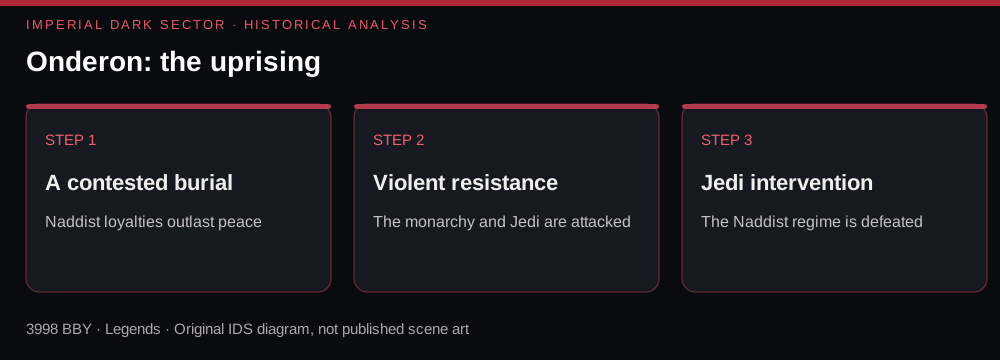
Event sequence
The Beast Wars end; Galia and Oron Kira take power.
Naddists seize Nadd and Amanoa's sarcophagi during the funeral procession.
King Ommin captures Arca Jeth; Ulic calls for help.
Republic ships and Jedi reinforcements arrive, leading to the Second Battle of Onderon.
Satal and Aleema Keto leave Onderon with Sith knowledge that helps create the Krath.
Explore this entry
Why were the sarcophagi so important?
Because in this setting relics were not merely symbolic. Freedon Nadd's legacy included a continuing spirit presence, and the tombs functioned as focal points of political and religious authority.
Was this just a Sith cult revolt?
No. The Naddists included religious followers, military mutineers, royal loyalists, and people tied to the old political system. Treating them as only a cult hides the institutional depth of the movement.
What makes this uprising historically important beyond Onderon?
Satal and Aleema Keto encountered Sith knowledge during the crisis. Their later Krath movement carried the consequences of Onderon's unresolved Naddist history into the Empress Teta system and eventually the Great Sith War.
Anthropological assessment
The uprising shows how material culture, hidden infrastructure, kinship, and religion can preserve a defeated political order. Galia held the throne, but Naddist authority survived in tombs, underground networks, military loyalties, and her own father.
It also illustrates how post-conflict settlements fail when they change leadership without changing the deeper institutions that made the previous regime durable.
Primary-source dossier · Tales of the Jedi
The uprising: evidence, ritual and failed containment
The trigger was an effort to remove two bodies. Galia's government and its Jedi allies intended to transfer the sarcophagi of Freedon Nadd and Queen Amanoa to Dxun, removing prominent relics of the old dynasty from the capital. The Naddists treated those remains as proof that their former sacred monarchy still mattered. Warb Null's force emerged from an underground boring vehicle and seized the sarcophagi. This was a coordinated political act that relied on familiar ground and organized followers, not an inexplicable eruption of dark-side magic.
The subsequent visit to King Ommin revealed that the palace's break with Naddist power had not reached every part of the royal family. Ommin's long isolation concealed active loyalty to Freedon Nadd. Ulic's defeat of Warb Null did not rescue Arca Jeth, whom Ommin held captive. That sequence explains why winning an individual duel did not solve the insurgency and why help from outside Onderon became necessary.
Relics as rival claims to authority
The Jedi expected that moving the remains could weaken the old movement's hold over Iziz. The Naddists regarded the same remains as sacred objects whose control helped legitimate a rival government. This is a conflict over access to the past, not merely the physical security of a tomb. The later movement of the bodies to Dxun also shows that removal from one city cannot undo an ideology already shared among living adherents.
Royal family, hidden city and federal intervention
Onderon's vast underground infrastructure enabled followers of the prior regime to organize outside ordinary palace surveillance. Galia's father remained a rallying point, while the Republic Senate had to decide whether protecting a Jedi Master and an allied government justified deployment. The result drew a local struggle into the Republic's political and military system.
Which outcome made the uprising more than an attempted theft of sarcophagi?
King Ommin's capture of Arca and the Naddists' continued control of important parts of Iziz turned the relic seizure into a governing crisis. Ulic's victory over Warb Null did not end the operation.
Source trail: Tales of the Jedi: The Freedon Nadd Uprising #1–2 (1994). Compare the second battle and the Krath founding. This is the Legends continuity; descriptions of policy and cultural practice are IDS analysis, not invented scenes.
3998 BBY · Legends · Primary-story and chronology comparison
The politics of funerary remains and underground power
The 3998 BBY Freedon Nadd Uprising was not the late phase of the 4000 BBY Battle of Iziz under another name. After Amanoa's death and the new union of Galia and Oron, the planned movement of the royal sarcophagi offered underground Naddist supporters a visible target. Attacking a funeral procession allowed the opposition to challenge the new government through possession of symbols associated with the previous ruling order.
The public attack was led by Warb Null, while King Ommin's continuing relationship to the Sith tradition gave the underground movement an institutional base. The presence of hidden spaces beneath the city is significant: political control over a palace or spaceport did not imply the ability to monitor every subterranean stronghold. An account should keep direct depictions of the procession and combat separate from inferences about the detailed beliefs or family histories of everyone who joined the uprising.
Marvel's catalog explicitly identifies The Freedon Nadd Uprising as its own two-issue 1994 comic series, separate from the 1993 Tales of the Jedi miniseries. Later accounts connect its outcome to the broader Old Sith Wars. The publication sequence should not be mistaken for a different historical chronology: the conflict comes approximately two years after the Beast Wars settlement. The battle, the theft of remains and the subsequent search for Naddist power are related but distinguishable stages.
Historical judgment: Did the 3998 BBY uprising begin before the 4000 BBY political settlement?
Explanation: No. It emerged afterward, when the new government attempted to move the old royal and Sith-associated remains.
Follow the complete Onderon political history →
Source reading: Marvel issue #2 catalog; original Tales of the Jedi comic sequence and later Tales of the Jedi Companion for dates. Sourcebook page and precise panel citations still require original-issue proofing. IDS political interpretation does not constitute quoted dialogue.
Sources and further reading
- Tom Veitch, Tales of the Jedi – The Freedon Nadd Uprising 1–2.
- The New Essential Chronology.
- Knights of the Old Republic Campaign Guide.