
Late in 4000 BBY, the Beast Wars ended with a Beast Rider victory. The conflict had begun around 4350 BBY but grew from exile policies established under Freedon Nadd centuries earlier. The fall of Queen Amanoa's government ended the long phase in which Iziz defined the wilderness communities as criminal outsiders beyond legitimate society.
4000 BBY · Legends · Historical evidence
The Beast Wars end through reintegration
What happened
The Battle of Iziz concluded a conflict whose recognized start lies near 4350 BBY. The Beast Riders had been created by earlier royal exile policies but survived and formed a rival community. Defeating Amanoa gave those former outsiders a path into political life alongside the city that had excluded them.
Political and cultural consequences
Peace was more than the transfer of palace guards. The new relationship between Galia and Oron Kira linked dynasties and made acceptance of the wilderness population part of a shared royal future. Sources do not document every reaction among city families or Beast Rider settlements, and the later Naddist uprising shows that reconciliation was not the disappearance of all conflict.
Did Onderon become permanently free of conflict after the 4000 BBY battle?
No. The Beast Wars ended, but the Freedon Nadd Uprising followed around 3998 BBY.
Source: Tales of the Jedi; Tales of the Jedi Companion. This is Legends history. Original publication page citations remain under review. The illustration is a clearly labelled IDS symbolic interpretation, not a licensed comic frame.
The outsiders enter the city as victors
Beast Riders had originated among people expelled from Iziz.
Their final victory reversed the political hierarchy that had defined them as uncivilized.
Two Onderonian societies begin political reunification
Galia and Oron Kira embodied the alliance between royal Iziz and Beast Rider leadership.
The end of war required more than military victory; it required a new relationship between communities.
Naddism survives the military defeat
King Ommin remained alive underground and continued serving Freedon Nadd.
The Naddist Uprising two years later showed that the ideology had not disappeared with Amanoa.
Anthropological assessment
The end of the Beast Wars demonstrates that winning a civil war does not automatically resolve the institutions or beliefs that created it.
Political reconciliation began through new alliances and kinship, while defeated Naddist networks survived beneath the surface.
Tales of the Jedi / Legends research
The Beast Wars end through a political alliance
By 4000 BBY, the long conflict between the fortified city of Iziz and the Beast Riders had hardened into an inherited political division. The court treated people outside the walls as enemies and outcasts. The visiting Jedi initially heard that account through Queen Amanoa, but the apparent kidnapping of Princess Galia revealed a different story: Galia and Oron Kira had a relationship that challenged the separation between the two societies. Reaching Oron's community changed the visitors' understanding of the people they had been sent to confront.
The fighting ended only after the confrontation with the Queen's dark-side power, the intervention of Arca Jeth and the collapse of Amanoa's rule. The union of Galia and Oron Kira gave the former opponents a means to recognize a shared governing order. The resolution should not be narrated as though a wedding instantly erased generations of grievances. Its significance was that a new political relationship became possible after the court's account of the Beast Riders had been discredited.
Social categories help sustain war
The words used to describe a rival community affect what kinds of actions appear legitimate. Treating Beast Riders as a permanent threat made negotiation difficult. The Jedi's discovery that the supposed captive wanted to marry Oron forced them to question the language inherited from Iziz's rulers.
Peace has to be governed
Ending a battle and establishing lasting institutions are different tasks. Galia and Oron's later rule was tested again in the Freedon Nadd Uprising. That later conflict shows why the end of the Beast Wars should be presented as a major transition rather than the end of every political dispute on Onderon.
Did the Beast Riders simply vanish after the war?
No. Their lineages and institutions became part of Onderon's changing political order through the relationship of Galia and Oron Kira.
Original source: Tales of the Jedi #1–2, Beast Wars of Onderon; subsequent Freedon Nadd Uprising #1–2. This is Legends. Political and anthropological interpretations are distinguished from scenes actually depicted in the comics, with approximate dates left explicit.
4000 BBY · Legends · Source and social history
The Beast Wars end without erasing their causes
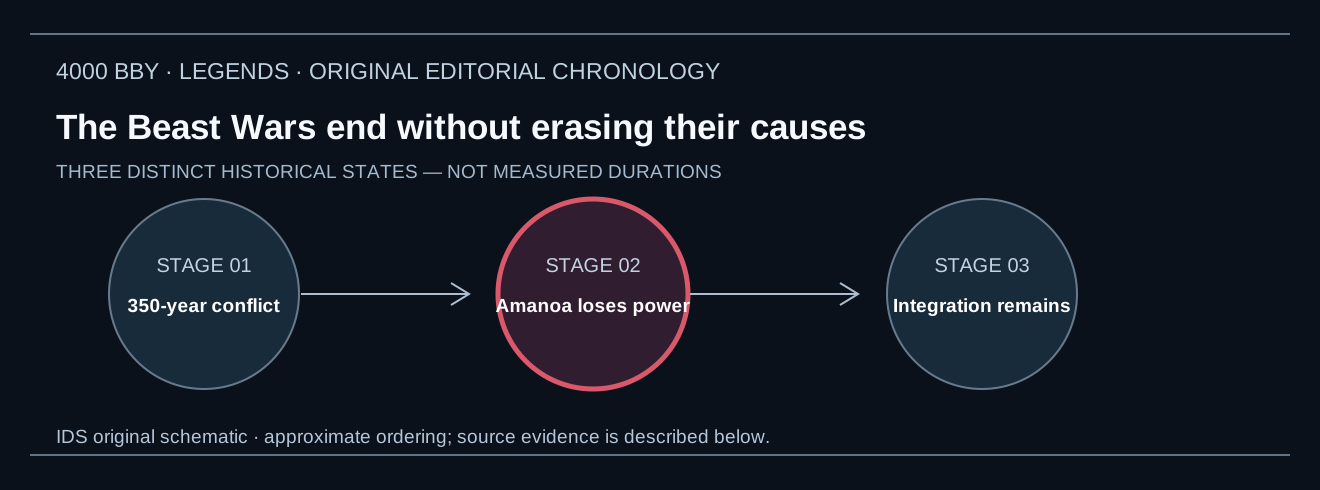
A conventional war name hides a social boundary
The conflict known as the Beast Wars opposed Iziz to communities beyond its walls. Earlier rulers used exile to remove people whom the city considered dangerous or undesirable, and those excluded people developed relationships and political institutions in the wilderness. The term Beast Rider reflects a distinctive material adaptation: mounted beasts made movement and warfare possible in terrain where city walls offered no safety. The date 4000 BBY identifies the end of the long series of wars, not a claim that every clash took place in a single uninterrupted campaign.
An unexpected cross-boundary coalition
Princess Galia's desire to marry Oron Kira exposed flaws in Queen Amanoa's account of the wilderness peoples. The Jedi who arrived as mediators came to understand that the conflict was not simply between civilized city inhabitants and animal-riding enemies. As Arca Jeth intervened and the Queen's power collapsed, the balance shifted toward an accommodation in which formerly excluded groups could enter public political life. That development is supported by the Tales of the Jedi narrative; it does not document the exact legal structure of every settlement outside Iziz.
Why cultural peace can lag behind combat
Ending a campaign does not immediately repair generations of mistrust, family separation or unequal claims to citizenship. The alliance between Galia and Oron Kira created a dynastic symbol of the new order, while the older Naddist network remained capable of later mobilization. An anthropological reading therefore distinguishes three outcomes: an end to the fighting, a new basis for political legitimacy, and the much slower work of incorporating people previously defined as outsiders.
Source judgment: Did the fall of Amanoa automatically eliminate every Naddist allegiance?
Explanation: No. The later Freedon Nadd Uprising establishes that Naddist loyalties and networks remained despite a new political settlement at Iziz.
Original publication context: Marvel's Tales of the Jedi overview. Public publisher summaries identify the story and creative edition, but precise birth years and off-panel histories often come from Legends reference chronology and require full print verification. Related timeline event →
4000 BBY · Legends · Primary-story and chronology comparison
A war can end before former adversaries fully trust one another
The end of the Beast Wars follows the Battle of Iziz, but the entries answer different historical questions. The battle record describes armed confrontation and the collapse of Amanoa's immediate control. This article should explain the broader political result: the previous distinction between the protected city and its excluded wilderness population was no longer sustainable in its old form. The Beast Riders emerged not simply as conquered combatants but as participants whose leaders would now help shape the future of Onderon.
The relationship between Galia and Oron Kira is central. A planned marriage revealed that the border between the populations had long been crossed in personal life, despite the official royal narrative of intractable enemies. After Arca's intervention, that relationship supplied a way to make political reconciliation publicly legible. The related binding-ceremony article covers its own ritual and kinship implications; it should not be mistaken for a second, independently sourced military victory.
Neither Marvel's account of the original comic nor the earlier Legends reference dates establish a universal peace treaty signed by every settlement in the wilderness. The 3998 BBY Naddist uprising is direct narrative evidence that important members of Iziz continued to reject the new order. Victory is therefore a change in institutions and alliances, not proof that all political disagreement had disappeared.
Historical judgment: Was the end of the Beast Wars also the end of every Naddist organization?
Explanation: No. The subsequent Freedon Nadd Uprising demonstrates that older underground networks retained support.
Follow the complete Onderon political history →
Source reading: Marvel's 1993-series retrospective; original Tales of the Jedi comic sequence and later Tales of the Jedi Companion for dates. Sourcebook page and precise panel citations still require original-issue proofing. IDS political interpretation does not constitute quoted dialogue.
Sources and further reading
- Tales of the Jedi.
- Beast Wars, Wookieepedia