
In 4000 BBY, Galia of Iziz and Oron Kira of the Beast Riders were joined in an Onderonian Binding Ceremony. Their relationship had already been central to the plot that exposed Queen Amanoa's Naddist rule. The marriage transformed that political alliance into kinship and helped unite communities that had fought for generations.
4000 BBY · Legends · Historical evidence
The binding of Galia and Oron Kira
What happened
Before the final fighting, the visiting Jedi discovered a wedding feast at the Beast Rider fortress and learned that Galia and Oron Kira were in a relationship. Their alliance contradicted Queen Amanoa's description of the wilderness as a wholly alien enemy. The binding associated with the post-battle settlement helped connect the royal house to the Beast Rider lineage.
Political and cultural consequences
Marriage can create kinship between groups with opposed political histories. The ceremony offered a public sign that an old boundary between city and wilderness was changing. It is not evidence that every later dispute vanished. Accounts of the earlier feast and the postwar ceremony should not be retold as two unrelated marriages invented from brief sources.
Was the relationship unrelated to the end of the Beast Wars?
No. It became a visible part of the political reconciliation between Iziz and the Beast Riders.
Source: Tales of the Jedi: Ulic Qel-Droma and the Beast Wars of Onderon; binding-ceremony references. This is Legends history. Original publication page citations remain under review. The illustration is a clearly labelled IDS symbolic interpretation, not a licensed comic frame.
Marriage as political action
Galia and Oron chose one another despite belonging to opposing sides of the planetary conflict.
Their partnership challenged inherited political categories before the war was formally over.
Royal and Beast Rider lineages join
Marriage connected the House of Kira to the royal family of Iziz.
Kinship became one mechanism for translating battlefield alliance into a durable political settlement.
Anthropological assessment
The Binding Ceremony demonstrates how marriage can function as statecraft without being only an arranged diplomatic transaction.
Galia and Oron's personal relationship acquired political meaning because it joined social groups whose institutions had defined one another as enemies.
An alliance that reshapes Onderon's political landscape
Galia's relationship with Oron Kira became part of the political resolution of the Beast Wars. The conflict had divided the citizens of Iziz from the Beast Riders outside the city for generations. Earlier accounts focused on raids and a supposedly hostile population, but the Jedi discovered that the princess and the Beast-Lord had developed a relationship that challenged the royal narrative. Their union thus represented a potential settlement across a boundary maintained by the ruling Naddist establishment.
Kinship is also diplomacy
Marriage or binding rituals can bring groups into relations of obligation and recognition, not merely record two people's private feelings. In this episode the future of the monarchy and the Beast Rider communities was implicated in the couple's decision. An alliance that changes how people are related can create a political language for ending conflict, although it does not remove every economic or ideological disagreement.
Changing the labels of the enemy
The story first presents the Beast Riders largely through the terms of their royal opponents. New information forces the visiting Jedi to reconsider those descriptions. The shift from 'barbaric kidnappers' to legitimate negotiators matters because the classification of a group influences whether outsiders treat its members as political actors or simply targets of force. The binding belongs to the aftermath of that reconsideration.
Did Galia's relationship settle every later Onderon conflict?
No. It contributed to ending the Beast Wars, but later fighting involving Freedon Nadd's legacy and other factions forms a separate history that cannot be collapsed into this agreement.
Evidence note: Dates, participants and outcomes follow the Legends source material identified below. Interpretive comparisons are IDS analysis, not invented historical dialogue or tactical reporting.
Tales of the Jedi / Legends historical dossier
A wedding before its wider political success
The binding of Galia and Oron Kira took place at Fortress Kira as part of a plan that challenged the story told by Queen Amanoa's royal court. From the perspective of Iziz, Beast Riders had raided the palace and taken the princess into the wilderness. The visiting Jedi first encountered the situation through that account. Discovering Galia's willingness to join Oron changed its meaning. The relationship was not simply a ransom demand; it created a potential alliance between a royal family and the people the city had long treated as outlaws.
The ceremonial feast occurred while the Beast Wars had not yet been resolved through the fall of Amanoa. This sequencing explains why the wedding and the later political settlement deserve separate records. Ritual can establish a relationship before state institutions decide whether to recognize it. In this case the family alliance helped make negotiation possible, but its promise depended on defeating the existing Naddist power structure. Once the immediate war ended, the couple's bond could carry authority across two previously opposed communities.
Ritual communicates legitimacy to participants
A binding ceremony gives a relationship public meaning before relatives and allies. Its witnesses can recognize obligations extending beyond the spouses, making a ceremony consequential for people who were not themselves at the center of it.
The Jedi learn the limits of a single witness
The initial account from Iziz presented the Beast Riders as kidnappers. Direct contact with the couple revealed a different political reality. The shift is a useful example of why an outsider should compare conflicting perspectives before accepting the categories favored by a governing authority.
Had Queen Amanoa already been defeated when the Fortress Kira feast took place?
No. The ceremonial alliance occurred during the ongoing Beast Wars crisis; the later political settlement followed the defeat of Amanoa's rule.
Evidence and dating: Tales of the Jedi: Ulic Qel-Droma and the Beast Wars of Onderon, Fortress Kira sequence. This account identifies a Legends source and distinguishes its dated events from interpretive comparisons and later plot developments.
4000 BBY · Legends · Source and social history
Galia and Oron Kira transform a private marriage into a public treaty
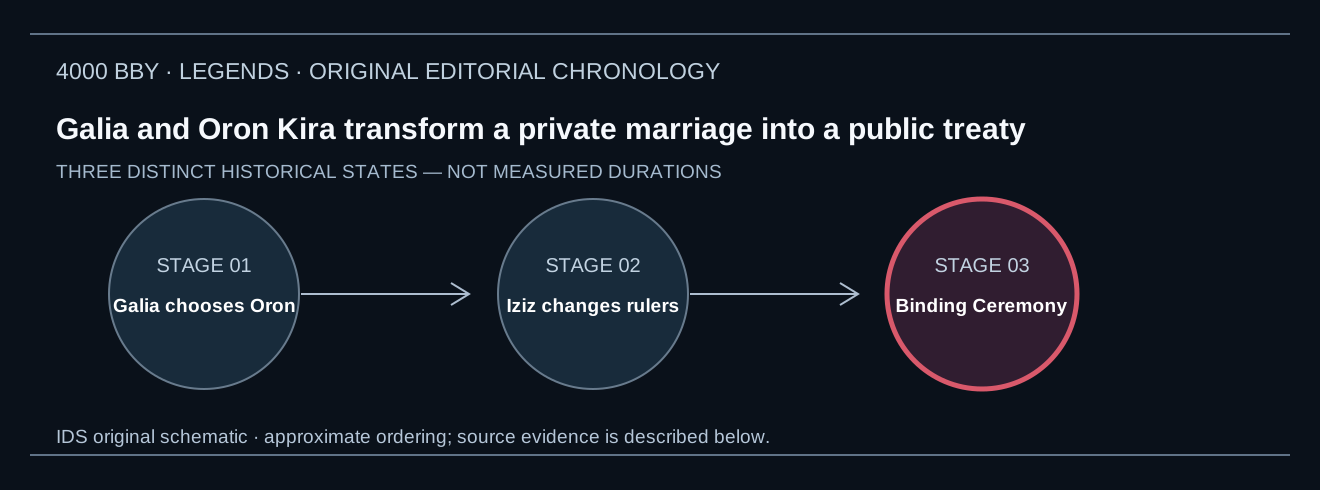
A marriage across a manufactured boundary
Galia's relationship with Oron Kira predated the final military resolution of the Beast Wars. Their union was more than a personal choice because Iziz had historically treated the Beast Riders and the people beyond its walls as enemies. The ceremony publicly connected members of two political communities who had been separated by exclusion and warfare. Marvel's original-series overview confirms that Galia helped plan her departure to marry Oron. The precise form of the later binding ritual belongs to the comic and its additional Legends references, not to the short publisher recap alone.
Marriage as a claim about legitimate rule
As the royal child of the defeated Naddist Queen and a member of the Beast Rider leadership formed outside Iziz, the partners symbolized a compromise that neither side could have imposed through military victory alone. The event illustrates how succession and household formation can serve public functions in a monarchy. This does not mean all Beast Riders accepted one centralized royal authority immediately or that the union produced a documented modern constitutional settlement. Those would be unwarranted projections onto the source.
The public ritual could not end a hidden movement
The defeat of Amanoa and the alliance involving Galia changed who could plausibly govern Onderon. It did not destroy the institutions and beliefs that had supported Freedon Nadd for generations. The later Naddist uprising is essential context: ceremony and new legitimacy can outlast warfare while older loyalties continue to generate resistance. In the archive, the marriage is therefore its own dated event, separate from the Battle of Iziz and the end of the Beast Wars.
Source judgment: Did the Jedi originally understand Galia's departure as a planned political alliance?
Explanation: No. The apparent abduction initially seemed hostile. Galia's later account revealed her intention to marry Oron, forcing a reassessment of the Beast Riders.
Original publication context: Marvel's 1993 Tales of the Jedi story guide. Public publisher summaries identify the story and creative edition, but precise birth years and off-panel histories often come from Legends reference chronology and require full print verification. Related timeline event →
4000 BBY · Legends · Primary-story and chronology comparison
Kinship makes a political agreement visible without settling everything
The Galia–Oron relationship was politically meaningful before the final battle. Marvel's retrospective of Tales of the Jedi specifically describes the apparent abduction of Galia as a plan she participated in so she could marry Oron Kira. The visiting Jedi first accept the royal court's claim that the Beast Riders had kidnapped her. Discovering her own intention changes the terms of mediation: the proposed union is not only a romantic episode but a direct challenge to the monarchy's depiction of the outsiders.
The earlier wedding feast, the agreement between Galia and Oron, and the Binding Ceremony connected with the postwar settlement should not be multiplied into separate invented marriages. The exact ceremonial order and ritual formula depend on the particular comic scene or Legends reference being cited. An article can report the historical importance of the relationship without inventing the number of participants, named witnesses or official wording of a treaty.
Kinship is useful in political anthropology because it can create responsibilities between lineages with different claims to authority. A marriage linking an Iziz royal heir to Beast Rider leadership makes a formerly excluded population visible within the royal future. That symbolic act does not guarantee a unified opinion across both communities. It would be equally misleading to treat the 3998 BBY uprising as evidence that the marriage was insignificant: the later rebellion reveals the limits, not the absence, of a political settlement.
Historical judgment: Was Galia simply kidnapped by Beast Riders without taking part in the plan?
Explanation: No. The original comic summary says she helped plan the apparent abduction because she wanted to marry Oron Kira.
Follow the complete Onderon political history →
Source reading: Marvel's 1993-series retrospective; original Tales of the Jedi comic sequence and later Tales of the Jedi Companion for dates. Sourcebook page and precise panel citations still require original-issue proofing. IDS political interpretation does not constitute quoted dialogue.
Sources and further reading
- Tales of the Jedi.
- Binding Ceremony of Oron Kira and Galia, Wookieepedia