
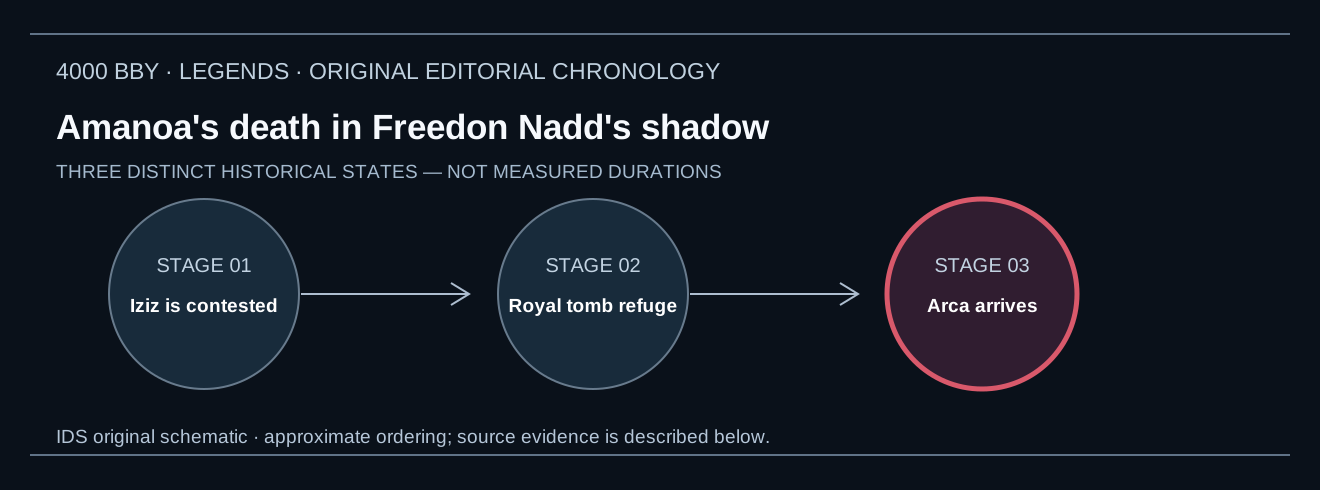
During the final phase of the Battle of Iziz, Queen Amanoa retreated into the tomb of Freedon Nadd beneath the royal palace. Galia, Oron Kira, and the Jedi followed. When Arca Jeth entered the tomb, his light-side power overwhelmed the dark-side influence Amanoa had drawn upon. Amanoa died, ending her personal rule of Iziz.
4000 BBY · Legends · Historical evidence
Amanoa dies beneath the royal palace
What happened
With her defenders losing control of Iziz, Queen Amanoa withdrew to Freedon Nadd's tomb under the palace. The tomb's dark-side influence had underpinned her monarchy. Arca Jeth entered the chamber and the power associated with his light-side presence overwhelmed her, bringing her reign to a close.
Political and cultural consequences
A tomb is not merely a burial place in this account. The continuing power associated with Nadd's relics and memory helped connect a ruling family to Sith legitimacy. Amanoa's death ended her individual rule, but could not by itself destroy the traditions of her supporters. Those tensions surfaced again in the 3998 BBY Freedon Nadd Uprising.
Did Amanoa's death permanently end all Naddist influence on Onderon?
No. Later Naddist unrest continued, including a separate uprising around 3998 BBY.
Source: Tales of the Jedi: Ulic Qel-Droma and the Beast Wars of Onderon. This is Legends history. Original publication page citations remain under review. The illustration is a clearly labelled IDS symbolic interpretation, not a licensed comic frame.
The royal center rests on a Sith tomb
Freedon Nadd's remains were placed beneath Iziz after his death.
The physical placement linked royal government to the dynasty's Sith ancestor.
Arca Jeth's presence breaks Amanoa's power
Amanoa's authority was portrayed as partly sustained through Nadd's dark-side legacy.
Her death symbolically and politically broke that visible connection, though Nadd's spirit and Ommin survived.
Anthropological assessment
Amanoa's death shows how sacred geography can support political legitimacy.
The tomb beneath the palace made ancestry, religion, and state power literally occupy the same space.
Tales of the Jedi / Legends research
When royal power loses its Sith foundation
Queen Amanoa's death came at the end of the Beast Wars crisis, after the Jedi investigated the supposedly hostile Beast Riders and learned of the royal court's connection to Freedon Nadd. The queen's authority had been supported by practices linked to the dead Sith Lord. As Arca Jeth and the other Jedi reached the tomb beneath the palace, that supernatural support failed and Amanoa died in the presence of her daughter. Her death belongs to the fall of an existing Naddist royal order, not to the later uprising led by her husband Ommin.
The moment matters because the earlier political story did not begin with one evil ruler confronting heroic visitors. Exiles from Iziz had formed communities outside the city's authority and learned to live with the planet's dangerous animals. Princess Galia's association with Oron Kira exposed the limits of the palace's account of those people. Only then did the Jedi begin to see how the Queen's political interests shaped the official description of the conflict.
The force supporting a crown
Amanoa's ability to draw on Nadd's power was more than private religious devotion. It helped sustain royal authority and the threat of punishment against enemies. When that support collapsed, the political order depending on it became vulnerable. The death of the ruler and end of fighting are linked but not identical events.
A daughter inherits a divided society
Galia survived her mother's death and became part of a new arrangement with the Beast Riders. The surviving court, city residents and formerly exiled people did not suddenly share one history. Later Naddist resistance shows that the change of leadership left deep unresolved loyalties.
Did Amanoa's death end every future Naddist conflict on Onderon?
No. It marked the collapse of her power during the end of the Beast Wars. Ommin's later Freedon Nadd Uprising was a separate conflict in 3998 BBY.
Original source: Tales of the Jedi #1–2: Ulic Qel-Droma and the Beast Wars of Onderon; Tom Veitch, Chris Gossett et al. This is Legends. Political and anthropological interpretations are distinguished from scenes actually depicted in the comics, with approximate dates left explicit.
Original-source investigation: Onderon's palace, royal legitimacy and the surviving comic evidence
Marvel's retrospective explains why Ulic Qel-Droma, Cay and Tott Doneeta initially assist Queen Amanoa, then learn that Galia plans her own departure and that Freedon Nadd's legacy shapes the royal court. It also describes Master Arca ending the fighting and identifying the dark-side influence at work in Iziz. This gives political context to Amanoa's fall instead of treating her death as an isolated magical incident.
The retrospective summarizes the initial Onderon story rather than proving the exact moment or mechanism of Amanoa's death. That detail belongs to the original comic scenes. As an anthropological comparison, the palace's location over a tomb is a material connection between kingship, ritual memory and coercion; it does not imply that every citizen of Onderon shared Amanoa's beliefs or accepted Sith rule.
Follow the sources: Marvel Spotlight: Tales of the Jedi · Tales of the Jedi #1 publication register. Publisher overviews and in-universe narrators do not replace original game scenes, chapters or comic panels.
4000 BBY · Legends · Source and social history
Amanoa's death in Freedon Nadd's shadow
The tomb beneath the palace
Queen Amanoa drew strength and political legitimacy from the dark side and the legacy of Freedon Nadd, a former Sith who had previously ruled Onderon. The location of the conflict is important: a royal center built in association with a tomb gave the regime a material point of connection to an older ruler's presence. Amanoa's withdrawal into the burial complex during the Battle of Iziz made the confrontation religious as well as military. The original comic series depicts the crisis; a later publicity synopsis confirms the Jedi's discovery of her allegiance but is not a panel-by-panel transcription of the tomb scene.
Arca confronts an inherited form of power
Arca Jeth's intervention deprived Amanoa of the advantage she had been exercising against the Jedi and the Beast Riders. Her death followed the breakdown of the dark-side protection around the royal center. It would be misleading to claim an ordinary army stormed the tomb with a verified number of soldiers, or that Arca's arrival constituted the execution of a Republic court sentence. The original story deals in supernatural Force conflict and a political transition whose consequences are more complex than a battlefield tally.
After the Queen: a dynasty and a movement remain
Amanoa's daughter Galia survived and became crucial to the peace with the Beast Riders. The lingering influence of Freedon Nadd did not vanish alongside the Queen; the later uprising and the role of King Ommin show continuity across the apparent rupture. Archaeological symbols, royal descent and religious adherence can be separated analytically. The same tomb might be a place of royal burial, a claimed source of power, and a site of competing historical memory.
Source judgment: Was Queen Amanoa's death proof that the Freedon Nadd religion had ceased to exist?
Explanation: No. Later Onderonian Naddists continued to organize around the former Sith ruler's legacy. A reigning figure's death does not extinguish religious institutions.
Original publication context: Marvel publisher recap of the 1993 story. Public publisher summaries identify the story and creative edition, but precise birth years and off-panel histories often come from Legends reference chronology and require full print verification. Related timeline event →
4000 BBY · Legends · Primary-story and chronology comparison
The fall of a ruler is not the disappearance of an ideology
Queen Amanoa's death belongs to the political and religious end of the 4000 BBY crisis at Iziz. Her power was bound to the Naddist presence beneath the royal palace. Arca Jeth's intervention deprived her of the strength she had drawn from that legacy, and she died near the tomb. A precise account should distinguish the battle in and around Iziz from the confrontation connected to the tomb, even though they form one narrative arc.
The tomb is significant as a place where royal government and a cultic tradition intersected. Custody of the dead, the location of sacred remains and access to subterranean spaces can become resources for claims to legitimate power. This explains why the later uprising's attempt to seize the sarcophagi mattered politically. That later raid is not evidence that Amanoa was somehow still personally ruling; it reveals that supporters were able to organize around the old royal symbols after her death.
Marvel's summary of the 1993 Tales of the Jedi confirms Amanoa's expectation that visiting Jedi would suppress the Beast Riders and the eventual challenge to her Sith-linked authority. It is not a line-by-line transcription of the tomb encounter. Exact visual sequences should be checked against the original issue before assigning quotations or invented ritual elements. Her death marks a rupture in the monarchy's immediate command, not an instant conversion of all inhabitants away from Naddist belief.
Historical judgment: Did Amanoa's death make the 3998 BBY Naddist uprising impossible?
Explanation: No. Naddist support survived underground and later mobilized around royal funerary remains.
Follow the complete Onderon political history →
Source reading: Marvel's 1993-series retrospective; original Tales of the Jedi comic sequence and later Tales of the Jedi Companion for dates. Sourcebook page and precise panel citations still require original-issue proofing. IDS political interpretation does not constitute quoted dialogue.
Sources and further reading
- Tales of the Jedi: Ulic Qel-Droma and the Beast Wars of Onderon; Marvel’s issue-by-issue publisher overview (context only; confirm the death scene within the original issue).
- Amanoa, Wookieepedia