
- World
- Coruscant
- Attacker
- Ulic's coalition
- Forces
- Krath · Mandalorians
- Result
- Ulic captured
The attack on Coruscant was the logical next step after Foerost. Ulic now possessed a fleet built by the Republic and a Mandalorian alliance capable of aggressive ground operations. Krath troops, Mandalorians, and Basilisk war droids struck the capital. Yet the same coalition politics that made the offensive possible also undermined it: Aleema Keto withdrew her support, leaving Ulic isolated enough for Jedi and Republic forces to capture him.
3996 BBY · Legends · Comic source edition
Coruscant: a coalition attacks the Republic center
What the story confirms
Marvel identifies issue three as the struggle to protect Coruscant from the Sith and the Mandalorians. Ulic brought ships taken from Foerost to the capital with support from Krath and Mandalorian allies. The offensive eventually failed when Aleema abandoned him and Republic and Jedi defenders captured him.
What the usual retelling overlooks
This was simultaneously an attack on a place, a government and a legal system. The use of former Republic ships illustrates that weapons and institutions can be turned against their creators. Coalition politics also matter: Ulic's vulnerability arose partly from dependencies within the coalition, not just the skill of his opponents.
Did Ulic's defeat end the Great Sith War at once?
No. Ulic was captured at Coruscant, but Exar Kun and the wider Sith coalition remained active. His trial became the setting for another attack.
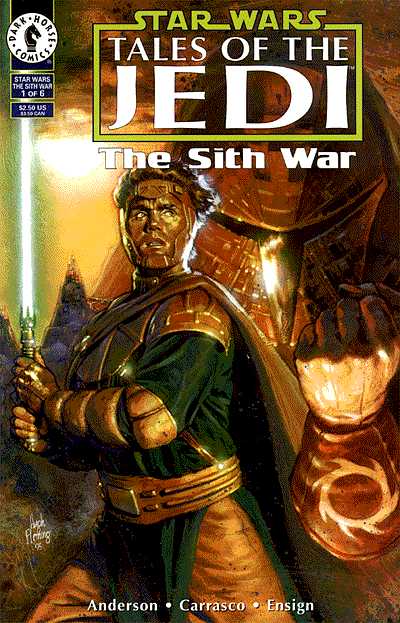
Publisher's issue record: Marvel — The Sith War #3 →. An issue synopsis can verify the story's broad premise and publication details; specific scene details in the full comics still require panel-by-panel verification. The hero is an original labelled IDS illustration, not reproduced comic art.
Why attack the Republic capital?
Coruscant represented command, legitimacy, communication, and Senate authority. A successful assault could create effects far beyond the territory physically occupied.
Capital attacks therefore seek symbolic shock as well as military advantage.
The Republic is attacked by its own fleet infrastructure
The assault depended directly on ships seized at Foerost. That linkage made the industrial defeat immediately political.
The Republic's ability to produce power had been temporarily converted into the enemy's ability to project power.
Mandalorian mobility changes the ground war
Basilisk war droids and Mandalorian assault tactics gave Ulic forces capable of rapid, aggressive strikes in dense urban and military environments.
The Mandalorians were not passive auxiliaries. Their own traditions and battlefield expertise shaped how the coalition fought.
Aleema abandons Ulic
Aleema's withdrawal exposed a core weakness in the Sith coalition: personal rivalry could override shared strategy. The same leaders who cooperated against the Republic continued calculating against one another.
Her betrayal transformed an attack on the Republic into a political struggle inside the attacking alliance.
Capturing Ulic creates a legal problem
Once Ulic was taken alive, the Republic had to decide what to do with a former Jedi who had become a Sith commander and attacker of the capital.
The answer was a public trial in the Senate—a deliberate attempt to convert battlefield victory into legal legitimacy.
Event sequence
Ulic captures a Republic fleet.
Coalition launches surprise attack.
Mandalorians and Krath fight Republic/Jedi defenders.
Aleema withdraws support.
Ulic is taken alive for trial.
Explore this entry
Why did Aleema betray Ulic?
Their relationship mixed alliance, rivalry, fear, and ambition. Leaving him to be captured removed a powerful partner who had increasingly overshadowed her.
Why not execute Ulic immediately?
A public trial offered the Republic a way to demonstrate that even a major wartime enemy would be judged through institutions rather than summary vengeance.
Did the attack nearly destroy the Republic?
It was serious and symbolically powerful, but the Republic retained enough military and Jedi capacity to repel the assault and capture Ulic.
Anthropological assessment
The battle illustrates how coalitions fail through internal politics. Military strength cannot compensate indefinitely for relationships organized around mistrust and personal competition.
Ulic's capture also changes the form of conflict from battle to law, showing how states use trials to reassert authority after spectacular attacks.
Primary comic / historical analysis
The capital attack and the fragility of a coalition
Ulic Qel-Droma's offensive against Coruscant was made possible by military assets stolen at Foerost and by his new Mandalorian alliance. Krath soldiers, Mandalorians and Basilisk war droids attacked the center of Republic government. The goal went beyond occupation of a particular building. Striking the capital threatened the Senate, command communications and the public claim that Republic institutions could protect their member worlds. The attack therefore concentrated symbolic and operational purposes in one target.
The coalition's weakness was as consequential as its strength. Aleema Keto's betrayal removed forces and support on which Ulic depended, leaving him vulnerable to capture. That internal act changed the result of the offensive more rapidly than a simple comparison of ship numbers would predict. The Republic had to respond not only as an armed government but as a legal one: Ulic was taken alive, giving the Senate an opportunity to judge an enemy commander in public. The next episode, Exar Kun's assault on the trial, shows why that legal response itself became a target.
A stolen navy attacks its original sponsor
Foerost and Coruscant are connected parts of one sequence. The attackers were partly using the Republic's own production capacity against it. Losing a shipyard can thus become a political crisis long before factories could replace the lost fleet.
Coalition politics determined the ending
Mandalorian, Krath and Sith leaders were not interchangeable agents. Aleema's separate ambitions meant the offensive lacked dependable shared control. A military coalition can collapse through a partner's withdrawal even when individual units remain powerful.
Was Ulic killed during the assault on Coruscant?
No. He was captured and brought before the Republic Senate. The public trial and Exar Kun's intervention belong to the following event.
Issue evidence: Tales of the Jedi: The Sith War #2, 'The Battle of Coruscant' (1995). The narrative distinguishes the comic's directly depicted action from historical consequences and IDS interpretation. Publication year is not the in-universe year; 3996/3997 BBY labels belong to Legends.
Sources and further reading
- Tales of the Jedi – The Sith War.
- The New Essential Chronology.