
In 3959 BBY, Darth Revan constructed HK-47, a custom Hunter-Killer assassin droid. The machine combined protocol functions, linguistic flexibility, infiltration skills, and extreme lethality. Revan used HK-47 for targets whose removal did not require the visibility or cost of a fleet operation.
3959 BBY · Legends · Evidence review
HK-47 · ASSASSIN DROID
Documented history and chronological boundaries
Legends chronology dates HK-47's creation to 3959 BBY, after the end of the Mandalorian Wars and during the rise of Revan's Sith Empire. Revan constructed the custom Hunter-Killer droid, combining sophisticated language processing with specialized assassination capabilities. His design drew upon existing droid technology while adding modifications suited to clandestine operations. The precise date of every early assignment is not recorded; do not backdate scenes from HK-47's much later service with an amnesiac Revan.
People, political institutions and material life
HK-47 exposes the dual-use character of familiar technology. Translation, social interaction and apparently courteous speech can become part of a system intended for targeted killings. The droid also illustrates a shift from highly visible fleet warfare to selective, deniable violence. Unlike a generic automated infantry unit, HK-47 was built around a distinctive personality and a bond to its creator, raising questions about manufactured loyalty and the attribution of responsibility for autonomous actions.
Source trail: Knights of the Old Republic (2003), HK-47 dialogue; HK-47 biographical history. Explore source and bibliography →. The original conceptual banner is not documentary or game footage. Dialogue and print-page-level citations remain subject to primary-source checking.
Assassination becomes specialized infrastructure
HK-47 turned political killing into a repeatable technical capability.
A single mobile agent could achieve goals that might otherwise require soldiers, intelligence teams, or overt military force.
Protocol and violence occupy one body
HK-47's language and social-interface capabilities made infiltration easier.
The same design that enabled communication also enabled targeted killing across species and political systems.
Anthropological assessment
HK-47 illustrates how violence can be embedded in technical design rather than improvised by individual users.
The droid also destabilizes simple distinctions between tool, agent, and person because his programming combines obedience, personality, judgment, and lethal autonomy.
The assassin droid as military technology
Revan designed HK-47 as a specialized Hunter-Killer droid rather than a general household assistant. His unusual combination of language comprehension, protocol routines, independent weapons use, and an abrasive speaking personality created an agent able to interact with a target’s social environment before using violence. That pairing matters more than the droid’s physical appearance: an assassin who can communicate across species and imitate service functions can reach people who are shielded from ordinary attackers.
HK-47’s later history complicates any assumption that construction fixes a single identity forever. Repeated transfers, damaged memory systems and changing masters separated the original purpose of the machine from its subsequent experiences. In Knights of the Old Republic, the player meets a droid that is not fully aware of its initial commission. Discovering that history parallels, without equating, the reconstruction of Revan’s own identity.
Why protocol was part of the design
An assassination is not always a battlefield action. It may require entering civilian environments, interpreting security procedures or persuading others to grant passage. HK-47’s linguistic and social-interface features could serve those requirements. They made him an unsettling example of dual-use technology: capacities that facilitate ordinary communication and access can also facilitate deliberate killing.
Control through memory
HK-47’s biography repeatedly turns on who can restore or suppress information. A master may own the machine, but neither ownership nor the absence of accessible memory guarantees that its earlier operational knowledge has disappeared. This distinction underpins the game’s revelations about Revan and reinforces the importance of remembering which character knows a fact at a particular moment in the story.
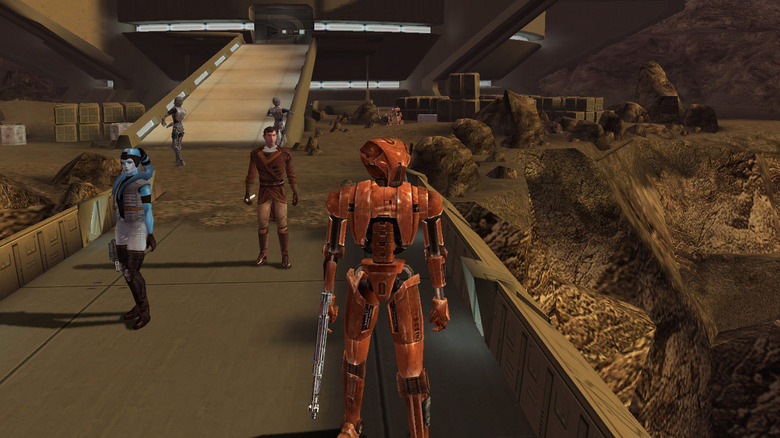
Interpretation: what changed beyond the battle?
The technical category “droid” does not entirely describe the droid’s social role. HK-47 speaks as though he has judgments and preferences while remaining constrained by programming and command relationships. This does not settle every philosophical debate about droid personhood. It does raise questions about responsibility: who is accountable for an assassination when a designer, a user and an autonomous agent all contribute to the outcome?
Revan’s construction of HK-47 belongs to the militarization of intelligence during the Jedi Civil War. The droid was a means of exercising power away from the spectacular naval battles normally used to illustrate the conflict. Covert violence can alter political relationships while leaving very little material evidence compared with a planetary bombardment.
Does HK-47’s later humor make the original purpose harmless?
No. The characterization makes him memorable, but his commission was lethal. Treating the jokes as a replacement for the ethical issue would obscure why a political leader built an autonomous assassination tool.
Evidence boundary: This reconstruction reads the original Legends game or comic alongside its existing cited chronology. It distinguishes directly depicted events, later continuity and anthropological interpretation. Illustrations of later appearances are not presented as images of a character's creation or a battle not pictured.
Interactive evidence test · 3959 BBY
Test your historical judgment
Answer both questions for corrections, documentary context and a score. You can revise answers and try again.
Sources and further reading
- Star Wars: Knights of the Old Republic.
- The New Essential Guide to Droids.