

In 3958 BBY, Saul Karath led the Sith attack on Telos IV. Using familiarity with Republic systems, the attackers achieved surprise and destroyed ships and defenses before conducting a devastating orbital bombardment. Millions of civilians died, including Carth Onasi's wife Morgana, and large areas of the planet were rendered ecologically ruined.
3958 BBY · Legends · Evidence review
TELOS IV BOMBARDED
Documented history and chronological boundaries
During 3958 BBY, Sith forces led by Saul Karath attacked Telos IV. The bombardment wrecked population centers and devastated its ecology, killing immense numbers of residents. Carth Onasi's family was caught in the catastrophe, with his wife Morgana killed and his son Dustil later becoming entangled with Sith institutions. The event belongs to the Jedi Civil War, not the earlier Mandalorian campaign or Telos's later Citadel Station restoration program.
People, political institutions and material life
The attack demonstrates the long distance between an offensive military choice and its extended social consequences. Survivors were forced to reconstruct family ties, livelihoods and damaged ecosystems. Telos later became a Republic-supported restoration project using orbital infrastructure and specialized ecological work. That reconstruction was not a retroactive success of Karath's bombardment. It was an effort to address the destruction that military policy had caused.
Source trail: Knights of the Old Republic (2003), Carth Onasi; Knights of the Old Republic II (2004), Telos Restoration Project. Explore source and bibliography →. The original conceptual banner is not documentary or game footage. Dialogue and print-page-level citations remain subject to primary-source checking.
Insider knowledge enables surprise
Karath's familiarity with Republic codes and defensive routines helped the Sith penetrate Telosian security.
The value of his defection became visible in a planetary catastrophe.
Civilian destruction becomes strategic messaging
The scale of the bombardment far exceeded a narrow attack on military targets.
Telos demonstrated what resistance to the Sith could cost civilian populations.
A planet becomes a reconstruction problem
Ecological devastation outlived the battle itself.
Telos would remain central to later Republic restoration efforts and to the Dark Wars.
Anthropological assessment
The bombing of Telos shows terror operating through infrastructure and ecology as well as bodies.
Destroying a population's environmental basis extends violence into future generations who must live with or repair the altered landscape.
Telos was attacked during the Jedi Civil War
The bombing of Telos IV must be distinguished from Darth Nihilus's later assault on the same system. In 3958 BBY, Saul Karath took part in a devastating Sith bombardment after defecting from Republic service. The attack caused catastrophic damage and became central to Carth Onasi's history and the subsequent efforts to rebuild the planet.
A military decision enters personal memory
Carth's relationship with Saul Karath had once involved service within the same military tradition. Karath's defection and role in the bombardment transformed that institutional connection into a personal grievance. Carth's family losses are inseparable from his hostility toward the Sith. The event therefore becomes more than a date in naval history: it drives motivations that shape the player's experience of the later game.
The planet becomes a recovery project
In Knights of the Old Republic II, Telos is used to test whether a devastated world can be environmentally restored. The presence of Citadel Station, Ithorian conservation efforts and competing commercial interests demonstrates the enormous political and technical work required after bombardment. Reconstruction involves governance, land use, ecology, labor and disputes over who benefits from recovery.
Evidence limits and casualty claims
The source narrative establishes widespread devastation but does not justify inventing an exact universal casualty total or a minute-by-minute order of bombardment. Different characters remember the event for different reasons. Their perspectives should be used to explain consequences without being mistaken for complete, neutral inventories of destruction.
Anthropological assessment: the aftermath of infrastructure destruction
Telos shows that attacking a planet's surface can remove the environmental and administrative conditions that sustain ordinary life. Restoring them requires new institutions, not simply the return of a friendly flag. The later battle for Telos illustrates why those institutions had to be defended even after the original war ended.
Source interpretation
How firm is the dating?
See the source caution above. The in-universe year or approximate range follows the listed Legends references. The original RPG's variable quests should not be misrepresented as a day-by-day universal calendar.
Does the visual portray an actual game screenshot?
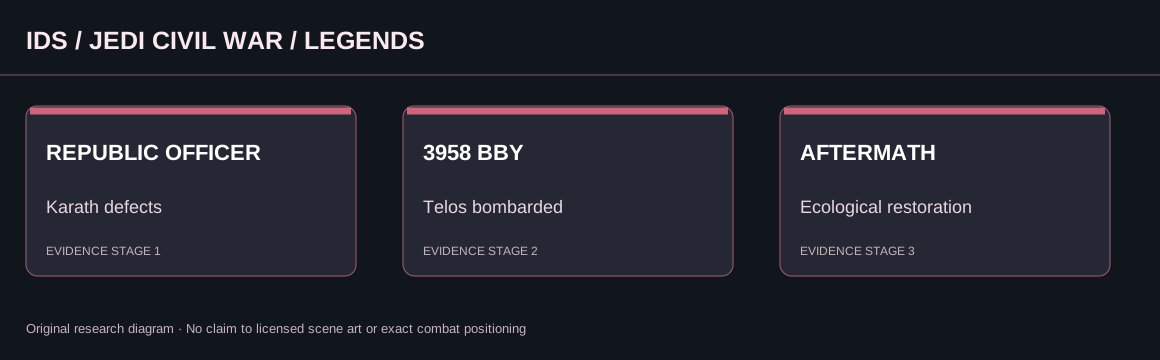
No. The illustration organizes narrative phases only. A verified event-specific publisher illustration is a separate editorial requirement.
Interactive evidence test · 3958 BBY
Test your historical judgment
Answer both questions for corrections, documentary context and a score. You can revise answers and try again.
Legends · historical source review
The consequences of an officer changing allegiance
Admiral Saul Karath serves the new Sith under Revan and Malak and turns his knowledge of Republic defenses against Telos IV. The devastation caused by orbital bombardment becomes a defining experience for Carth Onasi, whose family and former home are affected. The later Telos Restoration Project is an attempt to recover a living planet and community, not part of the original attack itself.
A defection can alter the meaning of trusted information. Karath's past position gives him operational knowledge that ordinary civilians do not control, while the costs of its use fall across a broad population. The bombing also shows how survivors carry a conflict forward through grief, distrust, and institutional demands for reconstruction. The archive should keep this in 3958 BBY separate from the Republic's later ecological intervention and from the earlier Mandalorian battles on other worlds.
Historical judgment: The bombardment precedes the restoration effort; they are not one event. Publisher's related original account →. The analysis of political institutions is IDS interpretation, not game dialogue. Day-level event dates and player-defined decisions are not asserted.
Original-source investigation: Bombardment and the social institutions of planetary repair
Saul Karath's attack on Telos IV belongs to the earlier Jedi Civil War. Knights of the Old Republic provides context for Karath and his betrayal of the Republic, while Knights of the Old Republic II places the damage in a longer sequence of restoration, resource allocation and conflict over recovery. These two perspectives should not be collapsed into one battle with a single outcome.
Lucasfilm's game catalog verifies the relevant titles but does not alone substantiate exact bombardment counts or civilian losses. Any figure or specific targeting claim needs a narrative or reference source. The political anthropology of Telos also involves what reconstruction institutions choose to save and who participates in rebuilding. The planet's later existence disproves any implication that the assault physically annihilated the world.
Follow the sources: Lucasfilm KOTOR series context · KOTOR II aftermath and Telos restoration. Publisher overviews and in-universe narrators do not replace original game scenes, chapters or comic panels.
Jedi Civil War · Legends evidence file
Telos IV: a commander tests loyalty by destroying the population
Event and historical sequence
In established Legends reference chronology, Saul Karath led the Sith fleet's bombardment of Telos IV in 3958 BBY. Karath had once served in the Republic Navy and used its military systems and procedures against his former allies. The attack destroyed much of Telos's ecosystem and killed millions. Later narrative explanations attribute the order to Darth Malak as a test of Karath's allegiance, despite Revan's preference for capturing the planet. Carth Onasi's wife Morgana died, and he believed his son Dustil lost. Dustil actually survived and was later drawn into Sith training.
Institutions, everyday life and political power
The bombardment combined intimate institutional knowledge with indiscriminate force. A former officer's awareness of dockyard access and defensive routines became a vulnerability for the Republic. For residents, the consequences reached beyond the deaths caused by the immediate attack: ecosystems, transport, medical supplies and the ability to maintain family life collapsed together. Telos later became a large-scale restoration project, which underscores the different timescales of military destruction and environmental recovery. Carth's personal history is important, but the deaths and displacement of other Telosians should not be reduced to his motivation for revenge.
Limits and conflicting evidence
The original Knights of the Old Republic dialogue implies Telos was bombed four years before the game, placing it near 3960 BBY; the Campaign Guide and later Legends chronology use 3958 BBY. Some cut-content dialogue instead attributes the original decision to Revan. This page follows the later 3958 BBY date and Malak-command explanation while disclosing the differences.
Historical judgment: Did every source agree on the exact year and who ordered Telos's destruction?
Correction and educational insight: No. The later chronology uses 3958 BBY and describes Malak's order, while original dialogue and cut-content material create identifiable discrepancies.
Source trail: Knights of the Old Republic (2003), Carth dialogue; Knights of the Old Republic Campaign Guide; Knights of the Old Republic II, Telos restoration. Reference and bibliography ↗. Primary-source location checks remain in progress.
Sources and further reading
- Star Wars: Knights of the Old Republic.
- Knights of the Old Republic Campaign Guide.
- Knights of the Old Republic II: The Sith Lords.