

After Revan defeated Malak, the Republic fleet broke the Sith defense around the Star Forge. The ancient Rakatan factory was destroyed, removing the industrial system that had made the Sith war effort extraordinarily difficult to exhaust. Revan's Sith Empire ceased to function as a unified galactic power, and the Jedi Civil War ended in a costly Republic victory.
3956 BBY · Legends · Historical evidence
THE JEDI CIVIL WAR ENDS
Events, sources and uncertainties
Following Malak's defeat at Rakata Prime, the Republic fleet destroyed the Star Forge and the Jedi Civil War ended in 3956 BBY. Revan's Sith Empire lost its coordinating ruler and the industrial source that had allowed it to challenge the Republic for years. The end of one war did not immediately restore the Jedi Order or eliminate all surviving Sith personnel, warships and factions. Some of those surviving groups soon engaged in their own violent struggles.
Anthropological analysis
War termination, restoration of authority and political reconciliation should be studied separately. The Republic obtained military victory but inherited devastated planets, broken families, insecure transport and a severely weakened Jedi. Revan's rehabilitation raised questions about the responsibility of a former conqueror as well as the Council's handling of his memory. Destroying a machine and defeating one ruler removed major threats without resolving every consequence of the conflict.
Source trail: Knights of the Old Republic (2003), light-side ending; Jedi Civil War history. Read source and reference context →. The new hero is conceptual IDS artwork, not documentary evidence; exact print pages and game dialogue timings require final verification.
Destroying production matters as much as killing the ruler
Malak's death removed the central leader, while destruction of the Star Forge removed the material base that could rapidly regenerate fleets.
Victory leaves a damaged Republic
The military, Jedi Order, economy, and refugee system remained under severe strain.
Ending one war did not recreate the prewar political order.
Anthropological assessment
The war's end demonstrates why military victory and social recovery are different processes.
Institutions can survive strategically while remaining demographically, economically, and morally weakened.
The battle and the broader outcome are distinct records
The final attack on the Star Forge is the decisive military event. The end of the Jedi Civil War is the broader political result. Treating both as separate timeline entries allows one page to describe the tactical fighting at Rakata Prime while this page explains why the fall of the Sith center changed the balance of power across the Republic. Neither should contradict the other about the established Legends outcome.
Production capacity collapses with the Forge
The station had made the Sith war effort extraordinary by rapidly supplying ships, weapons and military equipment. Malak's defeat removed the ruler who had inherited that resource from Revan. Destruction of the station deprived surviving Sith factions of its principal industrial advantage. Losing both leadership and production explains why the unified Sith offensive could not simply continue at its previous intensity.
A military victory is not administrative recovery
The Republic emerged with serious problems: damaged worlds, depleted fleets, displaced populations, and a Jedi Order that had suffered heavy losses and defections. Ordinary governance required resources that wartime mobilization had consumed. The later Dark Wars reveal how fragile the victory remained, especially for surviving Jedi who had not returned to stable institutions.
The consequences of Revan's rehabilitation
The Republic owed its success in part to the actions of a former Sith commander whose identity had been reconstructed and then revealed. This complicated the normal distinction between enemy, prisoner, soldier and hero. Revan's biography reminds readers that institutional loyalties can change, and that a war's final political narrative may be shaped by people who participated on more than one side.
Anthropological assessment: victory as a contested category
A victorious government may remain socially weakened. The Republic defeated the central Sith war effort but could not reverse every death, injury, disrupted family or lost archive. Military history records a formal endpoint; social history follows the institutions that try to rebuild afterward. This difference is crucial for connecting the Jedi Civil War to the First Jedi Purge and the later reconstruction of the Order.
Evidence comparison
Which details are directly supported?
The original game and referenced published chronology support the major participants, outcome, and broad story sequence. The diagram does not claim exact geographical distances or tactical deployments.
Are alternate gameplay choices historical events?
Only the outcome adopted by the continuing Legends storyline is treated as fixed. Other choices remain genuine game possibilities, not simultaneously established events.
Interactive source interpretation · 3956 BBY
Test your historical judgment
Choose both answers and receive detailed source-based explanations, corrections, and a score.
Legends · historical source review
The collapse of a war-making system
The end of the Jedi Civil War follows the defeat of Malak and destruction of the Star Forge. Without the station's production capability and with Sith leadership fragmented, the forces that had held the Republic under threat are less able to continue the same campaign. The outcome does not mean that every Sith ship vanishes or that the Republic has already completed its postwar recovery.
The political work of ending a war differs from the military moment that makes peace possible. Former allies must decide whether to return to old institutions, surviving Sith officers seek authority, and damaged worlds need rebuilding. For analytical purposes the ending of a named war should be separated from the eradication of a belief system or social identity. The adjacent Sith Civil War entry describes why removing a unified leadership can produce renewed fighting rather than immediate stability.
Historical judgment: A formal war's end is not the end of all Sith factions. Publisher's related original account →. The analysis of political institutions is IDS interpretation, not game dialogue. Day-level event dates and player-defined decisions are not asserted.
3956 BBY · Legends · Narrative vs. later chronology
The Star Forge's destruction ends one war, not its damage
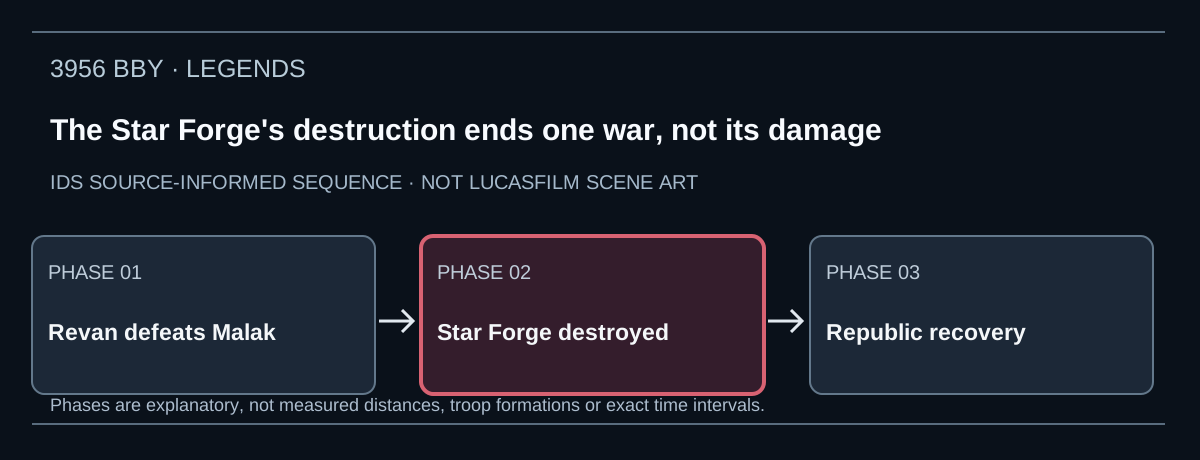
An industrial defeat and a political defeat coincide
In the light-side resolution later adopted by Legends continuity, Revan defeats Malak while the Republic fleet attacks the Star Forge. The old Rakatan manufacturing facility is destroyed, taking away the extraordinary production capacity that had sustained Malak's Sith fleet. That makes the final outcome more than a duel between two Force-users. The battle breaks a military system that had depended on automated production and the exploitation of an ancient technological complex.
The Republic inherits the aftermath
The end of an identifiable war does not settle displaced populations, devastated infrastructure, lost ships or the personal consequences of military betrayal. Worlds such as Taris and Telos had suffered catastrophic events; the Jedi Order had also lost members and credibility. A conclusion measured only by victory over Malak would overlook the later vulnerability of the surviving Jedi. The Dark Wars and First Jedi Purge develop in this already damaged setting, but their causes should not be projected backward as though the Star Forge's destruction itself initiated every later Sith plot.
Whose ending counts as the historical one?
The game's marketing describes explicit player choice between light and dark. A dark-side player can pursue an outcome very different from the later Revan tradition, including retaining control of the Forge. The Legends chronology generally uses the light-side course and the destruction of the factory as its historical spine. Both facts belong in an accurate archive: a documented game branch exists, while a later continuity convention selects one course. The distinctions between published narrative, playthrough and chronology should be visible.
Check your historical interpretation: Does losing the Star Forge mean the Republic's institutions are immediately repaired?
Explanation: No. The Sith war effort loses its extraordinary manufacturing center, but surviving populations, the Senate, the Jedi Order and planetary economies still face extensive recovery.
Original publication: Lucasfilm: original KOTOR. Publisher overviews confirm the RPG and its branching design, not every cutscene or exact 3950s BBY event date. Continue this timeline sequence →
3956–3955 BBY · Legends · Source inquiry
Destroying the Star Forge ends the centralized Sith war machine
Historical sequence
In 3956 BBY, Revan defeated Darth Malak at the Star Forge in the Lehon system. In the established Legends light-side continuation, Bastila Shan returned to the Republic cause and used battle meditation to help its fleet prevail. The Republic destroyed the Star Forge, removing the Rakatan manufacturing complex that had supplied the Sith war effort. This ended the Jedi Civil War but did not erase every Sith officer, academy or soldier who had served the defeated state.
Anthropological interpretation
Military victory and durable peace are different outcomes. The Republic eliminated the Sith empire's main industrial advantage and central leader, but its own society inherited dead civilians, ruined infrastructure and an exhausted Jedi Order. The Star Forge itself was more than a weapon: it was a production institution that transformed access to ancient technology into power over ships, military resources and people. Destroying that system changed what surviving commanders could do while giving the Republic new reconstruction obligations. Revan's role in both creating and defeating the empire also complicates accounts of personal responsibility and rehabilitation.
Chronology limits
The 2003 game offers different decisions and a dark-side ending; established Legends continuity follows the light-side resolution. Revan's first access to the Star Forge in 3960 BBY was a separate event.
Test your historical judgment: Did the destruction of the factory eliminate all Sith activity immediately?
Correction and insight: No. The central military system collapsed, but Sith factions and resources survived.
Source trail: Knights of the Old Republic (2003); Jedi Civil War chronology. Reference bibliography ↗. Primary edition page citations remain to be verified.
Sources and further reading
- Star Wars: Knights of the Old Republic.
- Knights of the Old Republic II: The Sith Lords.