
With Nihilus dead, Meetra traveled to Malachor V. The broken planet remained saturated with the consequences of the Mass Shadow Generator she had ordered activated nine years earlier. Meetra crossed the surface and entered the Trayus Academy, confronting the Sith institution built inside the landscape of her deepest trauma.
3951 BBY · Legends · Historical research
RETURN TO MALACHOR V
Events and source limitations
After Nihilus’s defeat, Meetra traveled to Malachor V, site of the 3960 BBY war-ending catastrophe. This 3951 encounter is a different battle nine years later. The planet’s surface and Trayus Academy were shaped by lasting dark-side corruption. Meetra fought through hostile creatures and Sith defenders, then faced Darth Sion and Darth Traya. The 2004 game offers divergent end states, but the established light-side Legends telling culminates in the deaths of the Sith leaders and the planet’s destruction.
People, institutions and consequences
Malachor was a memorial landscape and a functioning Sith training institution simultaneously. The site retained material evidence of the earlier atrocity while new rulers used its history to cultivate fear and obedience. Meetra’s return forced her to confront the consequences of an earlier decision from within a rebuilt political structure. The narrative’s repeating location allows direct comparison of how power, memory and injury change over time.
Sources: Knights of the Old Republic II, Malachor V and Trayus Academy finale. Explore source transcript or chronology →. The article distinguishes fixed game events, Legends light-side continuity, player-variable choices and editorial analysis.
The final battlefield is also a memory site
Malachor is not an arbitrary Sith fortress for Meetra.
Her earlier command decision killed thousands there and caused the wound that shaped her exile.
The Sith built an academy inside catastrophe
The Trayus institution uses a location saturated with dark-side power and historical trauma.
Landscape becomes part of pedagogy.
Anthropological assessment
Returning to Malachor turns political conflict into confrontation with personal memory.
Places of mass violence can become institutional resources when later movements deliberately build identity around the emotional power of the site.
Malachor V is not the same battle ten years later
This entry concerns the confrontation that concludes Knights of the Old Republic II in 3951 BBY. The original Battle of Malachor V in 3960 BBY ended the Mandalorian Wars and created the destruction from which the later Sith conflict emerged. Confusing the two battles obscures the central theme of the game: an earlier victory produced consequences that remained unresolved for nearly a decade.
The academy preserves a destructive tradition
Meetra's return places her inside the ruins of a world that had been fractured by the Mass Shadow Generator. The Trayus Academy was built around Sith teachings and a history of dark-side influence. It remained an organized center of power despite the catastrophic condition of the planet. A military defeat can destroy fleets without erasing institutions that later recruit followers, transmit doctrine, and create new leaders.
Survival requires confronting two kinds of Sith authority
Meetra fights through the academy and confronts Darth Sion before encountering Kreia, now acting as Darth Traya. Sion represents a form of power sustained through physical pain and refusal to die. Traya represents manipulation, teaching and an ideological attack on the Force itself. Their conflicts with Meetra belong to the same larger crisis but cannot be understood as interchangeable duels.
Choices and the established outcome
The game permits variation in character choices and the details of individual conversations. Later Legends sources use a light-side account of Meetra stopping Traya and departing in search of Revan. A chronology should describe that continuing narrative without falsely implying that every alternative game outcome happened simultaneously.
Anthropological assessment: the social life of battlefields
Malachor illustrates the way places acquire meanings through repeated violence. It is simultaneously the location of a Republic military victory, the site of extraordinary loss, a center of Sith teaching and the setting of Meetra's final confrontation. Historical memory is not one fixed story. Survivors, institutions and later factions interpret the same landscape through different experiences and goals.
Evidence comparison
Which details are directly supported?
The original game and referenced published chronology support the major participants, outcome, and broad story sequence. The diagram does not claim exact geographical distances or tactical deployments.
Are alternate gameplay choices historical events?
Only the outcome adopted by the continuing Legends storyline is treated as fixed. Other choices remain genuine game possibilities, not simultaneously established events.
Interactive historical judgment · 3951 BBY
Interpret this historical record
Answer both questions. Get corrections, an explanation and a score to distinguish what the sources show from interpretation.
Legends · 3951 BBY · Event source and interpretation
The final Malachor confrontation revisits an old atrocity
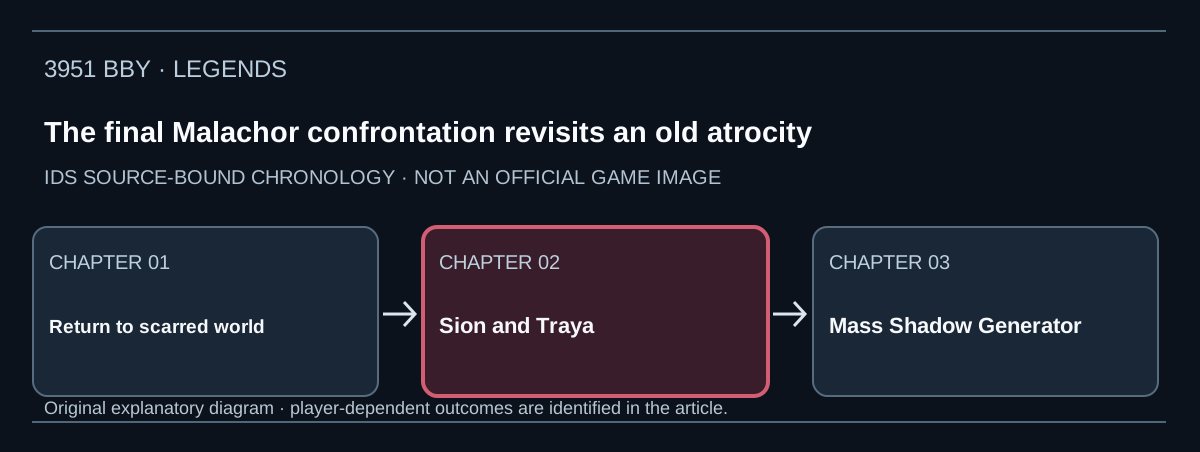
Returning does not erase the earlier war
Meetra's arrival on Malachor V is tied to a catastrophe at the end of the Mandalorian Wars, nine years earlier in the established Legends dating. The Mass Shadow Generator had caused mass death and a wound in the Force, shaping both Meetra's exile and her relationships to others. The broken landscape in 3951 BBY is therefore already an archive of war damage. The player is not discovering a newly devastated planet; the Exile is returning to a place where the earlier command decision still carries material and personal consequences.
Trayus Academy is an institution built within catastrophe
The Sith established a center of teaching and power amid the planet's broken geography. Darth Sion and Kreia represent distinct ways that institution exercises authority: Sion through endurance and intimidation, Kreia through judgment, persuasion and the manipulation of her students. Meetra's progress into the academy moves the conflict beyond conventional fleet warfare. The deaths and final confrontations within the academy belong to this story phase, while the possible destruction of the planetary surface by Bao-Dur's remote is a related but separately dated sequence.
Branching narrative needs an explicit historical frame
Different game choices can alter companion outcomes and the precise presentation of the finale. Later Legends narrative summaries generally place Meetra's story on a light-side path. The official game descriptions confirm that choices alter the story but do not determine every cutscene's fixed wording. An accurate timeline must not combine every branch into one impossible chain of events. The historical question is how Meetra responds to the ruins of an earlier decision and whether the Sith teaching structure established there can continue.
Test your historical judgment: Did Malachor V first become devastated during this 3951 BBY battle?
Analysis: No. It had already been scarred by the Mass Shadow Generator in 3960 BBY. The later journey returns to the site of that disaster and, in the later light-side course, ends with another destructive activation.
Publication basis: Lucasfilm: KOTOR II's ending choices. Original game content establishes the story; promotional pages do not verify all branch-specific scene details or exact chronological dates. Continue this historical sequence →
Sources and further reading
- Knights of the Old Republic II: The Sith Lords.