
Meetra, Visas Marr, and Mandalore boarded the Ravager while Mandalorian teams planted explosives. Nihilus attempted to feed on Meetra but found her nature incompatible with the consumption that sustained him. The three defeated the Sith Lord on the bridge and escaped before the Ravager was destroyed.
3951 BBY · Legends · Historical research
NIHILUS DEFEATED
Events and source limitations
Meetra Surik, Visas Marr and Mandalore the Preserver boarded the Ravager during the Battle of Telos IV as allied teams placed explosive charges aboard the vessel. Nihilus attempted to draw power from Meetra but was weakened by her unusual nature as a wound in the Force. The three defeated him, and the Ravager was destroyed. Visas’s presence makes the outcome a confrontation with the destroyer of Katarr, not merely an anonymous Sith officer.
People, institutions and consequences
Visas moved from forced subordinate to participant in the destruction of the person who had enslaved her. Meetra’s difference, feared by Jedi Masters, became an effective defense against Nihilus’s destructive form of Force hunger. The team also drew upon Mandalorian skills and collective military planning: no purely individual duel explains the boarding, sabotage and withdrawal. The story contrasts consuming others with alliances built through trust.
Sources: Knights of the Old Republic II, Ravager bridge confrontation and destruction. Explore source transcript or chronology →. The article distinguishes fixed game events, Legends light-side continuity, player-variable choices and editorial analysis.

Visas confronts the person who dominated her after Katarr
Her participation turns survival from passive endurance into direct opposition.
The former apprentice helps destroy the institution that had absorbed her life after genocide.
Meetra's wound becomes resistance
The same condition the Jedi Masters feared prevents Nihilus from consuming her in his normal way.
A trait classified as dangerous becomes the means of survival.
Anthropological assessment
Nihilus's defeat shows how categories such as weakness and danger depend on context.
A condition that threatens one institution can become protective against a different form of power.
The Ravager assault ends a planetary-scale threat
Darth Nihilus had consumed life on Katarr and later threatened Telos IV. Meetra Surik, Visas Marr and Canderous Ordo confronted him aboard the Ravager while Mandalorian troops arranged explosives to destroy the damaged warship. The duel took place within a larger operation involving ships, boarding parties and the defense of a recovering world.
Visas's participation changed her relation to the figure who had dominated her after Katarr. Meetra's wound in the Force, once feared by surviving Jedi Masters, made her resistant to Nihilus's attempt to feed on her. The episode is valuable precisely because a condition understood by some institutions as dangerous became an unexpected defense. Nihilus's death and the loss of the Ravager were decisive, but they did not erase every consequence of his earlier destruction of the Miraluka community.
Was Nihilus defeated only by the Republic fleet firing on him?
No. His death occurs during the boarding confrontation, and the Ravager's destruction belongs to the coordinated operation after explosives are placed.
Evidence distinction: The Legends narrative sources below establish participants, outcomes and historical constraints. Commentary on power, memory and institutions is IDS interpretation.

Interactive historical judgment · 3951 BBY
Interpret this historical record
Answer both questions. Get corrections, an explanation and a score to distinguish what the sources show from interpretation.
Legends · 3951 BBY · Event source and interpretation
Nihilus falls when domination becomes a weakness
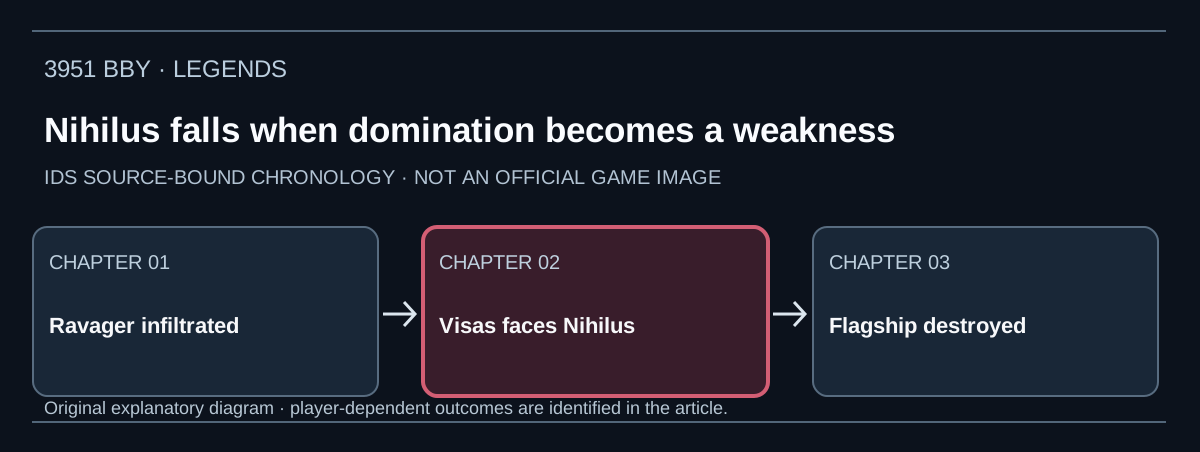
The operation separates command and infiltration
During the Battle of Telos IV, Republic and other allied forces confronted Nihilus's fleet while Meetra, Visas Marr and Mandalore boarded the Ravager. Mandalorian explosive charges threatened the flagship independently of the confrontation on its bridge. The combined operation matters: the destruction of a vessel required more than a single duel, and the duel alone cannot be used as evidence that every Sith vessel was destroyed simultaneously. Military logistics and the actions of ordinary fighters remain important to the outcome.
A bond works differently against the Exile
Nihilus's method of feeding on the Force had devastated Katarr and made him dangerous to groups of Force-sensitive beings. Meetra's unique Force wound undermined his usual advantage, helping the boarding party defeat him. Visas had lived under Nihilus after the annihilation of her people and brought a personal history to the encounter. This is not proof that all Miraluka are naturally immune to dark-side control, nor that Meetra's unusual state could be transferred to other Jedi as a generic combat technique.
The aftermath is not the end of the Sith threat
The Ravager was destroyed, and Nihilus no longer threatened Telos, but Darth Sion and Kreia remained connected to the separate crisis at Malachor V. The death of a Sith Lord and the destruction of his command ship are linked events without being interchangeable. Visas's testimony also frames the attack as the culmination of an individual survivor's confrontation with past oppression rather than a simple victory of one species over another.
Test your historical judgment: Was Visas's participation merely another mission performed on Nihilus's orders?
Analysis: No. Having escaped his control and joined Meetra, she participated in confronting the destroyer of Katarr. Her actions are part of a change in allegiance and agency.
Publication basis: Lucasfilm: KOTOR II and companion choices. Original game content establishes the story; promotional pages do not verify all branch-specific scene details or exact chronological dates. Continue this historical sequence →
Sources and further reading
- Knights of the Old Republic II: The Sith Lords.