
While Meetra fought inside the Trayus Academy, Bao-Dur's remote moved to reactivate the Mass Shadow Generator. G0-T0 tried to prevent destruction of a strategically valuable world, but in the light-side outcome the generator activated. Malachor V collapsed under renewed gravitational forces as the Ebon Hawk escaped. The Sith Triumvirate was destroyed, the First Jedi Purge ended, and the Dark Wars closed.
3951 BBY · Legends · Historical research
MALACHOR V DESTROYED
Events and source limitations
In the light-side ending of Knights of the Old Republic II, Bao-Dur’s remote set out to reactivate the Mass Shadow Generator, which had first devastated Malachor V in 3960 BBY. G0-T0 tried to stop the effort and preserve a world he judged strategically important. The remote succeeded, the planet was torn apart, and the Ebon Hawk escaped. This 3951 reactivation must not be confused with Meetra’s 3960 command to activate the original weapon, nor with alternate dark-side endings where the world remains.
People, institutions and consequences
Destroying the ruined world ended the use of its Sith Academy and dark-side concentration as a renewed coercive institution. Yet the decision also raises questions about whether a damaged landscape should be preserved as evidence or destroyed to prevent further harm. The game presents a clear light-side choice, not a universal principle governing all historical sites. The two deployments of one weapon illustrate how material technologies can carry responsibility across generations and political regimes.
Sources: Knights of the Old Republic II, Remote scenes and Malachor light-side ending; alternate dark-side outcome. Explore source transcript or chronology →. The article distinguishes fixed game events, Legends light-side continuity, player-variable choices and editorial analysis.
The same weapon ends two different wars
The Mass Shadow Generator had ended the Mandalorian Wars in 3960 BBY.
Its second activation destroys the institution built from the trauma of the first activation.
Bao-Dur's design outlives its creator
The remote carries out instructions tied to Bao-Dur even in his absence.
Technical systems can extend a person's agency beyond direct participation.
The old Jedi Order is nearly gone
Victory does not restore the prewar Order.
Reconstruction falls to Meetra's Force-sensitive companions and later generations.
Anthropological assessment
Malachor's destruction closes a cycle in which technology, trauma, and institutions repeatedly reproduced one another.
Ending the cycle requires destroying not only leaders but the landscape and infrastructure that had become central to Sith reproduction.
The planet's first catastrophe occurred in 3960 BBY
The destruction of Malachor V in 3951 BBY followed the earlier military disaster that had fractured the world at the end of the Mandalorian Wars. The original Mass Shadow Generator activation devastated fleets and created the wound in the Force. A later confrontation brought Meetra back to the same landscape. Keeping the two events distinct is necessary to understand the chronology.
The new crisis centers on the Sith academy
Meetra's return led through the Trayus Academy and the defeat of Darth Sion before the confrontation with Darth Traya. The final outcome closed the Dark Wars by ending the Triumvirate's remaining central leadership. The fate of the planet was connected to the threat posed by the academy and the Force wound rather than an unrelated natural disaster.
A mechanism from the older war ends the newer one
In the established light-side narrative, the Mass Shadow Generator is activated again and Malachor V is destroyed. The device thus links the beginning and end of Meetra's most consequential wartime experiences. Its second use should not be treated as though it produced the original wound or destroyed the Mandalorian fleet for the first time.
Branching game outcomes
Knights of the Old Republic II permits different end states according to player alignment and decisions. The continuing Legends account selects the destruction of Malachor and Meetra's departure in search of Revan. Other endings are part of the playable text but do not establish multiple simultaneous planetary histories.
Anthropological assessment: when a site cannot be preserved
Malachor demonstrates a conflict between memory and danger. Physical remains can preserve evidence of the past, but they can also continue to organize violent institutions. The decision to destroy the world removes a dangerous center at the cost of a landscape tied to collective trauma. The episode raises questions about whether preservation is always possible or desirable when a place remains actively destructive.
Source interpretation
How firm is the dating?
See the source caution above. The in-universe year or approximate range follows the listed Legends references. The original RPG's variable quests should not be misrepresented as a day-by-day universal calendar.
Does the visual portray an actual game screenshot?
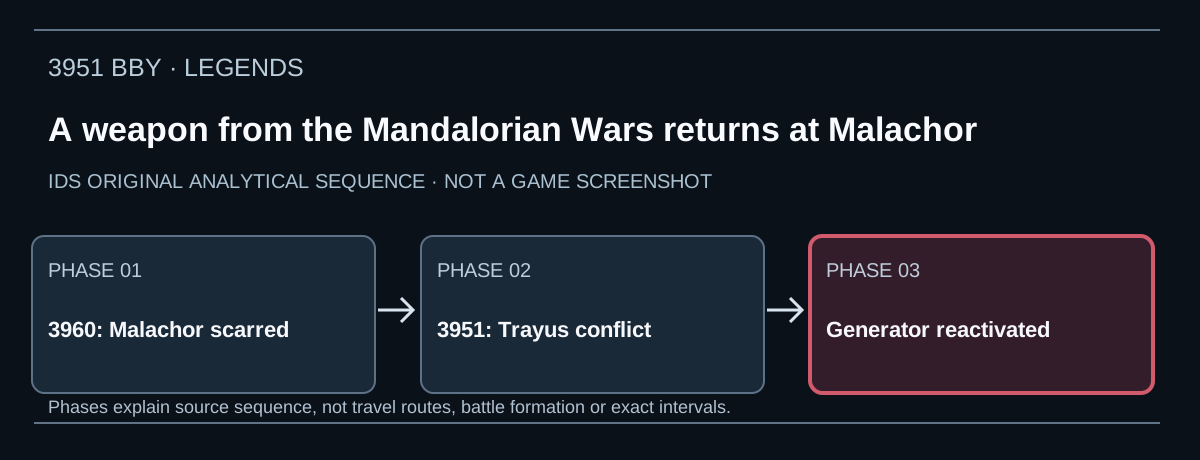
No. The illustration organizes narrative phases only. A verified event-specific publisher illustration is a separate editorial requirement.
Interactive historical judgment · 3951 BBY
Interpret this historical record
Answer both questions. Get corrections, an explanation and a score to distinguish what the sources show from interpretation.
3951 BBY · Legends · Narrative vs. later chronology
A weapon from the Mandalorian Wars returns at Malachor
The world is already a historical wound
Malachor V's first great catastrophe took place when the Mass Shadow Generator was used during the Mandalorian Wars, leaving a devastating physical and psychological legacy for Meetra Surik and Bao-Dur. At the end of the Dark Wars, the world remains home to Trayus Academy and becomes the site of a further confrontation. A date of 3951 BBY describes a later crisis; it must not be substituted for the original 3960 BBY mass-shadow event. Separating those incidents is essential for understanding the consequences of the earlier weapon.
Bao-Dur's remote returns to a disputed technology
Bao-Dur's remote can reactivate the generator, while G0-T0 seeks to preserve the world and its strategic significance. Depending on the game's sequence and player choices, HK-47-related events determine whether the remote can complete its task. The light-side ending later adopted as the main Legends historical path includes destruction of Malachor. It is inaccurate to treat every playable outcome as a single immutable sequence, because the developers built alternate resolutions into the RPG.
The social history of a technological decision
Destroying the world also ends the physical setting of a Sith institution and confronts a place associated with repeated catastrophic violence. The Exile's earlier role in activating the weapon, Bao-Dur's engineering responsibility and the remote's programming produce different kinds of agency. Material destruction does not itself resolve every survivor's memory or end the influence of Sith teachings elsewhere. The archive should distinguish documented consequences from broad moral interpretations of whether a site ought to have been preserved.
Check your historical interpretation: Is the Malachor V catastrophe of the Mandalorian Wars identical to its later destruction?
Explanation: No. The Mass Shadow Generator originally devastated the world at the end of the Mandalorian Wars. Its later reactivation near the end of KOTOR II is a separate event.
Primary work: Lucasfilm: Knights of the Old Republic II. Official publisher information confirms the work's scope; detailed scenes and dates belong to the full game or novel, with later Legends chronology identified separately. Continue this timeline sequence →
Sources and further reading
- Knights of the Old Republic II: The Sith Lords.
- Knights of the Old Republic Campaign Guide.