Kreia is one of the central figures in Star Wars: Knights of the Old Republic II: The Sith Lords. She enters the Exile's story as a mentor rather than a conventional Sith antagonist. Over time, the game reveals a longer institutional history: Jedi teacher, exile, Sith master known as Darth Traya, victim of betrayal by her own apprentices, and finally the person who tests whether the Exile has learned to act without surrendering judgment to a code, a faction, or even the Force itself.
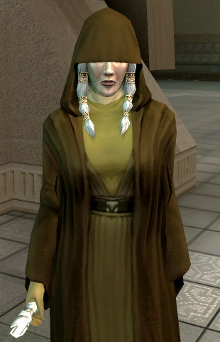
Historian, teacher, exile
Kreia describes an earlier life shaped by scholarship and teaching. She studies Jedi history and questions whether adherence to a single doctrine can answer every problem. Her association with students who later challenge the Order, including Revan in the Legends account presented by the game, makes her a target for institutional blame.
That history matters because Kreia's later hostility toward both Jedi and Sith is not simple indifference. She has lived inside both traditions and sees each as capable of turning doctrine into a substitute for judgment.
Darth Traya and the Sith Triumvirate
After leaving the Jedi path, Kreia becomes Darth Traya and helps form the Sith Triumvirate with Darth Sion and Darth Nihilus. The alliance is unstable by design. Its members share enemies but not the same understanding of power. Sion embodies survival through pain. Nihilus becomes consumption without limit. Traya privileges manipulation, interpretation, and the ability to make other people reveal themselves through choice.
Her apprentices eventually turn on her. Stripped of authority and cast out, she experiences betrayal not as an exceptional event but as confirmation of the social world she expects. That experience helps explain why she later treats dependency as dangerous and why she repeatedly pressures the Exile to understand the consequences of every relationship.
The Force bond with the Exile
Kreia's bond with the Jedi Exile makes mentorship materially consequential. Their connection means that instruction cannot be separated from vulnerability. She guides, criticizes, manipulates, and protects the Exile while also depending on the relationship for her larger project.
The game's influence system reinforces this theme. Companions do not simply supply exposition. Approval, trust, resistance, and disagreement change what the player can learn. Kreia is therefore both a character and part of the game's social mechanics.
A critique of charity, dependence, and easy morality
Kreia repeatedly challenges actions that look moral when they are judged only by immediate intention. She asks what a gift, rescue, threat, or act of mercy does to the recipient's future capacity to act. Her lessons can be insightful, coercive, or deliberately cruel. The game does not require the player to accept her conclusions.
Anthropologically, the important point is that Kreia treats every action as part of a relationship. Power is produced through dependency, obligation, reputation, fear, gratitude, and the stories people tell about what another person has done for them.
The Force as an institution without an institution
Kreia's deepest conflict is not only with Jedi or Sith organizations. She resents the possibility that the Force itself structures history by privileging some outcomes and binding lives into patterns larger than individual intention. Her project becomes an attempt to imagine agency without that governing presence.
This makes her unusual within Star Wars. Most disputes about the Force concern how it should be understood or used. Kreia questions whether dependence on it is itself a form of domination. The game places that argument beside the Exile, a person whose relationship to the Force has already been radically altered by mass violence.
Betrayal as a social theory
The title Darth Traya, the Lord of Betrayal, is useful because betrayal in her story is more than treachery. It is a method of revealing hidden commitments. When a student rejects a teacher, an ally chooses another cause, or an institution expels a member, the act exposes which relationship had priority.
Kreia repeatedly creates situations in which people must choose. This makes her mentorship ethically dangerous. A lesson can become an engineered crisis, and another person's suffering can become evidence in an argument only she has decided to test.
Anthropological assessment
Darth Traya is best read as a theorist of dependency who is herself unable to escape dependency. She condemns institutions for disciplining thought while constructing an intensely controlling relationship with the Exile. She distrusts attachment while organizing her plans around students, rivals, and successors. She rejects predetermined moral systems while repeatedly arranging conditions in which other people are forced to prove her expectations correct.
That contradiction is what makes the character useful. Her philosophy cannot be separated from her biography. Jedi discipline, exile, Sith apprenticeship, betrayal, war, and the Force bond all shape the person who later claims to stand outside those systems.
A teacher who distrusts every institution
Kreia’s philosophy grows from repeated disappointment with Jedi and Sith structures. She sees both traditions as systems that can turn students into extensions of inherited doctrine.
Her mentorship of the Exile therefore pushes constantly toward judgment rather than obedience, even when her own methods become manipulative.
The Force as a structure of dependence
Traya’s deepest conflict is not simply with individual Jedi or Sith. She questions the way the Force appears to shape events, reward some paths, and pull people into recurring patterns.
That makes her unusually useful for IDS because she treats metaphysics as a political problem: if destiny organizes lives from above, then freedom requires confronting the system that makes those lives legible.
Visual record
The Sith Lords
Publisher and character-reference imagery connected to Kreia's Legends story.

Collector note: Darth Traya is a Legends-era character whose strongest collecting connection is to KOTOR II, Old Republic gaming material, miniatures, and later game appearances rather than the main film-era merchandising lines.
Sources and further reading
- Knights of the Old Republic II: The Sith Lords, publisher listing
- Kreia reference article with game and developer citations
- Darth Revan character file
- Old Republic timeline
- Ancient Sith Empires dossier
Connected archive